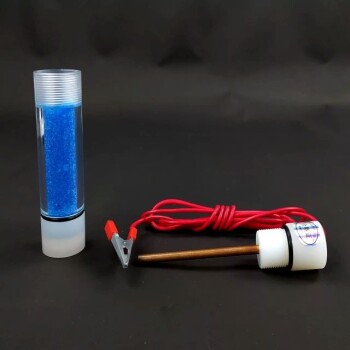
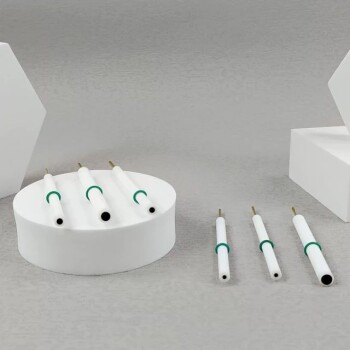
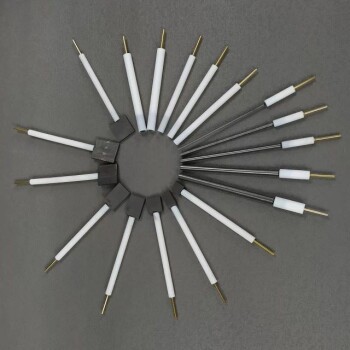
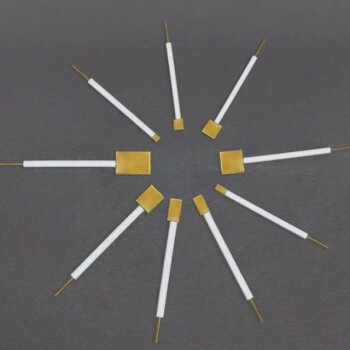
The primary reason for selecting a silver/silver chloride (Ag/AgCl) electrode is its exceptional potential stability within strong alkaline electrolytes. Specifically in environments utilizing 1 M KOH, this electrode maintains a constant reference point despite the harsh chemical conditions. This stability is critical for isolating the performance of the radioactive cell from external noise, ensuring that measurements of the radiocurrent are precise and reproducible.
Core Takeaway In the delicate testing of radioactive electrolytic cells, signal clarity is everything. The Ag/AgCl electrode provides an unwavering voltage baseline, allowing you to filter out environmental interference and accurately measure the minute redox activities occurring at the working electrode interface.
The Critical Role of Stability
Performance in Alkaline Media
The testing of radioactive electrolytic cells often requires strong electrolytes, such as 1 M KOH. In these aggressive alkaline conditions, many standard reference electrodes can drift or degrade.
The Ag/AgCl electrode is chosen because it possesses extremely high potential stability in these specific solutions. It resists the chemical fluctuations that would otherwise skew data, providing a reliable baseline for the entire duration of the test.
Eliminating Environmental Interference
Radioactive environments present unique challenges regarding signal noise. A major advantage of the Ag/AgCl electrode is its ability to eliminate interference from environmental potential fluctuations.
By providing a fixed reference, it ensures that any change in current recorded by the workstation is due to the chemistry of the cell itself, not external variables. This is essential for the accurate measurement of radiocurrent.
Functionality in the Three-Electrode System
Precision at the Interface
The goal of this testing is often to control and measure the redox potential at a specific interface, such as the platinum/titanium dioxide (Pt/TiO2) junction.
The Ag/AgCl electrode acts exclusively as the potential reference point. It does not carry the main current load; that role is reserved for the auxiliary electrode (typically high-purity platinum).
Standardizing the Measurement
Because the Ag/AgCl electrode provides a standardized potential, it allows the electrochemical workstation to function with high precision.
It acts as the anchor for the system. This allows the workstation to accurately detect and map potential fluctuations occurring specifically on the surface of the working electrode or test sample.
Understanding the Operational Prerequisites
The Anatomy of Stability
It is important to understand that the stability of this electrode is not magic; it is a result of specific internal chemistry. The system relies on a silver wire coated with a layer of solid silver chloride (AgCl).
Sensitivity to Internal Chemistry
To function correctly, this coated wire must remain immersed in a solution saturated with both potassium chloride (KCl) and silver chloride.
If this internal solution becomes diluted or contaminated, the standard potential reference point will be lost. The reliability of your radiocurrent data is directly tied to the integrity of this internal saturation.
Making the Right Choice for Your Goal
To ensure the validity of your electrolytic cell performance data, apply the following principles:
- If your primary focus is measuring radiocurrent: Rely on the Ag/AgCl electrode to eliminate environmental noise and provide a stable baseline in alkaline (KOH) solutions.
- If your primary focus is system configuration: Ensure you are using a three-electrode setup where a high-purity platinum electrode handles the current load, leaving the Ag/AgCl electrode solely responsible for reference.
Ultimately, the Ag/AgCl electrode is the standard choice not just for its chemistry, but for the confidence it provides in isolating the true performance of your working electrode.
Summary Table:
| Feature | Advantage in Radioactive Cell Testing |
|---|---|
| Potential Stability | Maintains a constant baseline in harsh 1 M KOH alkaline environments. |
| Noise Reduction | Eliminates environmental interference to isolate precise radiocurrent measurements. |
| Interface Precision | Allows accurate mapping of redox potential at the Pt/TiO2 junction. |
| Standardization | Provides a fixed anchor for electrochemical workstations in 3-electrode systems. |
Elevate Your Electrochemical Research Precision with KINTEK
Precise data in radioactive cell testing depends on uncompromising equipment quality. KINTEK specializes in advanced laboratory solutions, providing high-performance electrolytic cells and electrodes specifically designed for rigorous research environments. Beyond our industry-leading Ag/AgCl reference electrodes, we offer a comprehensive portfolio including:
- High-Temperature Systems: Muffle, tube, vacuum, and CVD furnaces.
- Sample Preparation: Crushing, milling, sieving, and hydraulic presses (pellet, hot, isostatic).
- Advanced Reactors: High-temperature high-pressure reactors and autoclaves.
- Lab Essentials: ULT freezers, freeze dryers, homogenizers, and high-purity ceramics/crucibles.
Whether you are measuring minute radiocurrents or configuring complex battery research tools, KINTEK delivers the reliability your mission-critical data requires. Contact KINTEK today to optimize your laboratory setup!
References
- Baek Hyun Kim, Jae Wan Kwon. Plasmon-assisted radiolytic energy conversion in aqueous solutions. DOI: 10.1038/srep05249
This article is also based on technical information from Kintek Solution Knowledge Base .
Related Products
- Reference Electrode Calomel Silver Chloride Mercury Sulfate for Laboratory Use
- Copper Sulfate Reference Electrode for Laboratory Use
- Electrolytic Electrochemical Cell Gas Diffusion Liquid Flow Reaction Cell
- Glassy Carbon Electrochemical Electrode
- Graphite Disc Rod and Sheet Electrode Electrochemical Graphite Electrode
People Also Ask
- What is the function of a reference electrode? Master Precision in Three-Electrode Reactor Reconstruction
- What is the recommended maintenance for the filling solution of a reference electrode? A Guide to Stable & Accurate Readings
- Which electrode is used as a ground reference? Master the Key to Accurate Electrochemical Measurements
- What is the reference electrode in potentiometry? The Key to Stable & Accurate Measurements
- Which electrode is used as a reference? A Guide to Accurate Electrochemical Measurements