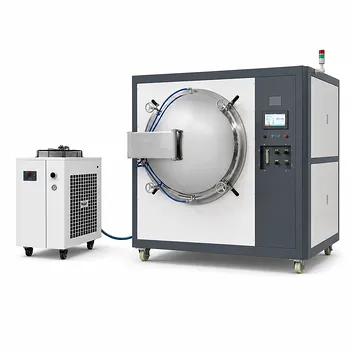
The fabrication of Cu-Ti3SiC2 composites requires a strictly controlled processing environment. A vacuum hot press furnace with atmosphere protection is essential primarily to prevent the rapid oxidation of the copper matrix at elevated temperatures and to inhibit the decomposition of the Ti3SiC2 reinforcement phase. By isolating the materials from oxygen, this equipment ensures the chemical stability of the composite while simultaneously applying the pressure needed for densification.
Core Insight Achieving a high-performance Cu-Ti3SiC2 composite is a balancing act between densification and chemical reaction control. The vacuum hot press furnace solves the fundamental conflict of sintering this material: it allows for the removal of volatile impurities and atomic diffusion without triggering the oxidation or detrimental phase changes that occur in open-air environments.
The Critical Role of Atmosphere Control
Preventing Matrix Oxidation
Copper is highly susceptible to oxidation when exposed to high temperatures. Without a protective environment, the copper matrix would rapidly degrade, compromising the structural integrity of the composite.
The vacuum hot press furnace mitigates this by creating a high-vacuum environment or introducing an inert gas like argon. This isolation effectively eliminates oxygen partial pressure, preserving the metallic nature of the copper matrix.
Stabilizing the Ti3SiC2 Phase
The Ti3SiC2 phase acts as the reinforcement, but it is chemically sensitive under sintering conditions. In the presence of oxygen or uncontrolled atmospheres, this phase can decompose, losing its desirable mechanical properties.
Atmosphere protection ensures that the reinforcement phase remains chemically stable. This prevents unintended chemical reactions that would otherwise degrade the composite's performance.
Enhancing Microstructural Integrity
Removing Surface Impurities
Beyond preventing oxidation, the high-vacuum capability serves a cleaning function. It actively facilitates the removal of adsorbed gases, moisture, and volatile impurities from the surface of the powder particles.
Clean particle surfaces are a prerequisite for strong bonding. By purifying the interface between the matrix and reinforcement, the furnace promotes atomic diffusion, which is vital for reducing porosity.
Promoting Densification
The "hot press" aspect of the furnace applies uniaxial pressure (mechanical force) simultaneously with heat. This combination drives particle rearrangement, plastic flow, and grain boundary sliding.
This mechanical pressure is critical for densifying the material. It forces the copper matrix to flow around the Ti3SiC2 particles, creating a solid, non-porous structure that would be difficult to achieve with heat alone.
The Necessity of Precision Temperature Control
Avoiding Harmful Phase Reactions
The processing of Cu-Ti3SiC2 is chemically delicate. At temperatures exceeding approximately 750°C, Copper and Ti3SiC2 can react to form undesirable impurity phases, such as titanium silicide (TiSi2).
These impurity phases are often brittle and degrade the material's properties. A vacuum hot press furnace offers the high-precision temperature regulation required to stay exactly at the optimal processing point (e.g., 750°C), preventing over-sintering or phase decomposition.
Understanding the Trade-offs
Process Speed vs. Quality
Vacuum hot pressing is a batch process that is generally slower than continuous sintering methods. The time required to pump down to a high vacuum and heat the mass under controlled rates limits throughput.
Complexity of Parameter Control
While the furnace offers control, it also demands it. The operator must strictly manage the interplay between vacuum levels, pressure application rates, and temperature hold times. A failure in the vacuum seal or a slight overshoot in temperature can instantly ruin the batch by triggering the Cu-Ti3SiC2 reaction.
Making the Right Choice for Your Goal
To maximize the utility of a vacuum hot press furnace for this specific composite, align your process parameters with your specific performance targets:
- If your primary focus is Electrical Conductivity: Prioritize high-vacuum levels (>1x10^-4 mbar) to ensure maximum removal of impurities from grain boundaries.
- If your primary focus is Mechanical Strength: Focus on the precise application of uniaxial pressure to maximize density, while strictly capping temperatures at 750°C to avoid brittle TiSi2 formation.
- If your primary focus is Phase Purity: Utilize a backfilled argon atmosphere rather than pure vacuum during the peak heating stage to further suppress decomposition of the Ti3SiC2.
Ultimate Success: The vacuum hot press furnace is not just a heating device; it is a reaction-control chamber that allows you to force densification physically while freezing chemical degradation.
Summary Table:
| Feature | Function in Cu-Ti3SiC2 Fabrication | Benefit to Composite |
|---|---|---|
| Vacuum Environment | Removes adsorbed gases & prevents oxidation | High electrical conductivity & matrix purity |
| Atmosphere Protection | Isolates materials from oxygen/reactive gases | Prevents Ti3SiC2 phase decomposition |
| Uniaxial Pressure | Drives particle rearrangement & plastic flow | Achieves near-theoretical densification |
| Precision Temp Control | Maintains strict processing (e.g., 750°C) | Prevents formation of brittle TiSi2 phases |
Elevate Your Material Research with KINTEK
Precision is non-negotiable when sintering sensitive composites like Cu-Ti3SiC2. KINTEK specializes in advanced laboratory solutions, including high-performance vacuum hot press furnaces, muffle furnaces, and precision hydraulic presses designed to prevent oxidation and ensure phase stability.
Whether you are focusing on electrical conductivity or mechanical strength, our equipment—ranging from high-temperature furnaces to crushing and milling systems—is engineered to meet the rigorous demands of material science. Let our experts help you achieve superior densification and chemical purity today.
Contact KINTEK for a Professional Consultation
Related Products
- Vacuum Hot Press Furnace Heated Vacuum Press Machine Tube Furnace
- 600T Vacuum Induction Hot Press Furnace for Heat Treat and Sintering
- Vacuum Hot Press Furnace Machine Heated Vacuum Press
- Vacuum Hot Press Furnace Machine for Lamination and Heating
- Vacuum Heat Treat and Pressure Sintering Furnace for High Temperature Applications
People Also Ask
- What advantages does a vacuum hot press furnace provide for LSLBO ceramic electrolytes? Achieve 94% Relative Density
- What role does a Vacuum Hot Press (VHP) furnace play in the densification of austenitic stainless steel 316 composites?
- What are the advantages of using a vacuum hot pressing furnace? Superior Densification for 2024Al/Gr/SiC Composites
- What are the advantages of a vacuum hot press furnace for LTPO solid electrolytes? Boost Density and Conductivity
- What core processing conditions does a vacuum hot press furnace provide? Achieve High-Density Cu-SiC/Diamond Composites