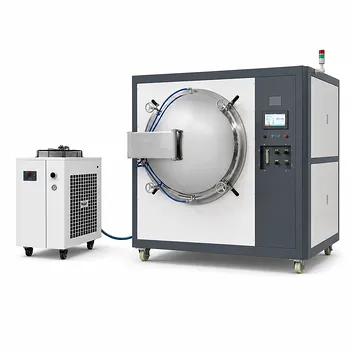
The primary reason a vacuum hot press sintering furnace is required for Co-50 mass% Cr alloys is its ability to simultaneously apply high temperature and uniaxial mechanical pressure. While conventional sintering relies solely on thermal energy, often leaving porosity levels above 5%, the hot press method uses physical force to accelerate plastic flow. This mechanical intervention is critical for eliminating internal pores and achieving high densification, such as 7.73 g/cm³, during the solid-phase sintering stage.
Core Takeaway Conventional powder metallurgy often fails to fully densify Co-Cr alloys, resulting in structural weaknesses and oxidation. Vacuum hot pressing resolves this by using hydraulic pressure to force particle rearrangement and a vacuum environment to prevent oxidation, driving relative density up to 96.09% while significantly reducing closed porosity.
Overcoming Porosity Through Mechanical Pressure
The Limitations of Thermal-Only Sintering
In conventional sintering, densification relies entirely on the diffusion of atoms at high temperatures. For Co-50 mass% Cr alloys, this passive process is often insufficient.
Without external pressure, the material frequently retains a porosity exceeding 5%. These internal voids compromise the mechanical integrity and performance of the final alloy.
Accelerating Plastic Flow
A hot press furnace overcomes these limitations by applying uniaxial pressure (typically 20–50 MPa). This external force acts as an additional driving mechanism for densification.
The pressure accelerates the plastic flow of the powder particles. It forces the material to rearrange physically, effectively squeezing out voids that thermal energy alone cannot close.
Densifying the Co-Cr Matrix
The specific interaction between Cobalt and Chromium benefits significantly from this pressure. The hydraulic loading forces ductile Cobalt particles to undergo plastic deformation.
These deformed particles are pressed tightly into the voids between the harder Chromium particles. This action reduces closed porosity to as low as 0.31%, creating a solid, cohesive structure.
The Role of the Vacuum Environment
Preventing Oxidation
Sintering metals at temperatures around 1050°C introduces a high risk of oxidation. A vacuum hot press maintains a low-pressure environment (e.g., 1.33x10^-1 Pa) to neutralize this threat.
By removing oxygen from the chamber, the system protects the metal powders. This ensures the final alloy remains free of oxides that would otherwise degrade its mechanical properties.
Managing Interface Reactions
The vacuum level is also critical for controlling reactions at the interface between the mold and the sample.
Precise control of the vacuum environment helps manage impurity levels. This ensures the chemical composition of the finished alloy remains pure and consistent.
Understanding the Trade-offs
Mold-Alloy Interactions
While the vacuum hot press technique yields superior density, it introduces specific challenges regarding the mold material. Graphite molds are commonly used to transmit the mechanical pressure.
However, under high vacuum and temperature, the chemical properties of the graphite can lead to interactions with the alloy. Specifically, the interface may react with Chromium.
Surface Phase Composition
This reaction can lead to the formation of carbides, such as Cr7C3, on the alloy's surface.
These unintended surface compounds can influence the phase composition of the final part. Engineers must account for this surface layer when planning the final machining or finishing of the component.
Making the Right Choice for Your Goal
The decision to use vacuum hot pressing is ultimately a trade-off between process complexity and material performance.
- If your primary focus is maximum density: Choose vacuum hot pressing to utilize uniaxial pressure, ensuring porosity drops below 1% and density reaches near-theoretical limits.
- If your primary focus is mechanical strength (TRS): Rely on the hydraulic loading of this furnace to force ductile particles into voids, significantly improving Transverse Rupture Strength.
- If your primary focus is surface purity: Monitor the vacuum level and mold material closely to mitigate the formation of unwanted carbides like Cr7C3 at the interface.
By leveraging the dual action of thermal and mechanical energy, you transform a porous powder compact into a high-performance, oxidation-free engineering material.
Summary Table:
| Feature | Conventional Sintering | Vacuum Hot Press Sintering |
|---|---|---|
| Driving Force | Thermal energy only | Thermal energy + Uniaxial pressure |
| Porosity Level | Often > 5% | < 1% (as low as 0.31%) |
| Max Relative Density | Lower/Inconsistent | Up to 96.09% (7.73 g/cm³) |
| Atmosphere | Ambient or Inert | High Vacuum (1.33x10⁻¹ Pa) |
| Primary Benefit | Simple process | Superior TRS & elimination of voids |
Elevate Your Material Performance with KINTEK
Ready to achieve near-theoretical density for your advanced alloys? KINTEK specializes in precision laboratory equipment designed to solve the toughest sintering challenges.
Our advanced Vacuum Hot Press Sintering Furnaces provide the precise mechanical pressure and vacuum control necessary to eliminate porosity and prevent oxidation in Co-Cr alloys and other high-performance materials. Beyond sintering, KINTEK offers a comprehensive range of high-temperature furnaces (muffle, tube, vacuum, CVD), hydraulic presses (pellet, hot, isostatic), and crushing/milling systems to streamline your entire research workflow.
Don't settle for structural weaknesses. Contact KINTEK today to discover how our high-pressure reactors, thermal solutions, and premium consumables can optimize your lab's efficiency and material integrity.
Related Products
- 600T Vacuum Induction Hot Press Furnace for Heat Treat and Sintering
- Vacuum Heat Treat and Sintering Furnace with 9MPa Air Pressure
- Vacuum Heat Treat and Pressure Sintering Furnace for High Temperature Applications
- 2200 ℃ Tungsten Vacuum Heat Treat and Sintering Furnace
- Vacuum Hot Press Furnace Heated Vacuum Press Machine Tube Furnace
People Also Ask
- What role does an induction vacuum hot pressing furnace play in sintering? Achieve 98% Density in Carbide Blocks
- What advantages does a vacuum hot press furnace provide for LSLBO ceramic electrolytes? Achieve 94% Relative Density
- What role does a Vacuum Hot Press (VHP) furnace play in the densification of austenitic stainless steel 316 composites?
- What role does mechanical pressure play during the vacuum diffusion bonding of tungsten and copper? Keys to Solid Bonding
- What are the advantages of a vacuum hot press furnace for W-50%Cu? Achieve 99.6% Density at Lower Temperatures