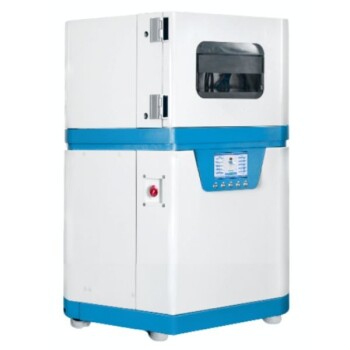
A vacuum hot pressing furnace is the indispensable core equipment for processing SiCf/Ti-43Al-9V composites because it creates a synergistic environment of extreme heat, high pressure, and vacuum isolation. This equipment allows the titanium-aluminum matrix to plastically deform and encapsulate silicon carbide fibers at temperatures up to 1200 °C and pressures of 160 MPa, ensuring full densification without the oxidation that typically destroys these reactive materials.
Core Takeaway: Success in fabricating SiCf/Ti-43Al-9V composites relies on synchronizing mechanical force with thermal management in an oxygen-free zone. The furnace does not merely heat the material; it utilizes stored strain energy to trigger dynamic recrystallization, establishing a high-strength metallurgical bond while simultaneously controlling phase transformations through programmable cooling.
Achieving Densification Through Extreme Conditions
Facilitating Matrix Flow
The primary challenge in consolidating this composite is the rigidity of the Ti-43Al-9V matrix. The furnace addresses this by maintaining temperatures up to 1200 °C.
At this thermal threshold, the metal matrix undergoes plastic deformation. This softening allows the matrix to flow around and fully encapsulate the rigid SiC fibers, acting as the binder for the composite.
Eliminating Internal Voids
Heat alone is insufficient to remove porosity. The furnace applies mechanical pressure reaching 160 MPa directly to the material during the heating cycle.
This high pressure forces the softened matrix into the microscopic gaps between fibers. This process fills internal voids and is the decisive factor in achieving full densification of the final part.
Triggering Metallurgical Bonding
The combination of heat and pressure does more than shape the material; it alters its internal structure. The process utilizes stored strain energy within the material.
This energy triggers dynamic recrystallization of the matrix and initiates necessary interfacial reactions. The result is a robust, high-strength metallurgical bond between the matrix and the fibers.
Preserving Chemical Integrity via Vacuum
Preventing Matrix Oxidation
Titanium and aluminum are highly chemically active, particularly at the elevated temperatures required for sintering. Without protection, they react rapidly with oxygen.
The vacuum environment effectively isolates the Ti-43Al-9V matrix from oxygen. This prevents the formation of oxide films and impurities that would lead to material embrittlement and catastrophic failure of the part.
Protecting Fiber Coatings
The silicon carbide (SiC) fibers are also vulnerable during processing. The vacuum safeguards the fiber coatings from oxidation.
By maintaining a pristine environment, the furnace preserves the interface bonding strength. This ensures that the mechanical performance of the composite is not degraded by oxidation-induced defects.
Removing Adsorbed Gases
Powder particles often trap volatile gases and air in their gaps. A high-vacuum environment actively eliminates these adsorbed gases.
Removing these volatiles is essential for ensuring clean interfacial bonding. It prevents gas pockets from forming inside the material, which would otherwise reduce density and structural integrity.
Controlling Microstructure via Cooling
Regulating Phase Composition
The utility of the furnace extends beyond the heating phase; the cooling phase is equally critical. The equipment features programmable temperature control to manage the rate of cooling.
A slow cooling rate provides the time necessary for the alpha phase to transform into an alpha-2/gamma lamellar structure. This transformation is essential for optimizing the material's mechanical properties.
Managing Residual Stress
Rapid cooling can lock in destructive thermal stresses. The controlled, slow cooling function allows the material to release residual thermal stresses generated during the pressing cycle.
This process also facilitates specific microstructural goals, such as the granular precipitation of the B2 phase, ensuring the final composite meets precise engineering specifications.
Understanding the Trade-offs
Process Cycle Time vs. Quality
The requirement for slow furnace cooling to achieve the correct alpha-2/gamma structure significantly extends the processing time.
While this ensures high-quality phase composition and stress relief, it limits production throughput. Users must accept longer cycle times as the cost of preventing cracking and ensuring microstructural stability.
Complexity of Parameter Control
The process requires a delicate balance between temperature and pressure. Excessive temperature can degrade the SiC fibers, while insufficient pressure results in voids.
Precise synchronization is mandatory. Any deviation in the vacuum level or pressure application can lead to incomplete diffusion bonding or surface contamination, rendering the expensive composite unusable.
Making the Right Choice for Your Goal
To maximize the effectiveness of your vacuum hot pressing process, focus on the specific outcome you need to achieve:
- If your primary focus is Structural Density: Prioritize the 160 MPa pressure application during the peak temperature window to forcibly eliminate all internal voids and porosity.
- If your primary focus is Mechanical Longevity: strictly adhere to programmable slow cooling to transform the alpha phase and release residual thermal stresses that cause premature cracking.
- If your primary focus is Chemical Purity: Ensure the vacuum integrity is maintained throughout the entire heating and cooling cycle to prevent embrittlement of the titanium-aluminum matrix.
By leveraging the furnace's ability to precisely control heat, pressure, and atmosphere simultaneously, you convert a loose assembly of reactive materials into a unified, high-performance structural composite.
Summary Table:
| Feature | Parameter/Goal | Critical Role in SiCf/Ti-43Al-9V Processing |
|---|---|---|
| Max Temperature | Up to 1200 °C | Softens Ti-43Al-9V matrix for plastic deformation and fiber encapsulation. |
| High Pressure | 160 MPa | Eliminates internal voids and porosity to achieve full material densification. |
| Atmosphere | High Vacuum | Prevents oxidation/embrittlement of Ti and Al; protects SiC fiber coatings. |
| Cooling Control | Programmable Slow Cooling | Manages phase transformation (alpha to lamellar) and releases residual stresses. |
| Bonding Mechanism | Dynamic Recrystallization | Utilizes strain energy to create high-strength metallurgical bonds. |
Elevate Your Advanced Material Fabrication with KINTEK
Precision is non-negotiable when consolidating reactive composites like SiCf/Ti-43Al-9V. KINTEK specializes in high-performance laboratory equipment designed to meet the extreme demands of modern metallurgy and material science.
Our vacuum hot pressing furnaces and high-temperature systems provide the synchronization of heat, pressure, and vacuum integrity required to prevent oxidation and ensure structural perfection. Beyond thermal processing, we offer a comprehensive range of high-pressure reactors, hydraulic presses, crushing systems, and specialized ceramics to support every stage of your research and production.
Ready to achieve superior density and microstructural control? Contact our technical experts today to find the ideal solution for your laboratory's needs.
Related Products
- Vacuum Hot Press Furnace Heated Vacuum Press Machine Tube Furnace
- 600T Vacuum Induction Hot Press Furnace for Heat Treat and Sintering
- Vacuum Hot Press Furnace Machine Heated Vacuum Press
- Vacuum Hot Press Furnace Machine for Lamination and Heating
- Vacuum Heat Treat and Pressure Sintering Furnace for High Temperature Applications
People Also Ask
- What advantages does a vacuum hot press furnace provide for LSLBO ceramic electrolytes? Achieve 94% Relative Density
- What role does a Vacuum Hot Press (VHP) furnace play in the densification of austenitic stainless steel 316 composites?
- What are the advantages of using a vacuum hot pressing furnace? Superior Densification for 2024Al/Gr/SiC Composites
- What are the advantages of a vacuum hot press furnace for LTPO solid electrolytes? Boost Density and Conductivity
- What core processing conditions does a vacuum hot press furnace provide? Achieve High-Density Cu-SiC/Diamond Composites