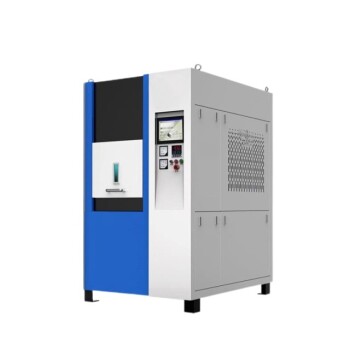
Vacuum hot pressing is the preferred fabrication method for Cu/Ti3SiC2/C/MWCNTs composites because it integrates a high-temperature thermal field with simultaneous uniaxial mechanical pressure within a protective environment. Unlike standard sintering, which relies primarily on thermal diffusion, this technique actively forces particle rearrangement and plastic deformation while strictly controlling the atmosphere. This approach is essential for preventing the oxidation of the copper matrix and carbon reinforcements while achieving relative densities significantly higher than pressureless methods allow.
The Core Insight The unique advantage of this furnace lies in the "coupling effect" of heat and force; by applying mechanical pressure (e.g., 27.7 MPa) during the heating phase, you eliminate internal pores and bridge particles that would otherwise remain separated in a standard sintering process.
The Critical Role of the Vacuum Environment
Preventing Copper Matrix Oxidation
The primary challenge in sintering copper-matrix composites is copper's high susceptibility to oxidation at elevated temperatures. Standard sintering furnaces often struggle to maintain the low oxygen partial pressure required to keep copper chemically pure. A vacuum environment effectively isolates the material, preventing the formation of copper oxides that would degrade electrical and thermal conductivity.
Protecting Carbon Reinforcements
The composite includes carbon-based reinforcements: Graphite (C) and Multi-Walled Carbon Nanotubes (MWCNTs). These materials are prone to ablation or burning when exposed to oxygen at sintering temperatures (around 950°C). Vacuum processing protects these phases, ensuring they retain their structural integrity to reinforce the matrix effectively.
Eliminating Adsorbed Gases
Powder particles often contain gases adsorbed into their interstices or surfaces. The vacuum environment actively assists in removing these trapped gases before the pores close. This reduction in gas entrapment minimizes micro-porosity in the final sintered body, directly improving electrical conductivity.
Stabilizing the Ti3SiC2 Phase
The Ti3SiC2 phase within the composite can decompose under improper atmospheric conditions. By isolating the materials from oxygen and reactive gases, the furnace prevents unintended chemical reactions. This ensures the chemical stability of the Ti3SiC2 phase, maintaining the intended composition of the final product.
The Impact of Mechanical Pressure
Facilitating Particle Rearrangement
Standard sintering relies on atomic diffusion, which can be slow and result in residual porosity. Vacuum hot pressing applies uniaxial pressure (specifically noted as 27.7 MPa in your context) to physically force particles into a tighter packing arrangement. This mechanical force overcomes friction between particles, leading to immediate densification.
Inducing Plastic Deformation
The simultaneous application of heat and pressure promotes the plastic flow of the copper matrix. This flow fills the voids between the harder Ti3SiC2 and carbon particles. It also promotes grain boundary sliding, which is essential for forming strong sintering necks.
Achieving Superior Relative Density
The combination of pore elimination and plastic flow results in a much higher relative density compared to pressureless sintering. Research indicates that vacuum hot pressing can achieve a relative density of approximately 93.51% for these composites. This density creates a solid, cohesive material with improved mechanical strength.
Understanding the Trade-offs
Uniaxial vs. Isotropic Pressure
While superior to standard sintering, vacuum hot pressing applies pressure in only one direction (uniaxial). This can occasionally lead to density gradients or non-uniform properties depending on the geometry of the sample. It is less effective at eliminating pores than Hot Isostatic Pressing (HIP), which applies uniform gas pressure (isotropic).
The Density Gap
Although vacuum hot pressing achieves high density (93.51%), it does not typically reach near-theoretical levels. For comparison, secondary processing with a Hot Isostatic Press (HIP) at higher pressures (100 MPa) can push density to 99.54%. Therefore, vacuum hot pressing is an excellent intermediate or primary consolidation step, but may not yield absolute maximum density on its own.
Making the Right Choice for Your Goal
To optimize your fabrication process, align your choice of equipment with your specific density and purity requirements.
- If your primary focus is oxidation prevention: Choose the vacuum hot press to strictly control the atmosphere and protect the Cu and MWCNTs from degradation.
- If your primary focus is rapid densification: Rely on the vacuum hot press to utilize the coupling effect of heat and 27.7 MPa pressure to significantly reduce sintering time compared to pressureless methods.
- If your primary focus is maximum theoretical density: Consider using vacuum hot pressing as a pre-sintering step, followed by Hot Isostatic Pressing (HIP) to eliminate the final ~6% of residual porosity.
Vacuum hot pressing offers the optimal balance of atmosphere control and mechanical consolidation to produce high-quality, oxidation-free copper composites.
Summary Table:
| Feature | Standard Sintering | Vacuum Hot Pressing (VHP) |
|---|---|---|
| Mechanism | Thermal Diffusion | Thermal Field + Uniaxial Pressure (27.7 MPa) |
| Atmosphere Control | Often Limited | High Vacuum (Prevents Oxidation) |
| Relative Density | Low/Moderate | High (~93.51%) |
| Material Protection | Risk of MWCNT Ablation | Protects Carbon & Ti3SiC2 Phases |
| Particle Interaction | Passive Rearrangement | Active Plastic Deformation & Flow |
Elevate Your Composite Fabrication with KINTEK
Ready to achieve superior density and purity in your advanced material research? KINTEK specializes in high-performance laboratory equipment, including state-of-the-art vacuum hot pressing furnaces, induction melting systems, and hot isostatic presses (HIP) designed for the most demanding sintering applications.
Whether you are working with copper-matrix composites, ceramic-metal hybrids, or carbon nanotubes, our solutions ensure precise atmosphere control and mechanical consolidation to eliminate oxidation and porosity. Beyond furnaces, we provide a comprehensive suite of crushing and milling systems, hydraulic presses, and specialized consumables like ceramics and crucibles to support your entire workflow.
Maximize your research outcomes today. Contact our technical experts at KINTEK to find the perfect sintering solution for your lab!
Related Products
- 600T Vacuum Induction Hot Press Furnace for Heat Treat and Sintering
- Vacuum Heat Treat and Sintering Furnace with 9MPa Air Pressure
- Vacuum Heat Treat and Pressure Sintering Furnace for High Temperature Applications
- 2200 ℃ Tungsten Vacuum Heat Treat and Sintering Furnace
- Vacuum Hot Press Furnace Heated Vacuum Press Machine Tube Furnace
People Also Ask
- What role does an induction vacuum hot pressing furnace play in sintering? Achieve 98% Density in Carbide Blocks
- What advantages does a vacuum hot press furnace provide for LSLBO ceramic electrolytes? Achieve 94% Relative Density
- What role does a Vacuum Hot Press (VHP) furnace play in the densification of austenitic stainless steel 316 composites?
- What are the advantages of a vacuum hot press furnace for W-50%Cu? Achieve 99.6% Density at Lower Temperatures
- What role does mechanical pressure play during the vacuum diffusion bonding of tungsten and copper? Keys to Solid Bonding