High-precision pressure control is the defining factor in the manufacturing quality of lead-antimony alloy components. Equipment such as industrial hydraulic presses is strictly required to guarantee the internal structural density and uniformity of the alloy during the casting or pressing process. Without this exact control, the structural integrity necessary for battery components cannot be achieved.
By maintaining constant, precise pressure, manufacturers ensure that antimony is uniformly distributed within the lead matrix. This consistency is the prerequisite for maximizing mechanical strength, corrosion resistance, and the overall operational lifespan of the battery.
The Role of Pressure in Material Science
Achieving Structural Density
High-precision equipment ensures that the lead-antimony mixture is compacted effectively. This process eliminates internal voids and maximizes the structural density of the component.
Uniform Distribution of Antimony
Antimony serves as a critical hardening agent within the soft lead base. To function correctly, it must be dispersed evenly throughout the material.
Establishing Constant Pressure
Constant pressure helps drive the antimony into a uniform suspension within the lead. This prevents the hardening agent from clustering or settling unevenly during the formation process.
Impact on Battery Performance
Consistency of the Alloy Phase
Precise pressure control ensures that the "alloy phase"—the distinct physical structure of the mixed metals—remains consistent throughout the component.
Enhancing Mechanical Strength
A uniform alloy phase directly translates to superior physical durability. This is vital for components like battery terminals and grids, which must withstand physical stress without deforming.
Maximizing Corrosion Resistance
Uniform density prevents weak spots where chemical breakdown typically begins. By eliminating these vulnerabilities, the alloy becomes significantly more resistant to corrosion.
Understanding the Risks of Improper Control
The Danger of Pressure Fluctuations
If pressure is not held constant, the internal structure of the alloy becomes inconsistent. This results in uneven distribution of the antimony hardener.
Compromised Component Lifespan
Areas with low antimony concentration will lack strength, while porous areas are prone to accelerated corrosion. These defects inevitably shorten the service life of the battery.
Optimizing Production for Battery Performance
To ensure the production of high-performance lead-antimony components, align your manufacturing parameters with your performance goals:
- If your primary focus is mechanical durability: Prioritize constant pressure to ensure the antimony hardening agent is evenly distributed for maximum grid strength.
- If your primary focus is extended service life: Focus on high-precision compression to maximize density, which directly improves corrosion resistance.
Precision in the pressing process is not just about shaping the metal; it is about engineering the microscopic structure that defines the battery's longevity.
Summary Table:
| Key Feature | Impact on Lead-Antimony Alloy | Battery Performance Benefit |
|---|---|---|
| Structural Density | Eliminates internal voids and porosity | Maximizes corrosion resistance and life |
| Antimony Distribution | Ensures even dispersion of hardening agent | Increases mechanical strength of grids |
| Pressure Consistency | Prevents alloy phase fluctuations | Ensures uniform chemical stability |
| Precision Compaction | Creates a robust metallic matrix | Prevents deformation under physical stress |
Elevate Your Battery Manufacturing Precision with KINTEK
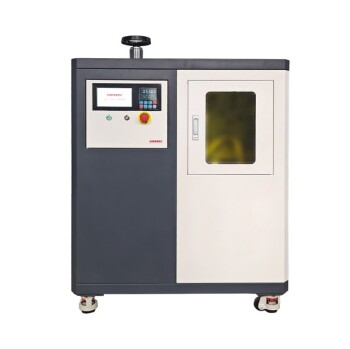
Don't let pressure fluctuations compromise the integrity of your lead-antimony components. KINTEK specializes in high-performance laboratory and industrial solutions designed for material excellence. Our advanced hydraulic presses (pellet, hot, and isostatic) provide the exact pressure control required to achieve superior structural density and uniform alloy distribution.
Whether you are optimizing battery grids for mechanical strength or developing next-generation energy storage, our comprehensive portfolio—including high-temperature furnaces, crushing systems, and specialized battery research tools—ensures your lab achieves repeatable, industry-leading results.
Ready to enhance your production quality? Contact our experts today to find the perfect precision equipment for your application.
References
- Robert R. Seal, Byron R. Berger. Antimony. DOI: 10.3133/pp1802c
This article is also based on technical information from Kintek Solution Knowledge Base .
Related Products
- Warm Isostatic Press for Solid State Battery Research
- Laboratory Hydraulic Press Lab Pellet Press for Button Battery
- Battery Lab Equipment 304 Stainless Steel Strip Foil 20um Thick for Battery Test
- Button Battery Tablet Press Sealing Mold for Lab Use
- Manual button battery sealing machine
People Also Ask
- What is the temperature of a warm isostatic press? Achieve Optimal Densification for Your Materials
- What is the function of a Warm Isostatic Press (WIP) in all-solid-state pouch cells? Optimize Battery Density
- Why are Warm Isostatic Presses (WIP) necessary for solid-state batteries? Achieve Atomic-Level Contact
- What advantages does a warm isostatic press offer over a traditional uniaxial press for Li6PS5Cl electrolyte sheets?
- How do warm isostatic presses improve dry electrode performance? Enhance ASSB Conductivity with Heat & Pressure