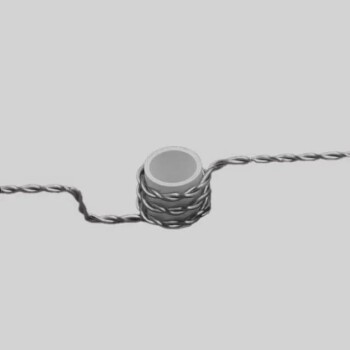
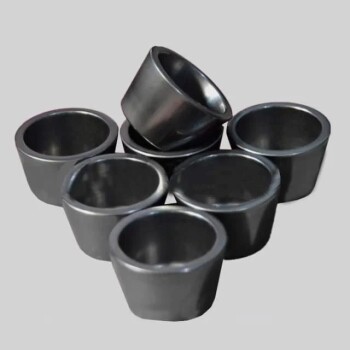
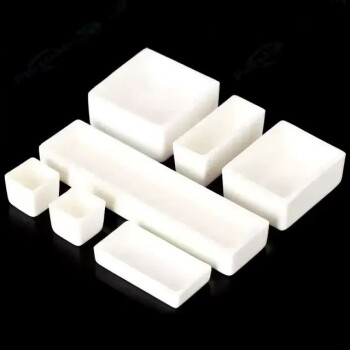
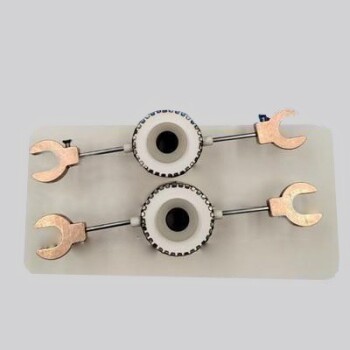
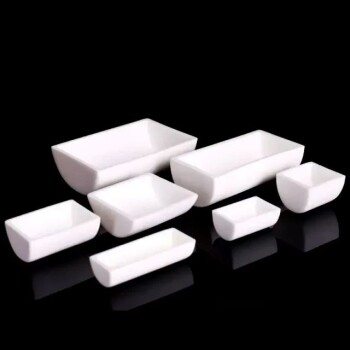
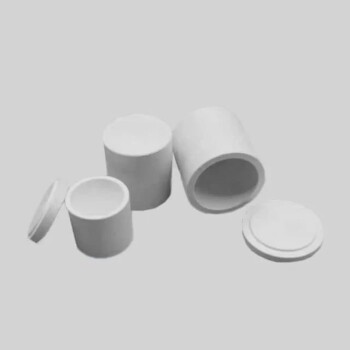
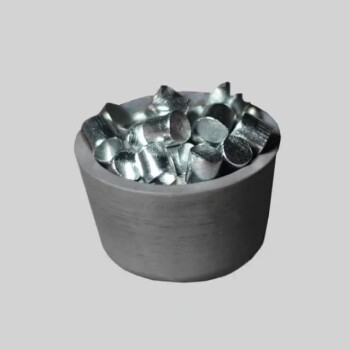
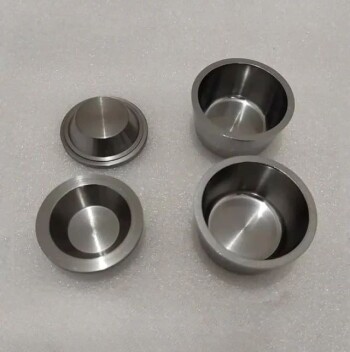
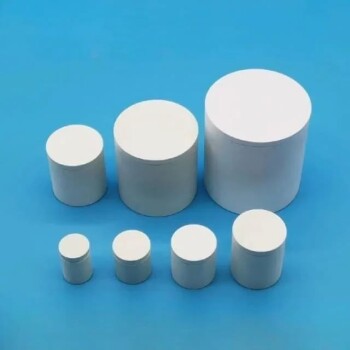
The use of small ceramic or quartz crucibles is essential for regulating the sulfur vapor flux during the growth process. By restricting the exposed surface area of the sulfur powder, these crucibles allow researchers to maintain a precise, saturated vapor pressure within the reaction zone. This controlled environment is the fundamental prerequisite for growing high-quality, defect-free crystals like Molybdenum Disulfide ($MoS_2$) and Tungsten Disulfide ($WS_2$).
Small crucibles act as a thermal and physical throttle for sulfur evaporation, ensuring that the vapor concentration remains stable and predictable throughout the reaction. This precision prevents the over-saturation of the reaction tube and ensures the correct chemical proportions (stoichiometry) required for high-performance 2D materials.
Controlling the Evaporation Rate
Limiting Exposed Surface Area
The primary function of a small crucible is to reduce the exposed top surface of the sulfur powder. Because sublimation occurs at the surface, a smaller diameter prevents an uncontrollable "burst" of vapor as the furnace heats up.
Sustaining Saturated Vapor Pressure
Maintaining a consistent saturated vapor pressure is critical for the growth kinetics of Transition Metal Dichalcogenides (TMDs). If the vapor pressure fluctuates, the resulting crystal flakes may be irregular in size, thickness, or lateral orientation.
Material Integrity and Purity
Thermal Resistance at High Temperatures
Quartz and ceramic materials can withstand the specific processing temperatures required at the furnace inlet without structural failure. This ensures the container remains stable and does not warp or crack during repeated heating cycles.
Chemical Inertness
Sulfur becomes highly reactive when heated and can easily contaminate or corrode lesser materials. Using high-purity quartz or ceramic prevents unwanted chemical reactions between the container and the precursor, ensuring no foreign impurities are introduced into the crystal lattice.
Achieving Stoichiometric Precision
Uniform Sublimation Dynamics
The thermal mass of a small ceramic boat helps distribute heat more evenly to the sulfur powder. This promotes a steady, uniform sublimation rate rather than erratic boiling, which is vital for maintaining a constant flow of precursor.
Stable Transport via Carrier Gas
A controlled evaporation rate facilitates the efficient transport of sulfur vapor to the reaction zone by the carrier gas. This ensures that the sulfur arrives at the substrate in the exact concentrations needed to react perfectly with the metal precursors.
Understanding the Trade-offs
Precursor Volume vs. Control
While small crucibles provide superior control, they limit the total volume of sulfur available for the reaction. This can be a significant bottleneck for very long-duration growth cycles or experiments requiring high-density coverage across large substrates.
Temperature Sensitivity
Because the surface area is limited, the evaporation rate becomes highly sensitive to even minor temperature fluctuations at the inlet. Researchers must ensure precise furnace calibration, as a small change in heat can have a magnified effect on the vapor concentration when using restricted-opening crucibles.
How to Apply This to Your CVD Project
Choosing the right container depends on your specific experimental goals and the sensitivity of your target material.
- If your primary focus is crystal uniformity and quality: Use a small-diameter quartz crucible to tightly regulate the evaporation flux and maintain a steady state.
- If your primary focus is achieving specific stoichiometry in $WS_2$: Opt for high-purity ceramic boats that offer high chemical stability to ensure the sulfur-to-tungsten ratio remains perfectly balanced.
- If your primary focus is large-area growth or long run times: Consider a slightly larger crucible but utilize a "cap" with a small aperture to maintain surface area control while housing a larger volume of powder.
Mastering the thermodynamics of sulfur evaporation through proper crucible selection is the first step toward achieving repeatable, high-performance 2D material synthesis.
Summary Table:
| Feature | Function in CVD Process | Impact on Material Quality |
|---|---|---|
| Limited Surface Area | Regulates sulfur sublimation rate | Prevents vapor bursts; ensures uniform thickness |
| Chemical Inertness | Prevents precursor contamination | Maintains high purity in the crystal lattice |
| Thermal Stability | Resists warping at high temperatures | Ensures repeatable and stable vapor pressure |
| High Thermal Mass | Evenly distributes heat to powder | Facilitates stable stoichiometry (e.g., for $MoS_2$) |
Elevate Your 2D Material Synthesis with KINTEK
Precision is the backbone of high-quality CVD research. At KINTEK, we specialize in providing the high-purity laboratory equipment and consumables essential for advanced material science. Whether you are growing $MoS_2$ or complex TMDs, our high-purity quartz and ceramic crucibles ensure the stable sulfur flux required for defect-free crystals.
Our comprehensive portfolio includes:
- Advanced Furnaces: CVD, PECVD, MPCVD, and high-temperature tube/muffle furnaces.
- Precision Tools: Hydraulic presses, crushing systems, and cooling solutions (ULT freezers).
- Essential Consumables: Specialized PTFE products, high-grade ceramics, and high-purity crucibles.
Ready to optimize your thin-film deposition process? Contact KINTEK today to discover how our tailored solutions can enhance your laboratory’s efficiency and research outcomes.
References
- Romana Alice Kalt, Andreas Stemmer. CVD of MoS<sub>2</sub> single layer flakes using Na<sub>2</sub>MoO<sub>4</sub> – impact of oxygen and temperature–time-profile. DOI: 10.1039/d3nr03907b
This article is also based on technical information from Kintek Solution Knowledge Base .
Related Products
- Ceramic Evaporation Boat Set Alumina Crucible for Laboratory Use
- High Purity Pure Graphite Crucible for Evaporation
- High Purity Pure Graphite Crucible for Electron Beam Evaporation
- Engineering Advanced Fine Alumina Al2O3 Ceramic Crucible for Laboratory Muffle Furnace
- Aluminized Ceramic Evaporation Boat for Thin Film Deposition
People Also Ask
- Why is an alumina boat selected for catalyst precursors? Ensure Sample Purity at 1000 °C
- Why are high-purity ceramic boats used for lignin activation? Ensure Purity & Thermal Stability
- Why is an alumina boat and Ti3AlC2 powder bed necessary for Ti2AlC sintering? Protect MAX Phase Purity
- Why use an alumina boat for high-temperature carbon activation? Ensure Maximum Material Purity & Thermal Stability
- Why are high-purity alumina crucibles used for liquid lead corrosion experiments? Ensure Data Accuracy at 550°C