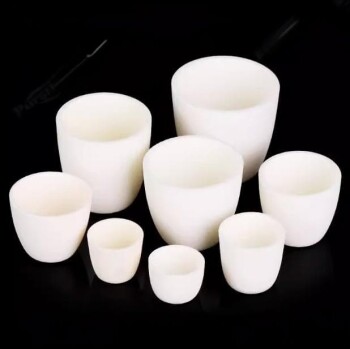
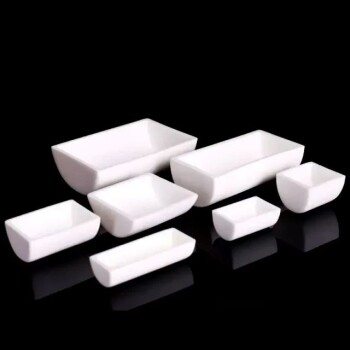
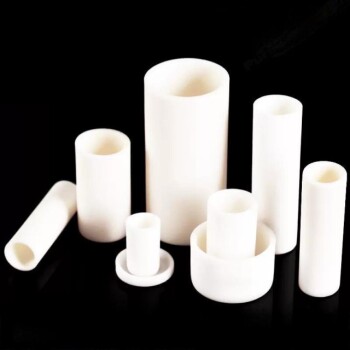
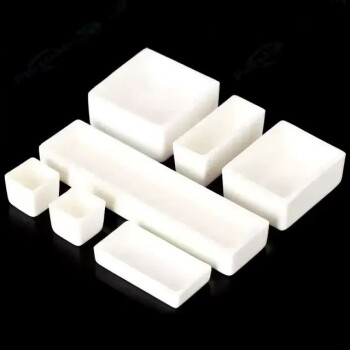
Alumina crucibles are the standard choice for this application because they offer the critical combination of extreme heat resistance and superior chemical neutrality. By remaining stable at temperatures reaching 1000 °C, they ensure that the thermal analysis captures only the behavior of the sodium-functionalized biochar, rather than artifacts caused by the container reacting with the sample.
The selection of alumina ensures data integrity by eliminating background interference. Its chemical inertness prevents reactions with active sodium sites or carbon structures, guaranteeing that all recorded weight changes result exclusively from the catalyst's physical and chemical decomposition.
The Necessity of Chemical Inertness
To understand why alumina is required, one must look at the chemical activity of the sample being tested. Sodium-functionalized biochar is not an inert substance; it is a chemically active catalyst.
Preventing Sample-Crucible Interaction
Biochar catalysts often contain active functional groups or added metals—in this case, sodium. At high temperatures, these elements become increasingly reactive.
Alumina provides a neutral barrier. It prevents the crucible material from chemically interacting with the sodium or the carbon lattice, ensuring the sample remains pure throughout the heating cycle.
Avoiding Lattice Contamination
If a reactive crucible material were used, impurities could leach into the catalyst.
This acts similarly to uncontrolled doping, where the crucible material absorbs into the catalyst's structure. Alumina’s high purity prevents this migration, preserving the specific catalytic properties you are trying to measure.
Ensuring Accuracy in High-Temperature Environments
Thermogravimetric analysis (TG/DTG) relies entirely on the precision of weight change measurements. The stability of the vessel is just as important as the sensitivity of the balance.
Stability up to 1000 °C
The analysis of biochar requires heating samples to approximately 1000 °C to observe complete degradation.
Alumina exhibits exceptional refractoriness. It maintains its structural integrity and mass constancy even at these extreme temperatures, providing a stable baseline for the experiment.
Isolating Physical Phenomena
The goal of TG/DTG is to track specific physical changes in the biochar. These include the desorption of adsorbed water, dehydroxylation, and the breakdown of carbon structures.
Because alumina does not degrade or off-gas in this temperature range, analysts can be certain that every milligram of weight loss is derived solely from these specific sample phenomena.
Common Pitfalls in Material Selection
While alumina is the robust choice for this specific application, understanding the risks of alternative materials clarifies why it is selected.
The Risk of Reactive Vessels
Using crucibles made of more reactive materials (such as standard glass or lower-grade ceramics) can lead to "ghost" data.
If the crucible reacts with the sodium functional groups, it may gain or lose mass independent of the sample's decomposition. This leads to skewed thermal stability profiles and inaccurate degradation curves.
The Dangers of Leaching
In high-temperature calcination or analysis, active materials (like the titanium dioxide mentioned in comparative contexts) are prone to absorbing ions from their container.
If the crucible leaches ions (such as calcium or additional sodium) into the biochar, it fundamentally alters the catalyst's composition. This renders the analysis void, as you are no longer testing the original material.
Making the Right Choice for Your Goal
Selecting the correct crucible is not a trivial detail; it is a fundamental requirement for valid data.
- If your primary focus is determining thermal stability: Rely on alumina to withstand the 1000 °C requirement without contributing background noise to the weight loss data.
- If your primary focus is analyzing chemical composition: Use high-purity alumina to prevent the crucible from reacting with sodium functional groups or leaching impurities into your catalyst.
By treating the crucible as an active component of your experimental design, you ensure that your results reflect the true nature of your catalyst, not the limitations of your equipment.
Summary Table:
| Feature | Alumina Crucible (Al2O3) | Importance for Biochar TG/DTG |
|---|---|---|
| Temperature Resistance | Up to 1750°C | Stable baseline up to the 1000°C biochar degradation limit. |
| Chemical Inertness | Exceptionally High | Prevents reactions with active sodium functional groups. |
| Mass Constancy | Stable | No off-gassing or weight loss, ensuring 100% accurate mass tracking. |
| Purity Grade | 99% - 99.9% | Eliminates lattice contamination and leaching of impurities. |
Elevate Your Research with KINTEK Precision Ceramics
In high-temperature thermogravimetric analysis, your crucible shouldn't be a variable. KINTEK specializes in high-purity laboratory consumables, providing premium alumina crucibles and ceramics designed to withstand extreme temperatures while maintaining chemical neutrality.
Whether you are performing catalyst characterization or advanced thermal analysis, our comprehensive range of high-temperature furnaces (muffle, vacuum, and tube) and durable consumables ensure your data reflects the true nature of your materials. Don't let crucible interference compromise your results—Contact KINTEK today to find the perfect fit for your laboratory needs!
References
- Thaíssa Saraiva Ribeiro, Leyvison Rafael Vieira da Conceição. Functionalized Biochar from the Amazonian Residual Biomass Murici Seed: An Effective and Low-Cost Basic Heterogeneous Catalyst for Biodiesel Synthesis. DOI: 10.3390/molecules28247980
This article is also based on technical information from Kintek Solution Knowledge Base .
Related Products
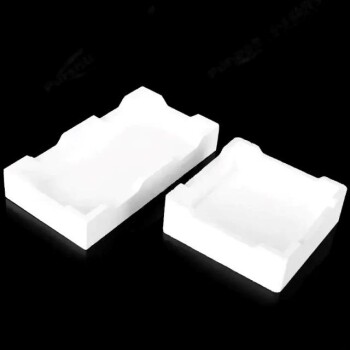
- Arc-Shaped Alumina Ceramic Crucible High Temperature Resistant for Engineering Advanced Fine Ceramics
- Alumina Al2O3 Ceramic Crucible Semicircle Boat with Lid for Engineering Advanced Fine Ceramics
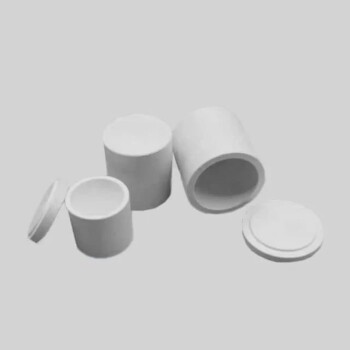
- Engineering Advanced Fine Ceramics Alumina Al2O3 Crucible With Lid Cylindrical Laboratory Crucible
- Engineering Advanced Fine Ceramics Alumina Crucibles (Al2O3) for Thermal Analysis TGA DTA
- Engineering Advanced Fine Alumina Al2O3 Ceramic Crucible for Laboratory Muffle Furnace
People Also Ask
- Why Use Alumina Crucibles & Powder Burial for NaSICON? Ensure Phase Purity and Prevent Elemental Volatilization
- What is the primary purpose of using alumina crucibles for LLTO ceramics? Optimize Your High-Temperature Sintering
- Why are alumina crucibles and mother powder essential for LATP sintering? Optimize Your Solid Electrolyte Performance
- Why are high-purity alumina crucibles used for liquid lead corrosion experiments? Ensure Data Accuracy at 550°C
- Primary considerations for choosing alumina crucibles and quartz tubes in indium intercalation: Ensure Material Purity