Laboratory heating equipment is essential because ambient conditions cannot provide the energy required to initiate the necessary chemical and physical changes. Specifically, maintaining the mixture at 100°C is critical to overcome the dissolution energy barrier of the PIN precursor polymer. Without this sustained thermal input, the polymer simply cannot dissolve effectively into the succinonitrile (SN) solvent.
The application of constant heat acts as the catalyst for transforming raw components into a functional electrolyte glue. It drives the swelling and dispersion of polymer powder, ensuring a uniform, precipitate-free final product that remains stable.
Overcoming Chemical Resistance
The Dissolution Energy Barrier
The primary challenge in preparing P@S glue solutions is the natural resistance of the PIN precursor polymer to interact with the solvent.
This polymer possesses a high dissolution energy barrier.
Standard mixing at room temperature is insufficient to breach this threshold; the system requires a constant high-temperature environment of 100°C to activate the dissolution process.
Activation Through Thermal Energy
Laboratory equipment like hot plates or thermostatic baths provides precise, sustained energy.
This energy is not merely for warming the liquid; it is a reactant in the process.
It forces the polymer chains to relax and interact with the succinonitrile (SN) solvent, initiating the transition from a solid powder to a dissolved state.
Facilitating Physical Transformation
Promoting Polymer Swelling
Before the polymer can fully dissolve, it must undergo swelling.
The 100°C environment accelerates the absorption of the SN solvent into the PIN polymer matrix.
This swelling is the precursor to breaking down the solid structure of the powder, allowing it to integrate into the liquid phase.
Ensuring Effective Dispersion
Once swollen, the polymer must be dispersed evenly throughout the mixture.
Thermal treatment promotes the kinetic movement of molecules, preventing the powder from clumping.
This ensures that the PIN powder spreads uniformly within the SN solvent rather than settling as a sediment.
Ensuring Product Quality
Achieving a Homogeneous Mixture
The ultimate goal of this process is to create a viscous electrolyte glue solution.
Heating guarantees that the final mixture is uniform in consistency.
Without this step, the resulting solution would likely be inconsistent, affecting its performance as an electrolyte.
Preventing Precipitation
Stability is the hallmark of a successfully prepared solution.
Proper heating ensures the solution remains precipitate-free, meaning no solid particles fall out of the solution after mixing.
This creates a stable compound that retains its properties over time.
The Risks of Inadequate Thermal Control
Inconsistent Temperature
If the temperature fluctuates or fails to reach 100°C, the dissolution energy barrier will not be fully overcome.
This often leads to partial dissolution, where the polymer remains in a semi-solid state.
Structural Weakness
A failure to maintain heat results in a non-uniform mixture.
This lack of uniformity introduces weak points in the glue, compromising its mechanical and electrochemical integrity.
Furthermore, un-dissolved precipitates can act as contaminants, rendering the electrolyte solution ineffective.
Making the Right Choice for Your Process
To ensure the successful preparation of P@S glue solutions, consider your primary objectives:
- If your primary focus is Solution Stability: Prioritize equipment that maintains a strict 100°C to guarantee the final product is precipitate-free.
- If your primary focus is Process Efficiency: Utilize heating methods that rapidly promote the swelling and dispersion of the PIN powder to reduce preparation time.
Precision in thermal management is the difference between a functional electrolyte glue and a failed mixture.
Summary Table:
| Feature | Requirement | Impact on P@S Glue Solution |
|---|---|---|
| Target Temp | 100°C | Overcomes the PIN polymer dissolution energy barrier |
| Equipment | Hot plates/Baths | Provides sustained, precise energy for solvent absorption |
| Phase Change | Swelling & Dispersion | Transforms solid powder into a uniform liquid phase |
| Final Quality | Homogeneity | Prevents precipitation and ensures electrochemical integrity |
Elevate Your Electrolyte Research with KINTEK Precision
Achieving the perfect 100°C thermal environment is critical for the stability and performance of your P@S glue solutions. KINTEK specializes in advanced laboratory equipment designed to meet the rigorous demands of battery research and material science.
From high-precision thermostatic baths and cooling solutions to robust crushing and milling systems and high-temperature reactors, our portfolio supports every stage of your workflow. Whether you need reliable PTFE consumables or specialized battery research tools, we provide the consistency your lab deserves.
Ready to optimize your dissolution process? Contact us today to find the perfect heating solution for your lab!
Related Products
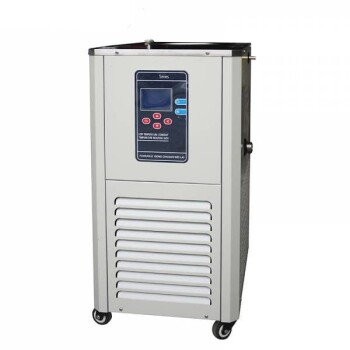
- High Temperature Constant Temperature Heating Circulator Water Bath Chiller Circulator for Reaction Bath
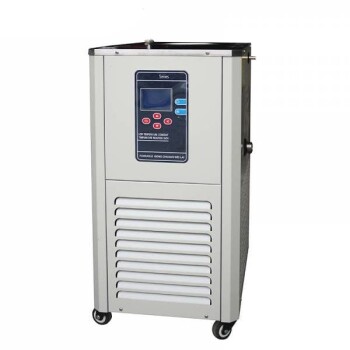
- 50L Heating Chilling Circulator Cooling Water Bath Circulator for High and Low Temperature Constant Temperature Reaction
- 20L Heating Chilling Circulator Cooling Water Bath Circulator for High and Low Temperature Constant Temperature Reaction
- 10L Chilling Circulator Cooling Water Bath Low Temperature Constant Temperature Reaction Bath
- 30L Heating Chilling Circulator Cooling Water Bath Circulator for High and Low Temperature Constant Temperature Reaction
People Also Ask
- What is the necessity of a circulating water bath in chlorate production? Optimize Yield & Purity with Precision
- How do constant temperature circulators impact weight-loss immersion tests? Ensure Precision in Corrosion Analysis
- How does a constant temperature circulator support the leaching reaction of gold scrap? Optimize Gold Recovery Results
- Why is a constant temperature water bath used for precursor storage in CVD? Achieve Stable Nanocrystalline SiC Deposition
- Why is a high-precision constant temperature water bath necessary for anaerobic digestion? Ensure Success at 37±0.02°C