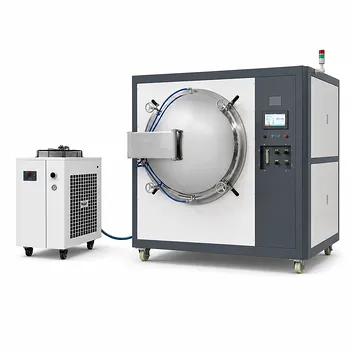
Precise temperature control is the single most critical variable when operating a vacuum hot pressing furnace for aluminum matrix composites. It is essential to strictly limit the processing temperature—often below a critical threshold of 630°C—to prevent chemical reactions between the aluminum matrix and reinforcing particles. Without this precision, the process generates brittle interfacial compounds, such as WAl12 or Aluminum Carbide (Al4C3), which severely compromise the material's mechanical strength and thermal properties.
The core objective of thermal precision is to maintain a "Goldilocks" state: high enough to soften the matrix for proper densification, yet sufficiently low to arrest the chemical kinetics that create brittle, structural defects at the interface.
Preventing Brittle Phase Formation
Controlling Interfacial Reactions
The primary danger in fabricating aluminum matrix composites is the chemical reactivity between the reinforcing particles and the matrix.
If the temperature rises unchecked, it triggers an aggressive reaction at the interface. This transforms useful reinforcement into brittle reaction products, such as WAl12, which act as fracture initiation points rather than structural supports.
Adhering to Critical Thresholds
Your furnace must be capable of stabilizing temperatures within a tight tolerance window to avoid specific critical limits.
For many aluminum composites, exceeding 630°C is the tipping point where detrimental reactions accelerate. Maintaining the process below this limit is non-negotiable for preserving the mechanical integrity of the final part.
Avoiding Aluminum Carbide (Al4C3)
Beyond WAl12, precise control prevents the formation of Aluminum Carbide (Al4C3), a common issue when carbon or diamond reinforcements are involved.
Al4C3 is chemically unstable and brittle; its presence leads to lower thermal conductivity and premature material failure. By limiting the temperature, you suppress the reaction kinetics required to form this harmful phase.
Balancing Densification and Flowability
Optimizing Matrix Wetting
While high heat is dangerous, insufficient heat results in a porous, weak material.
The temperature must be high enough to induce "flowability" in the aluminum, allowing it to wet the reinforcing fibers or particles effectively. This wetting is the prerequisite for a strong physical bond between the metal and the reinforcement.
Solid-State Sintering
Vacuum hot pressing often relies on densification within the solidus temperature range—meaning the material is sintered below the melting point of aluminum.
This solid-state approach is a strategic choice to avoid the rapid chemical attacks associated with liquid-phase infiltration. Precision heating ensures the material densifies fully without crossing into the liquid phase where reaction rates spike.
Understanding the Trade-offs
The Risks of Thermal Fluctuations
It is not enough to simply reach a set point; the rate of heating and stability at the dwell temperature are equally important.
Rapid heating or fluctuating temperatures can cause thermal stress, leading to abnormal grain coarsening or the destruction of delicate structures like graphene. A controlled heating rate (e.g., 10°C/min) allows the composite to reach equilibrium without inducing internal structural damage.
The Consequence of Over-shooting vs. Under-shooting
There is very little margin for error in this thermal process.
If you overshoot the temperature, you risk metal leakage and the irreversible formation of brittle phases. If you undershoot, the matrix remains too stiff to fill voids, resulting in poor density and weak adhesion.
Making the Right Choice for Your Goal
To optimize your vacuum hot pressing process, align your thermal strategy with your specific material performance targets:
- If your primary focus is Mechanical Strength: Prioritize staying strictly below the 630°C threshold to prevent the formation of brittle WAl12 or Al4C3 phases that cause fracture.
- If your primary focus is Thermal Conductivity: Ensure temperatures are high enough to achieve maximum densification and wetting, but low enough to avoid Al4C3, which acts as a thermal barrier.
- If your primary focus is Microstructural Homogeneity: Utilize a slow, steady heating rate to prevent grain coarsening and thermal stress during the ramp-up phase.
Mastering the temperature curve is not just about heating the material; it is about chemically engineering the interface to ensure the composite performs as a unified solid.
Summary Table:
| Factor | Goal | Risk of Poor Control |
|---|---|---|
| Temperature Limit | < 630°C | Formation of brittle WAl12 or Al4C3 phases |
| Matrix State | Softened/Solid-state | Liquid-phase infiltration and metal leakage |
| Interface Quality | Optimal Wetting | Porosity (too cold) or chemical reaction (too hot) |
| Heating Rate | Controlled (e.g. 10°C/min) | Thermal stress and abnormal grain coarsening |
Elevate Your Material Research with KINTEK Precision
Don't let temperature fluctuations compromise your composite's integrity. KINTEK specializes in advanced laboratory solutions, providing high-performance vacuum hot pressing furnaces and isostatic presses engineered for the strict thermal tolerances required in aluminum matrix fabrication.
Our comprehensive portfolio includes:
- High-Temperature Furnaces: Muffle, tube, vacuum, and CVD systems for precise sintering.
- Sample Preparation: Crushing, milling, and hydraulic pellet presses for consistent matrix density.
- Specialized Tools: High-pressure reactors, electrolytic cells, and essential ceramic crucibles.
Achieve structural perfection today. Contact our technical experts to find the ideal equipment for your laboratory's needs.
Related Products
- Vacuum Hot Press Furnace Heated Vacuum Press Machine Tube Furnace
- 600T Vacuum Induction Hot Press Furnace for Heat Treat and Sintering
- Vacuum Hot Press Furnace Machine Heated Vacuum Press
- Vacuum Hot Press Furnace Machine for Lamination and Heating
- Vacuum Heat Treat and Pressure Sintering Furnace for High Temperature Applications
People Also Ask
- What advantages does a vacuum hot press furnace provide for LSLBO ceramic electrolytes? Achieve 94% Relative Density
- What role does a Vacuum Hot Press (VHP) furnace play in the densification of austenitic stainless steel 316 composites?
- What are the advantages of using a vacuum hot pressing furnace? Superior Densification for 2024Al/Gr/SiC Composites
- What are the advantages of a vacuum hot press furnace for LTPO solid electrolytes? Boost Density and Conductivity
- What core processing conditions does a vacuum hot press furnace provide? Achieve High-Density Cu-SiC/Diamond Composites