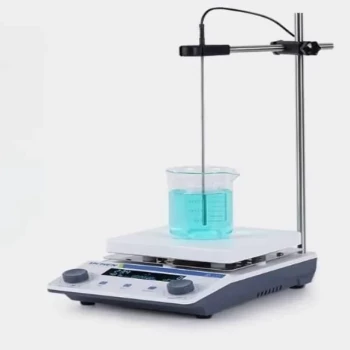
Continuous magnetic stirring is a fundamental requirement for obtaining valid data in TiO2/CuxOy nanotube photocatalysis. By using controlled rotation to drive a stir bar, you create forced convection that ensures pollutants—such as phenol or bacteria—are uniformly distributed throughout the aqueous phase, rather than stagnant.
Core Takeaway The primary function of continuous stirring is to eliminate mass transfer limitations at the solid-liquid interface. Without this forced motion, your data will measure how slowly pollutants diffuse through the liquid rather than the true chemical reaction rate (kinetic performance) of your catalyst.
The Role of Hydrodynamics in Photocatalysis
Eliminating Mass Transfer Limitations
In a static solution, a thin layer of liquid surrounds the catalyst surface, creating a barrier. Pollutants must slowly diffuse across this barrier to react.
Continuous stirring disrupts this layer through forced convection. This ensures the rate of reaction is limited only by the catalyst's efficiency, not by how fast molecules can swim to the surface.
Maximizing Contact with Active Sites
For the TiO2/CuxOy nanotubes to function, the target molecule must physically contact the "active sites" on the nanotube surface.
Stirring constantly refreshes the liquid directly touching the catalyst. This guarantees that fresh pollutant molecules are always available to replace those that have already been degraded.
Ensuring Uniform Distribution
Whether you are degrading chemical pollutants or neutralizing bacterial strains, the concentration must be homogeneous throughout the vessel.
Mechanical mixing prevents the formation of "dead zones" where the pollutant concentration might be lower than the rest of the solution, which would skew your efficiency calculations.
Ensuring Data Validity and Reproducibility
Measuring True Kinetic Performance
To claim your catalyst is effective, you must measure its intrinsic activity.
If the stirrer is off or too slow, you are measuring external mass transfer resistance (a physical transport problem) rather than the photocatalytic degradation rate (a chemical reaction capability). Continuous operation isolates the chemical performance of the nanotubes.
Maintaining Consistent Light Exposure
While the primary focus is mass transfer, stirring also stabilizes the physical environment of the reaction.
It prevents the settling or aggregation of particles (if using a suspension), ensuring that the catalyst receives uniform irradiation from the light source. This prevents self-shadowing, where clumps of catalyst block light from reaching other active sites.
Understanding Common Pitfalls
The Risk of Concentration Gradients
If stirring is intermittent or insufficient, concentration gradients will form rapidly.
This leads to a localized depletion of pollutants near the catalyst surface. The result is a false "slow" reaction rate that has nothing to do with the actual quality of your TiO2/CuxOy material.
Inconsistent Rotation Speeds
The speed of rotation is a variable that must be controlled, not just the presence of rotation.
Fluctuations in stirring speed can alter the thickness of the liquid boundary layer mentioned above. For reproducible scientific data, the rotation rate must remain constant throughout the entire experiment.
Ensuring Success in Your Experiments
If your primary focus is determining reaction kinetics: Ensure the stirring speed is high enough that increasing it further does not change the reaction rate; this confirms you have eliminated mass transfer limitations.
If your primary focus is comparing different catalysts: Maintain identical stirring speeds and vessel geometries for every sample to ensure that differences in performance are due to material properties, not hydrodynamics.
If your primary focus is long-term stability: Verify that the mechanical force of the stirrer does not physically degrade the nanotube morphology over extended reaction times.
Reliable photocatalytic data is impossible without the uniform, forced convection that continuous stirring provides.
Summary Table:
| Feature | Impact on Photocatalytic Experiment |
|---|---|
| Mass Transfer | Eliminates stagnant boundary layers; ensures reactants reach active sites. |
| Kinetic Accuracy | Measures true chemical reaction rates instead of physical diffusion speeds. |
| Homogeneity | Prevents "dead zones" and ensures uniform pollutant/bacteria distribution. |
| Light Exposure | Prevents catalyst aggregation and ensures uniform irradiation across the surface. |
| Data Reliability | Eliminates concentration gradients for reproducible and valid scientific results. |
Elevate Your Photocatalytic Research with KINTEK Precision
Precise and reproducible data starts with the right laboratory environment. At KINTEK, we specialize in high-performance equipment designed to eliminate variables and ensure experimental success. From robust magnetic stirrers and heating solutions to advanced CVD/PECVD systems for nanotube synthesis, we provide the tools researchers need for breakthrough results.
Whether you require high-temperature furnaces, precision hydraulic presses, or specialized electrolytic cells and electrodes, our team is dedicated to supporting your lab's unique requirements.
Ready to optimize your experimental setup? Contact us today to discover how KINTEK’s comprehensive range of laboratory equipment and consumables can enhance your research efficiency and accuracy.
References
- Magda Kozak, Adriana Zaleska‐Medynska. Electrochemically Obtained TiO2/CuxOy Nanotube Arrays Presenting a Photocatalytic Response in Processes of Pollutants Degradation and Bacteria Inactivation in Aqueous Phase. DOI: 10.3390/catal8060237
This article is also based on technical information from Kintek Solution Knowledge Base .
Related Products
- Laboratory Small Constant Temperature Heated Magnetic Stirrer Heater and Stirrer
- Custom PTFE Teflon Parts Manufacturer for Magnetic Stirring Bar
- High Performance Laboratory Stirrers for Diverse Applications
- Three-dimensional electromagnetic sieving instrument
- Custom PTFE Teflon Parts Manufacturer for PTFE Stirring Bar Recovery Rod
People Also Ask
- What role does a magnetic stirrer with heating play in ZnO nanoparticle synthesis? Precision Control for Quality Results
- What role does a constant temperature heating magnetic stirrer play in MFC-HAp synthesis? Achieve Material Homogeneity
- What is the function of a laboratory magnetic stirrer in Ni–Cr–P electrodeposition? Optimize Ion Transport & Coating
- Why is a laboratory magnetic stirrer required for benzoic acid esters? Boost Reaction Speed & Yield with High RPM
- What role does a laboratory magnetic stirrer play in TiO2 and TiO2-Ag sol preparation? Master Chemical Kinetics