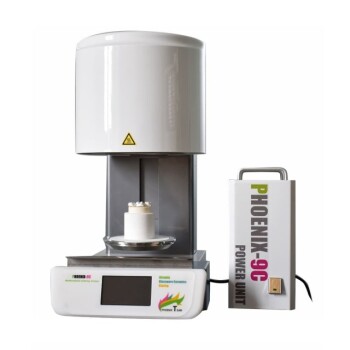
Knowledge Why must high-temperature furnaces provide precise heating rate control during ZrC-SiC debinding? Avoid Critical Defects
Author avatar

Tech Team · Kintek Solution

Updated 3 days ago

Why must high-temperature furnaces provide precise heating rate control during ZrC-SiC debinding? Avoid Critical Defects


High-temperature furnaces must provide precise control during the debinding stage to safely manage the volatilization of organic additives within ZrC-SiC green bodies. Without this regulation, the rapid generation of gases creates internal pressure that destroys the structural integrity of the material before sintering even begins.

The debinding phase is the critical transition where organic components are removed from the ceramic matrix. Precise thermal control is the only mechanism available to balance gas generation with gas diffusion, preventing catastrophic defects like cracking and blistering.

The Mechanics of Debinding

Managing Organic Additives

Green bodies—the unfired ceramic shapes—are packed with organic additives like PVB binders and PEG plasticizers. These materials are essential for shaping the part, but they must be completely removed before high-temperature sintering.

The Decomposition Process

As the furnace heats up, these organic components begin to decompose and turn into gas. This conversion must happen gradually.

The Function of Holding Steps

Furnaces are often programmed to hold at specific temperatures, such as 550°C. This "soak" period ensures that the decomposition process is thorough and that all organic material has time to volatilize and exit the material.

The Consequences of Rapid Heating

Internal Pressure Buildup

If the heating rate is too aggressive (exceeding controlled rates like 10°C/min), gases are generated faster than they can diffuse out of the dense ceramic body.

Structural Failure

This trapped gas creates significant internal stress. The resulting pressure inevitably seeks an escape route, causing physical damage to the green body.

Common Defects

The primary reference highlights three specific failure modes caused by uncontrolled heating: internal cracks, blistering, and delamination. Once these defects occur during debinding, the part is effectively ruined and cannot be salvaged by sintering.

Understanding the Trade-offs

Process Time vs. Yield

The primary trade-off in debinding is time. Implementing slow ramp rates and extended holding periods significantly increases the total cycle time of the furnace run.

The Cost of Rushing

However, prioritizing speed during this specific stage is a false economy. Accelerating the debinding phase almost invariably leads to a higher scrap rate due to the defects mentioned above.

Optimizing Your Thermal Cycle

To ensure the structural integrity of ZrC-SiC components, you must prioritize the stability of the debinding phase over speed.

  • If your primary focus is part quality: Configure your furnace to maintain a strict heating rate (e.g., 10°C/min) and ensure a complete hold at 550°C to guarantee defect-free gas removal.
  • If your primary focus is process efficiency: Optimize your cycle times during the later sintering or cooling phases, never during the volatile debinding stage where the risk of delamination is highest.

Control the gas evolution, and you control the integrity of the final ceramic product.

Summary Table:

Stage Temperature / Rate Primary Function Potential Risk (if uncontrolled)
Heating Ramp ≤ 10°C/min Controlled gas generation Internal pressure buildup & cracking
Holding/Soak ~550°C Complete volatilization of PVB/PEG Residual organics causing delamination
Sintering High Temp (Final) Material densification Permanent structural defects from debinding

Elevate Your Material Integrity with KINTEK Precision

Don't let uncontrolled thermal cycles compromise your research or production yields. KINTEK specializes in advanced laboratory equipment, providing high-performance muffle, tube, and vacuum furnaces designed for the rigorous demands of ceramic debinding and sintering.

Whether you are processing ZrC-SiC composites or specialized alloys, our systems offer the precise heating rate control and multi-step holding functions essential for defect-free results. Beyond furnaces, we support your entire workflow with crushing and milling systems, isostatic presses, and high-temperature reactors.

Ready to achieve superior structural integrity? Contact KINTEK today to discuss your application and find the perfect thermal solution for your lab!

Related Products

People Also Ask

Related Products

1800℃ Muffle Oven Furnace for Laboratory

1800℃ Muffle Oven Furnace for Laboratory

KT-18 muffle furnace with Japan Al2O3 polycrystalline fibe and Silicon Molybdenum heating element, up to 1900℃, PID temperature control and 7" smart touch screen. Compact design, low heat loss, and high energy efficiency. Safety interlock system and versatile functions.

1700℃ Muffle Oven Furnace for Laboratory

1700℃ Muffle Oven Furnace for Laboratory

Get superior heat control with our 1700℃ Muffle Furnace. Equipped with intelligent temperature microprocessor, TFT touch screen controller & advanced insulation materials for precise heating up to 1700C. Order now!

1400℃ Muffle Oven Furnace for Laboratory

1400℃ Muffle Oven Furnace for Laboratory

Get precise high-temperature control up to 1500℃ with KT-14M Muffle furnace. Equipped with a smart touch screen controller and advanced insulation materials.

Horizontal High Temperature Graphite Vacuum Graphitization Furnace

Horizontal High Temperature Graphite Vacuum Graphitization Furnace

Horizontal Graphitization Furnace: This type of furnace is designed with the heating elements placed horizontally, allowing for uniform heating of the sample. It's well-suited for graphitizing large or bulky samples that require precise temperature control and uniformity.

High Pressure Laboratory Vacuum Tube Furnace Quartz Tubular Furnace

High Pressure Laboratory Vacuum Tube Furnace Quartz Tubular Furnace

KT-PTF High Pressure Tube Furnace: Compact split tube furnace with strong positive pressure resistance. Working temp up to 1100°C and pressure up to 15Mpa. Also works under controller atmosphere or high vacuum.

Vertical High Temperature Graphite Vacuum Graphitization Furnace

Vertical High Temperature Graphite Vacuum Graphitization Furnace

Vertical high temperature graphitization furnace for carbonization and graphitization of carbon materials up to 3100℃.Suitable for shaped graphitization of carbon fiber filaments and other materials sintered in a carbon environment.Applications in metallurgy, electronics, and aerospace for producing high-quality graphite products like electrodes and crucibles.

Graphite Vacuum Furnace Bottom Discharge Graphitization Furnace for Carbon Materials

Graphite Vacuum Furnace Bottom Discharge Graphitization Furnace for Carbon Materials

Bottom-out graphitization furnace for carbon materials, ultra-high temperature furnace up to 3100°C, suitable for graphitization and sintering of carbon rods and carbon blocks. Vertical design, bottom discharging, convenient feeding and discharging, high temperature uniformity, low energy consumption, good stability, hydraulic lifting system, convenient loading and unloading.

Ultra-High Temperature Graphite Vacuum Graphitization Furnace

Ultra-High Temperature Graphite Vacuum Graphitization Furnace

The ultra-high temperature graphitization furnace utilizes medium frequency induction heating in a vacuum or inert gas environment. The induction coil generates an alternating magnetic field, inducing eddy currents in the graphite crucible, which heats up and radiates heat to the workpiece, bringing it to the desired temperature. This furnace is primarily used for graphitization and sintering of carbon materials, carbon fiber materials, and other composite materials.

Molybdenum Vacuum Heat Treat Furnace

Molybdenum Vacuum Heat Treat Furnace

Discover the benefits of a high-configuration molybdenum vacuum furnace with heat shield insulation. Ideal for high-purity, vacuum environments like sapphire crystal growth and heat treatment.

Graphite Vacuum Furnace High Thermal Conductivity Film Graphitization Furnace

Graphite Vacuum Furnace High Thermal Conductivity Film Graphitization Furnace

The high thermal conductivity film graphitization furnace has uniform temperature, low energy consumption and can operate continuously.

Graphite Vacuum Furnace Negative Material Graphitization Furnace

Graphite Vacuum Furnace Negative Material Graphitization Furnace

Graphitization furnace for battery production has uniform temperature and low energy consumption. Graphitization furnace for negative electrode materials: an efficient graphitization solution for battery production and advanced functions to enhance battery performance.

Graphite Vacuum Continuous Graphitization Furnace

Graphite Vacuum Continuous Graphitization Furnace

High-temperature graphitization furnace is a professional equipment for graphitization treatment of carbon materials. It is a key equipment for the production of high-quality graphite products. It has high temperature, high efficiency and uniform heating. It is suitable for various high-temperature treatments and graphitization treatments. It is widely used in metallurgy, electronics, aerospace, etc. industry.

1400℃ Laboratory High Temperature Tube Furnace with Alumina Tube

1400℃ Laboratory High Temperature Tube Furnace with Alumina Tube

Looking for a tube furnace for high-temperature applications? Our 1400℃ Tube Furnace with Alumina Tube is perfect for research and industrial use.

Laboratory Muffle Oven Furnace Bottom Lifting Muffle Furnace

Laboratory Muffle Oven Furnace Bottom Lifting Muffle Furnace

Efficiently produce batches with excellent temperature uniformity using our Bottom Lifting Furnace. Features two electric lifting stages and advanced temperature control up to 1600℃.

2200 ℃ Tungsten Vacuum Heat Treat and Sintering Furnace

2200 ℃ Tungsten Vacuum Heat Treat and Sintering Furnace

Experience the ultimate refractory metal furnace with our Tungsten vacuum furnace. Capable of reaching 2200℃, perfect for sintering advanced ceramics and refractory metals. Order now for high-quality results.

1200℃ Split Tube Furnace with Quartz Tube Laboratory Tubular Furnace

1200℃ Split Tube Furnace with Quartz Tube Laboratory Tubular Furnace

KT-TF12 split tube furnace: high-purity insulation, embedded heating wire coils, and max. 1200C. Widely used for new materials and chemical vapour deposition.

Vacuum Heat Treat and Sintering Furnace with 9MPa Air Pressure

Vacuum Heat Treat and Sintering Furnace with 9MPa Air Pressure

The air pressure sintering furnace is a high-tech equipment commonly used for the sintering of advanced ceramic materials. It combines vacuum sintering and pressure sintering techniques to achieve high-density and high-strength ceramics.

Multi-zone Laboratory Tube Furnace

Multi-zone Laboratory Tube Furnace

Experience precise, efficient thermal testing with our Multi Zone Tube Furnace. Independent heating zones and temperature sensors allow for controlled high-temperature gradient heating fields. Order now for advanced thermal analysis!

Vacuum Heat Treat Sintering Brazing Furnace

Vacuum Heat Treat Sintering Brazing Furnace

A vacuum brazing furnace is a type of industrial furnace used for brazing, a metalworking process that joins two pieces of metal using a filler metal that melts at a lower temperature than the base metals. Vacuum brazing furnaces are typically used for high-quality applications where a strong, clean joint is required.

Vacuum Sealed Continuous Working Rotary Tube Furnace Rotating Tube Furnace

Vacuum Sealed Continuous Working Rotary Tube Furnace Rotating Tube Furnace

Experience efficient material processing with our vacuum-sealed rotary tube furnace. Perfect for experiments or industrial production, equipped with optional features for controlled feeding and optimized results. Order now.


Leave Your Message