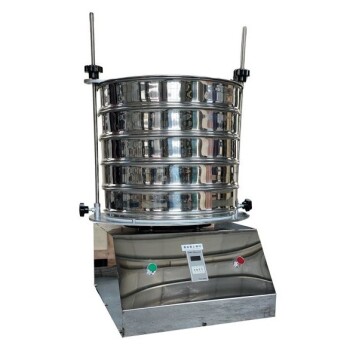
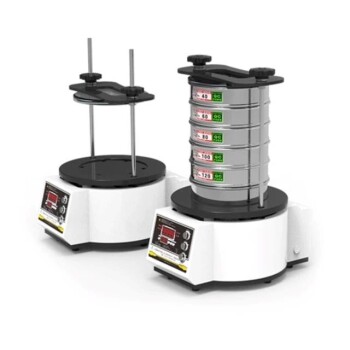
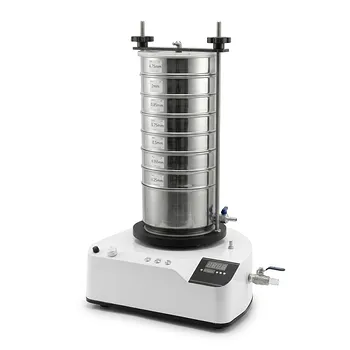
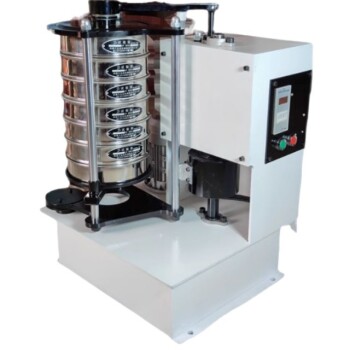
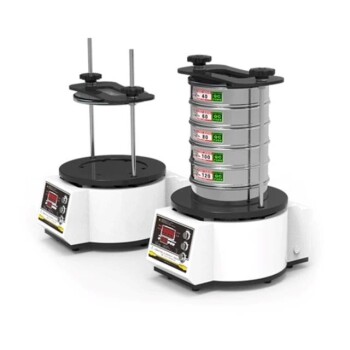
The primary function of sieving ultra-fine ceramic powders is to eliminate hard agglomerates that form during the vacuum drying process. Before the powder is loaded into a mold, passing it through a standard sieve (such as 200 mesh) breaks up or removes these large clumps. This step is non-negotiable for ensuring the powder flows smoothly and packs with high density, which prevents structural failures in the final product.
Core Takeaway: Vacuum drying introduces a hidden variable—hard agglomerates—that disrupt powder uniformity. Sieving is the critical quality control step that normalizes particle distribution, ensuring even mold filling and preventing internal defects like voids or cracks during the high-stress sintering phase.
The Mechanics of Powder Preparation
Counteracting Vacuum Drying Side Effects
The process of vacuum drying ultra-fine ceramic powders often results in the formation of hard agglomerates. These are clusters of particles that bind together, effectively behaving like much larger, coarser grains.
Processing the powder with a standard sieve is the only way to mechanically separate or remove these clusters. By eliminating these drying artifacts, you return the powder to its intended fine state.
Optimizing Flow and Density
For a ceramic component to be structurally sound, the raw powder must possess excellent flowability. Large agglomerates impede flow, creating pockets of air and loose packing.
Sieving significantly improves the tap density of the material. Higher tap density means the particles naturally settle closer together, reducing the amount of shrinkage and movement required during the firing process.
Impact on Final Structural Integrity
Ensuring Uniform Mold Filling
When loading powder into graphite molds, consistency is paramount. If the powder contains agglomerates, it will not settle into uniform layers.
Uneven layer thickness creates density gradients within the "green" (unfired) body. By standardizing the particle size through sieving, you ensure every layer in the mold is mechanically identical.
Preventing Sintering Defects
The ultimate goal of sieving is to protect the material during sintering. Internal defects, such as cracks or voids, often originate from inconsistencies in the initial powder packing.
If large particles or aggregates remain, they create stress points. Sieving removes these initiators, ensuring a homogeneous structure that can withstand the thermal physics of sintering without failing.
The Risks of Inadequate Preparation
Critical Failure in Thin Membranes
In specialized applications like Li6.4La3Zr1.4Ta0.6O12 (LLZTO) production, the margin for error is microscopic. Large particles can physically pierce ultra-thin solid-state electrolyte membranes.
If the sieve does not strictly control the upper limit of particle size, these aggregates can cause battery short circuits, rendering the component dangerous or useless.
Surface and Density Compromises
For applications involving coatings or electrophoretic deposition, large impurities disrupt the surface finish. Solid residues larger than the standard mesh (e.g., 44 micrometers) lead to surface lumps and voids.
These imperfections ruin the density of the coating. Furthermore, they degrade the material's anti-oxidation performance, shortening the lifespan of the final glass-ceramic product.
Strategies for Defect-Free Production
To ensure the reliability of your ceramic components, match your sieving protocol to your specific failure risks:
- If your primary focus is Structural Sintering: Use a standard sieve (e.g., 200 mesh) to remove vacuum-drying agglomerates and guarantee uniform layer thickness in graphite molds.
- If your primary focus is Thin-Film Electronics: Employ high-precision analytical sieves (e.g., 500 mesh) to strictly cap particle size and prevent physical membrane puncture.
- If your primary focus is Surface Coatings: Utilize precision vibrating sieves (e.g., 44 micrometers) to remove coarse residues that cause voids and lumps.
Consistency in the powder phase is the only way to guarantee integrity in the ceramic phase.
Summary Table:
| Objective | Impact of Sieving | Risk of Skipping |
|---|---|---|
| Particle Uniformity | Eliminates hard agglomerates from vacuum drying | Large clusters create density gradients and voids |
| Flowability | Enhances tap density for smoother mold filling | Poor flow leads to air pockets and uneven layers |
| Sintering Quality | Ensures a homogeneous structure for thermal stress | Internal stress points cause cracks and failures |
| Component Safety | Prevents piercing in ultra-thin membranes (e.g., LLZTO) | Large particles cause battery short circuits |
| Surface Finish | Removes coarse residues for smooth coatings | Leads to surface lumps and oxidation issues |
Elevate Your Material Precision with KINTEK
Don't let powder agglomeration compromise your research or production quality. KINTEK specializes in high-performance laboratory equipment designed to ensure material integrity from preparation to final sintering.
Our extensive portfolio includes:
- Precision Sieving & Milling: Advanced sieving equipment and crushing systems to achieve perfect particle distribution.
- High-Temperature Processing: Industry-leading muffle, vacuum, and atmosphere furnaces for superior sintering results.
- Pressure & Shaping: Hydraulic presses, pellet systems, and graphite molds for uniform density.
- Advanced Materials Research: Specialized tools for battery research, high-pressure reactors, and premium ceramics/crucibles.
Achieve structural perfection today. Contact our technical experts at KINTEK to find the right equipment for your ceramic processing needs!
Related Products
- Custom PTFE Teflon Parts Manufacturer for PTFE Mesh F4 Sieve
- Laboratory Test Sieves and Sieving Machines
- Vibratory Sieve Shaker Machine Dry Three-Dimensional Vibrating Sieve
- Laboratory Vibratory Sieve Shaker Machine for Dry and Wet Three-Dimensional Sieving
- Laboratory Vibratory Sieve Shaker Machine Slap Vibrating Sieve
People Also Ask
- What are the primary reasons for selecting PTFE as a matrix? Enhance Composites with Carbon Nanotube Reinforcement
- How is PTFE utilized for insulation in Alloy 22 corrosion setups? Ensure Signal Purity & Accuracy
- Is PTFE corrosion resistant? Discover the Ultimate Chemical Resistance for Your Lab
- What are the specific applications of PTFE in micro-batch slug flow systems? Enhance Your Microfluidic Reaction Purity
- What is the mesh size of a sieve? A Guide to Particle Size and Sieve Selection