Knowledge Why PECVD can achieve high deposition rates at relatively low temperature? Unlock Efficient, Low-Temp Film Growth
Author avatar

Tech Team · Kintek Solution

Updated 6 days ago

Why PECVD can achieve high deposition rates at relatively low temperature? Unlock Efficient, Low-Temp Film Growth


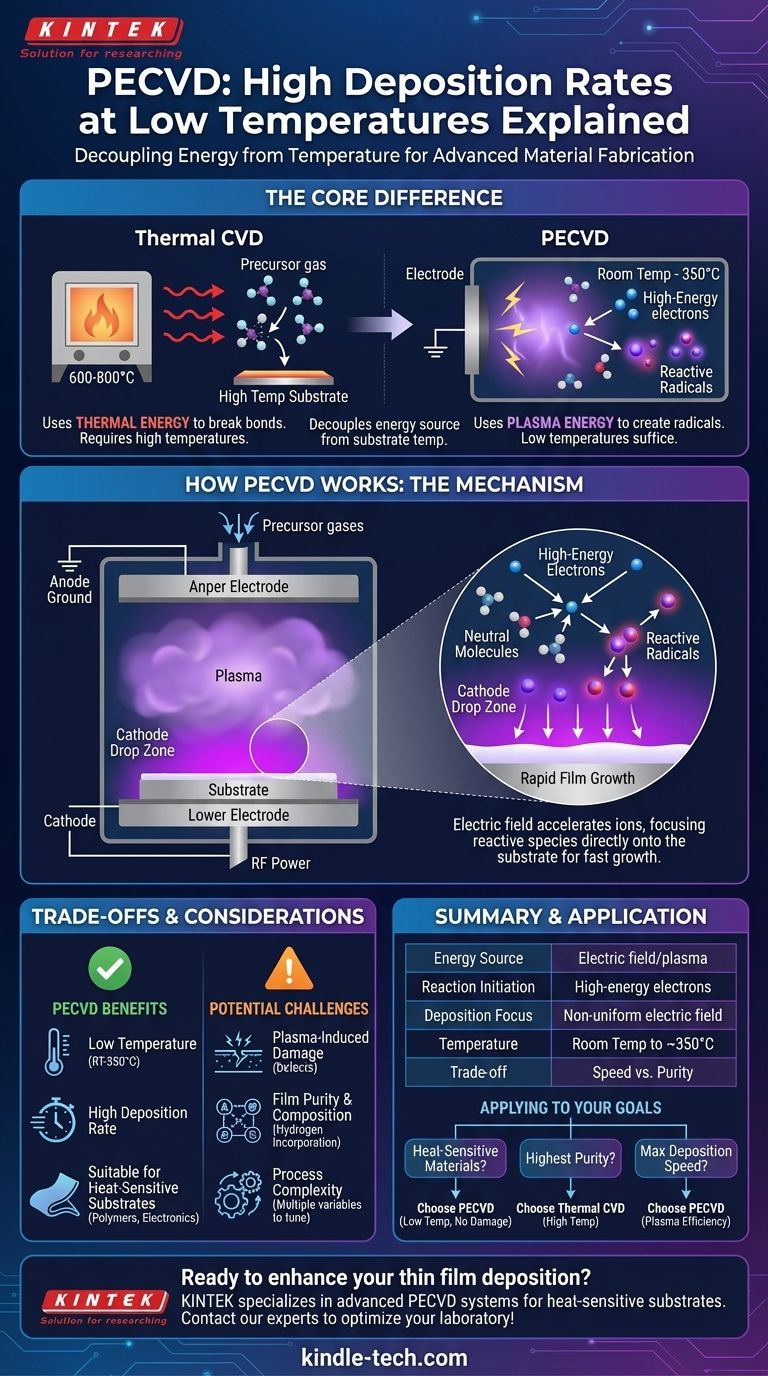
At its core, Plasma-Enhanced Chemical Vapor Deposition (PECVD) achieves high deposition rates at low temperatures because it uses energy from an electric field—not thermal energy—to initiate chemical reactions. A plasma is generated to create highly reactive gas molecules, and an uneven electric field concentrates these reactive species directly onto the substrate surface, accelerating film growth without needing to heat the entire system.

The critical insight is that PECVD decouples the energy source for chemical reactions from the substrate's temperature. Instead of using brute-force heat to break down precursor gases, it uses a plasma to create chemical radicals that are inherently reactive even at low temperatures.
Why PECVD can achieve high deposition rates at relatively low temperature? Unlock Efficient, Low-Temp Film Growth

The Core Problem: Overcoming the Energy Barrier

To understand why PECVD is effective, we must first look at the fundamental challenge of thin film deposition.

The Thermal CVD Approach

Traditional Chemical Vapor Deposition (CVD) relies on high temperatures, often exceeding 600-800°C. This intense heat provides the thermal energy necessary to break the chemical bonds of the precursor gases introduced into the reaction chamber.

The Need for Activation Energy

Once these bonds are broken, the resulting atoms or molecules can deposit onto the substrate and form a solid thin film. Without sufficient energy, the precursor gases remain stable, and no deposition occurs.

How PECVD Changes the Energy Equation

PECVD provides an alternative pathway to supply this activation energy, one that does not rely on heating the substrate to extreme temperatures.

Generating the Plasma: The New Energy Source

The process begins by applying a strong electric field to a low-pressure gas, ionizing it and creating a plasma. This plasma is a partially ionized gas containing a mix of neutral atoms, ions, and—most importantly—high-energy free electrons.

Creating Reactive Species Without Heat

These high-energy electrons collide with the neutral precursor gas molecules. The impact transfers enough energy to break the molecules' chemical bonds, creating highly reactive radicals. This is the key step: the reaction is initiated by energetic electron collisions, not by thermal vibration.

The Role of the Cathode and Electric Field

The substrate is typically placed on the cathode (the negative electrode). The electric field is highly non-uniform and is strongest in a region directly in front of this cathode, known as the cathode drop zone.

This intense field acts like a focusing lens, accelerating ions toward the substrate and concentrating the reactive radicals in the precise location where the film needs to grow. This localization dramatically increases the deposition rate and prevents reactants from being wasted on the chamber walls.

Understanding the Trade-offs

While powerful, the use of a plasma introduces unique considerations and potential downsides compared to purely thermal methods.

Plasma-Induced Damage

The energetic ions from the plasma that bombard the substrate can create defects in the growing film or in the underlying substrate itself. This can impact the material's electrical or optical properties.

Film Purity and Composition

Because the reactions are driven by complex plasma chemistry, it's possible for unwanted elements (like hydrogen from precursor gases) to become incorporated into the film. This can alter the film's density, stress, and stoichiometry.

Process Complexity

Controlling a PECVD process requires careful tuning of multiple variables beyond temperature, including RF power, pressure, gas flow rates, and chamber geometry. This can make process optimization more complex than for a simple thermal furnace.

Applying This to Your Deposition Goal

Understanding this mechanism allows you to make informed decisions based on your primary objective.

  • If your primary focus is deposition on heat-sensitive materials (like polymers or pre-processed electronics): PECVD is the superior choice, as its ability to operate from room temperature to ~350°C prevents substrate damage.
  • If your primary focus is achieving the highest possible film purity and crystalline quality: A high-temperature thermal CVD or annealing process may be necessary, provided your substrate can withstand the heat.
  • If your primary focus is maximizing deposition speed and throughput: PECVD offers excellent rates due to the efficient, localized reaction chemistry driven by the plasma.

By substituting electrical energy for thermal energy, PECVD provides a versatile and efficient path to fabricating advanced materials.

Summary Table:

Key Aspect How PECVD Achieves It
Energy Source Uses electric field/plasma instead of thermal energy.
Reaction Initiation High-energy electrons create reactive radicals from precursor gases.
Deposition Focus Non-uniform electric field concentrates reactive species on the substrate.
Typical Temperature Range Room temperature to ~350°C, ideal for sensitive materials.
Trade-off Potential for plasma-induced damage vs. thermal CVD's high purity.

Ready to enhance your thin film deposition process? KINTEK specializes in advanced lab equipment, including PECVD systems, to help you achieve high deposition rates on heat-sensitive substrates like polymers and pre-processed electronics. Our expertise ensures you get the right solution for your specific material and throughput needs. Contact our experts today to discuss how we can optimize your laboratory's capabilities!

Visual Guide
Why PECVD can achieve high deposition rates at relatively low temperature? Unlock Efficient, Low-Temp Film Growth Visual Guide

Related Products

People Also Ask

Related Products

Inclined Rotary Plasma Enhanced Chemical Vapor Deposition PECVD Equipment Tube Furnace Machine

Inclined Rotary Plasma Enhanced Chemical Vapor Deposition PECVD Equipment Tube Furnace Machine

Upgrade your coating process with PECVD coating equipment. Ideal for LED, power semiconductors, MEMS and more. Deposits high-quality solid films at low temps.

Chemical Vapor Deposition CVD Equipment System Chamber Slide PECVD Tube Furnace with Liquid Gasifier PECVD Machine

Chemical Vapor Deposition CVD Equipment System Chamber Slide PECVD Tube Furnace with Liquid Gasifier PECVD Machine

KT-PE12 Slide PECVD System: Wide power range, programmable temp control, fast heating/cooling with sliding system, MFC mass flow control & vacuum pump.

RF PECVD System Radio Frequency Plasma-Enhanced Chemical Vapor Deposition RF PECVD

RF PECVD System Radio Frequency Plasma-Enhanced Chemical Vapor Deposition RF PECVD

RF-PECVD is an acronym for "Radio Frequency Plasma-Enhanced Chemical Vapor Deposition." It deposits DLC (Diamond-like carbon film) on germanium and silicon substrates. It is utilized in the 3-12um infrared wavelength range.

Customer Made Versatile CVD Tube Furnace Chemical Vapor Deposition Chamber System Equipment

Customer Made Versatile CVD Tube Furnace Chemical Vapor Deposition Chamber System Equipment

Get your exclusive CVD furnace with KT-CTF16 Customer Made Versatile Furnace. Customizable sliding, rotating, and tilting functions for precise reactions. Order now!

Split Chamber CVD Tube Furnace with Vacuum Station Chemical Vapor Deposition System Equipment Machine

Split Chamber CVD Tube Furnace with Vacuum Station Chemical Vapor Deposition System Equipment Machine

Efficient split chamber CVD furnace with vacuum station for intuitive sample checking and quick cooling. Up to 1200℃ max temperature with accurate MFC mass flowmeter control.

Microwave Plasma Chemical Vapor Deposition MPCVD Machine System Reactor for Lab and Diamond Growth

Microwave Plasma Chemical Vapor Deposition MPCVD Machine System Reactor for Lab and Diamond Growth

Get high-quality diamond films with our Bell-jar Resonator MPCVD machine designed for lab and diamond growth. Discover how Microwave Plasma Chemical Vapor Deposition works for growing diamonds using carbon gas and plasma.

Cylindrical Resonator MPCVD Machine System Reactor for Microwave Plasma Chemical Vapor Deposition and Lab Diamond Growth

Cylindrical Resonator MPCVD Machine System Reactor for Microwave Plasma Chemical Vapor Deposition and Lab Diamond Growth

Learn about Cylindrical Resonator MPCVD Machine, the microwave plasma chemical vapor deposition method used for growing diamond gemstones and films in the jewelry and semi-conductor industries. Discover its cost-effective advantages over traditional HPHT methods.

Small Vacuum Heat Treat and Tungsten Wire Sintering Furnace

Small Vacuum Heat Treat and Tungsten Wire Sintering Furnace

The small vacuum tungsten wire sintering furnace is a compact experimental vacuum furnace specially designed for universities and scientific research institutes. The furnace features a CNC welded shell and vacuum piping to ensure leak-free operation. Quick-connect electrical connections facilitate relocation and debugging, and the standard electrical control cabinet is safe and convenient to operate.

VHP Sterilization Equipment Hydrogen Peroxide H2O2 Space Sterilizer

VHP Sterilization Equipment Hydrogen Peroxide H2O2 Space Sterilizer

A hydrogen peroxide space sterilizer is a device that uses vaporized hydrogen peroxide to decontaminate enclosed spaces. It kills microorganisms by damaging their cellular components and genetic material.

1200℃ Controlled Atmosphere Furnace Nitrogen Inert Atmosphere Furnace

1200℃ Controlled Atmosphere Furnace Nitrogen Inert Atmosphere Furnace

Discover our KT-12A Pro Controlled atmosphere furnace - high precision, heavy duty vacuum chamber, versatile smart touch screen controller, and excellent temperature uniformity up to 1200C. Ideal for both laboratory and industrial application.

1200℃ Split Tube Furnace with Quartz Tube Laboratory Tubular Furnace

1200℃ Split Tube Furnace with Quartz Tube Laboratory Tubular Furnace

KT-TF12 split tube furnace: high-purity insulation, embedded heating wire coils, and max. 1200C. Widely used for new materials and chemical vapour deposition.

Non Consumable Vacuum Arc Induction Melting Furnace

Non Consumable Vacuum Arc Induction Melting Furnace

Explore the benefits of Non-Consumable Vacuum Arc Furnace with high melting point electrodes. Small, easy to operate & eco-friendly. Ideal for laboratory research on refractory metals & carbides.

Custom PTFE Wafer Holders for Lab and Semiconductor Processing

Custom PTFE Wafer Holders for Lab and Semiconductor Processing

This is a high-purity, custom-machined PTFE (Teflon) holder, expertly designed for the secure handling and processing of delicate substrates like conductive glass, wafers, and optical components.

1700℃ Laboratory Quartz Tube Furnace with Alumina Tube Tubular Furnace

1700℃ Laboratory Quartz Tube Furnace with Alumina Tube Tubular Furnace

Looking for a high-temperature tube furnace? Check out our 1700℃ Tube Furnace with Alumina Tube. Perfect for research and industrial applications up to 1700C.

Vacuum Sealed Continuous Working Rotary Tube Furnace Rotating Tube Furnace

Vacuum Sealed Continuous Working Rotary Tube Furnace Rotating Tube Furnace

Experience efficient material processing with our vacuum-sealed rotary tube furnace. Perfect for experiments or industrial production, equipped with optional features for controlled feeding and optimized results. Order now.

Laboratory Muffle Oven Furnace Bottom Lifting Muffle Furnace

Laboratory Muffle Oven Furnace Bottom Lifting Muffle Furnace

Efficiently produce batches with excellent temperature uniformity using our Bottom Lifting Furnace. Features two electric lifting stages and advanced temperature control up to 1600℃.

1400℃ Laboratory Quartz Tube Furnace with Alumina Tube Tubular Furnace

1400℃ Laboratory Quartz Tube Furnace with Alumina Tube Tubular Furnace

Looking for a tube furnace for high-temperature applications? Our 1400℃ Tube Furnace with Alumina Tube is perfect for research and industrial use.

High Performance Laboratory Freeze Dryer

High Performance Laboratory Freeze Dryer

Advanced lab freeze dryer for lyophilization, preserving biological & chemical samples efficiently. Ideal for biopharma, food, and research.

Three-dimensional electromagnetic sieving instrument

Three-dimensional electromagnetic sieving instrument

KT-VT150 is a desktop sample processing instrument for both sieving and grinding. Grinding and sieving can be used both dry and wet. The vibration amplitude is 5mm and the vibration frequency is 3000-3600 times/min.

High Performance Laboratory Freeze Dryer for Research and Development

High Performance Laboratory Freeze Dryer for Research and Development

Advanced laboratory freeze dryer for lyophilization, preserving sensitive samples with precision. Ideal for biopharmaceuticals, research & food industries.


Leave Your Message