Blog Beyond Heat: The Controlled Chaos of Chemical Vapor Deposition
Beyond Heat: The Controlled Chaos of Chemical Vapor Deposition

Beyond Heat: The Controlled Chaos of Chemical Vapor Deposition

3 hours ago

The Illusion of Emptiness

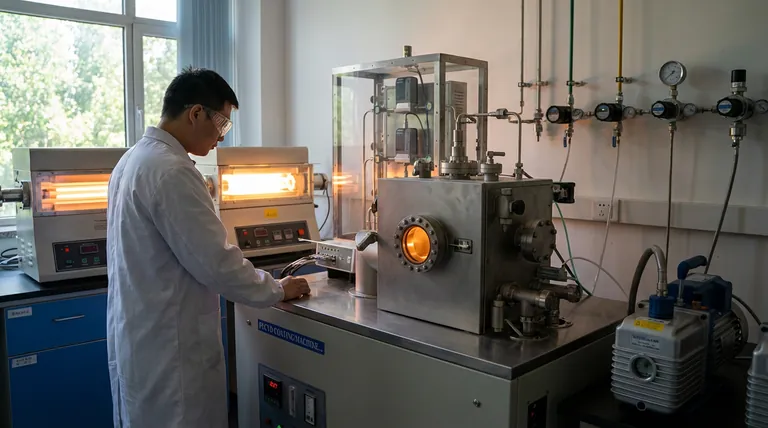
To a casual observer, the process seems deceptively simple. A researcher carefully slides a small, polished substrate into a clear quartz tube, seals the chamber, and presses a button. The furnace begins to glow. It looks like a high-tech oven.

But the real work isn't happening in the heat alone. It's happening in the apparent emptiness.

The magic of a Chemical Vapor Deposition (CVD) tube furnace lies in its mastery over nothingness. It's a system designed not just to bake a material, but to construct a new one, atom by atom, within a meticulously controlled vacuum. This is not metallurgy; it's atomic-scale architecture.

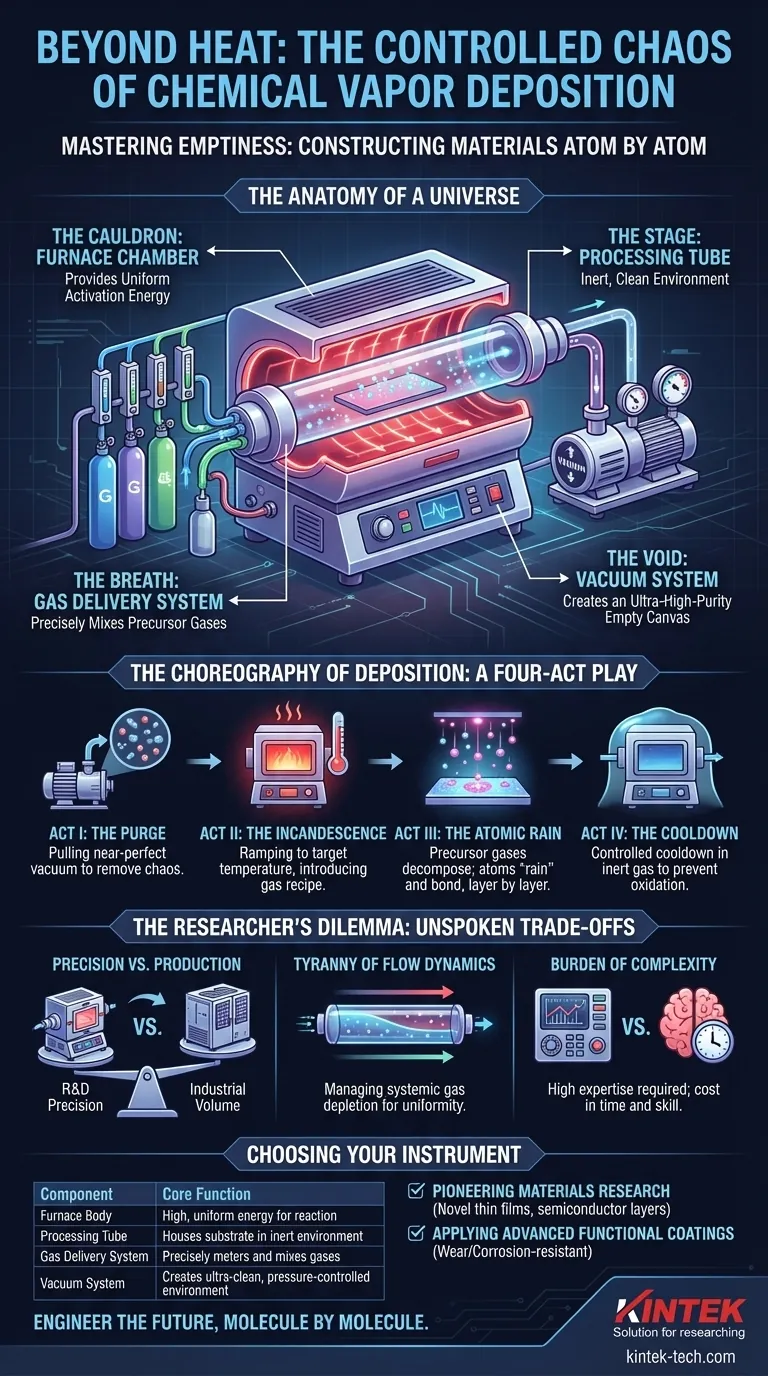
The Anatomy of a Universe

A CVD furnace is less a single machine and more a self-contained ecosystem for material creation. Each component governs a fundamental force—temperature, pressure, and chemical composition—with surgical precision.

The Cauldron: The Furnace Chamber

At the system's heart is a high-temperature furnace. Its job is to provide the raw activation energy needed to break chemical bonds. But its true challenge isn't just getting hot; it's creating a perfectly stable and uniform thermal landscape. Any cold spot or fluctuation is a potential defect in the final atomic structure.

The Stage: The Processing Tube

This tube, typically made of inert quartz or high-purity alumina, is the arena where the drama unfolds. It's more than a container; it's a clean stage, isolated from the outside world. The choice between transparent quartz for lower temperatures and opaque alumina for extreme heat is the first of many critical decisions a researcher makes, trading visibility for resilience.

The Breath: The Gas Delivery System

This is what elevates a furnace to a reactor. A bank of Mass Flow Controllers (MFCs) acts as the lungs of the system. They don't just release gas; they conduct an atomic orchestra, precisely measuring and mixing precursor gases in exact ratios. This flow is the very breath that will form the new material layer.

The Void: The Vacuum System

Before creation, there must be a void. A powerful vacuum pump violently purges the processing tube of every stray particle of air, water, and contaminant. This act creates a pristine, ultra-high-purity environment—an empty canvas essential for ensuring the deposited film is composed of only the intended atoms, and nothing else.

The Choreography of Deposition: A Four-Act Play

Synergizing these components enables a precise, repeatable process for building materials from the ground up.

Act I: The Purge

The substrate is placed, the system sealed. The vacuum pump roars to life, pulling the chamber down to a near-perfect vacuum. The goal is to remove the chemical chaos of our atmosphere, creating a controlled and predictable environment.

Act II: The Incandescence

The furnace ramps to the target temperature, often exceeding 1000°C. Once the thermal environment is stable, the MFCs open with micro-liter precision, introducing a carefully programmed recipe of gases.

Act III: The Atomic Rain

Fueled by the intense heat, the precursor gases decompose. Their atoms, now free, "rain down" and bond with the surface of the substrate. This process continues, layer by atomic layer, slowly building a thin, uniform, and often flawless film with properties the original substrate never had.

Act IV: The Cooldown

Once the desired thickness is achieved, the reactive gas flow stops. The furnace begins a controlled cooldown, often under the protective blanket of an inert gas like argon, to prevent the newly formed layer from oxidizing. The masterpiece is now complete.

The Researcher's Dilemma: Unspoken Trade-Offs

The power of a CVD furnace comes with inherent tensions—trade-offs that every scientist must navigate. This is where the art of the possible meets the laws of physics.

Precision vs. Production

A lab-scale CVD furnace offers almost god-like control over a few square centimeters. This is ideal for R&D. However, scaling this perfection to industrial volumes presents immense challenges. The same principles apply, but the engineering becomes exponentially more complex.

The Tyranny of Flow Dynamics

Achieving a perfectly uniform film is a constant battle against physics. As precursor gases flow down the tube, they are depleted. The substrate at the front of the tube is exposed to a different gas concentration than the substrate at the back. This "depletion effect" is a systemic problem that requires deep process knowledge to mitigate.

The Burden of Complexity

This is not a "set it and forget it" machine. It's a sensitive instrument. The complexity of managing vacuum, gas flows, and thermal profiles requires expertise. The cost is not just in the equipment, but in the time and skill needed to master its operation.

Choosing Your Instrument

The right tool depends entirely on your intent. A CVD system is a specialist, not a generalist.

Component Core Function
Furnace Body Provides high, uniform energy for the chemical reaction.
Processing Tube Houses the substrate in a chemically inert environment.
Gas Delivery System Precisely meters and mixes precursor gases.
Vacuum System Creates an ultra-clean, pressure-controlled environment.
  • For pioneering materials research—synthesizing novel thin films or fabricating semiconductor layers—the granular control of a CVD system is non-negotiable.
  • For applying advanced functional coatings—like wear-resistant or corrosion-resistant layers on high-value parts—it is the essential tool.
  • For simple heat treatment or annealing, a standard tube furnace without the complex gas and vacuum systems is the more logical and cost-effective choice.

Ultimately, a CVD furnace is for those who aren't content with the materials we have, but are driven to create the materials we need. At KINTEK, we understand that these instruments are partners in discovery. We provide the robust, reliable CVD furnace systems that turn atomic-scale theories into tangible realities.

If you are ready to engineer the future, molecule by molecule, Contact Our Experts.

Visual Guide
Beyond Heat: The Controlled Chaos of Chemical Vapor Deposition Visual Guide

Related Products

Related Articles

Related Products

Inclined Rotary Plasma Enhanced Chemical Vapor Deposition PECVD Equipment Tube Furnace Machine

Inclined Rotary Plasma Enhanced Chemical Vapor Deposition PECVD Equipment Tube Furnace Machine

Upgrade your coating process with PECVD coating equipment. Ideal for LED, power semiconductors, MEMS and more. Deposits high-quality solid films at low temps.

HFCVD Machine System Equipment for Drawing Die Nano-Diamond Coating

HFCVD Machine System Equipment for Drawing Die Nano-Diamond Coating

The nano-diamond composite coating drawing die uses cemented carbide (WC-Co) as the substrate, and uses the chemical vapor phase method ( CVD method for short ) to coat the conventional diamond and nano-diamond composite coating on the surface of the inner hole of the mold.

915MHz MPCVD Diamond Machine Microwave Plasma Chemical Vapor Deposition System Reactor

915MHz MPCVD Diamond Machine Microwave Plasma Chemical Vapor Deposition System Reactor

915MHz MPCVD Diamond Machine and its multi-crystal effective growth, the maximum area can reach 8 inches, the maximum effective growth area of single crystal can reach 5 inches. This equipment is mainly used for the production of large-size polycrystalline diamond films, the growth of long single crystal diamonds, the low-temperature growth of high-quality graphene, and other materials that require energy provided by microwave plasma for growth.

Vacuum Hot Press Furnace Machine for Lamination and Heating

Vacuum Hot Press Furnace Machine for Lamination and Heating

Experience clean and precise lamination with Vacuum Lamination Press. Perfect for wafer bonding, thin-film transformations, and LCP lamination. Order now!

1200℃ Split Tube Furnace with Quartz Tube Laboratory Tubular Furnace

1200℃ Split Tube Furnace with Quartz Tube Laboratory Tubular Furnace

KT-TF12 split tube furnace: high-purity insulation, embedded heating wire coils, and max. 1200C. Widely used for new materials and chemical vapour deposition.

Small Vacuum Heat Treat and Tungsten Wire Sintering Furnace

Small Vacuum Heat Treat and Tungsten Wire Sintering Furnace

The small vacuum tungsten wire sintering furnace is a compact experimental vacuum furnace specially designed for universities and scientific research institutes. The furnace features a CNC welded shell and vacuum piping to ensure leak-free operation. Quick-connect electrical connections facilitate relocation and debugging, and the standard electrical control cabinet is safe and convenient to operate.

CVD Diamond Cutting Tool Blanks for Precision Machining

CVD Diamond Cutting Tool Blanks for Precision Machining

CVD Diamond Cutting Tools: Superior Wear Resistance, Low Friction, High Thermal Conductivity for Non-Ferrous Materials, Ceramics, Composites Machining

Laboratory Rapid Thermal Processing (RTP) Quartz Tube Furnace

Laboratory Rapid Thermal Processing (RTP) Quartz Tube Furnace

Get lightning-fast heating with our RTP Rapid Heating Tube Furnace. Designed for precise, high-speed heating and cooling with convenient sliding rail and TFT touch screen controller. Order now for ideal thermal processing!

Graphite Vacuum Furnace IGBT Experimental Graphitization Furnace

Graphite Vacuum Furnace IGBT Experimental Graphitization Furnace

IGBT experimental graphitization furnace, a tailored solution for universities and research institutions, with high heating efficiency, user-friendliness, and precise temperature control.

High Temperature Muffle Oven Furnace for Laboratory Debinding and Pre Sintering

High Temperature Muffle Oven Furnace for Laboratory Debinding and Pre Sintering

KT-MD High temperature debinding and pre-sintering furnace for ceramic materials with various molding processes. Ideal for electronic components such as MLCC and NFC.

Vacuum Heat Treat and Molybdenum Wire Sintering Furnace for Vacuum Sintering

Vacuum Heat Treat and Molybdenum Wire Sintering Furnace for Vacuum Sintering

A vacuum molybdenum wire sintering furnace is a vertical or bedroom structure, which is suitable for withdrawal, brazing, sintering and degassing of metal materials under high vacuum and high temperature conditions. It is also suitable for dehydroxylation treatment of quartz materials.

1400℃ Laboratory High Temperature Tube Furnace with Alumina Tube

1400℃ Laboratory High Temperature Tube Furnace with Alumina Tube

Looking for a tube furnace for high-temperature applications? Our 1400℃ Tube Furnace with Alumina Tube is perfect for research and industrial use.

Laboratory Vacuum Tilt Rotary Tube Furnace Rotating Tube Furnace

Laboratory Vacuum Tilt Rotary Tube Furnace Rotating Tube Furnace

Discover the versatility of Laboratory Rotary Furnace: Ideal for calcination, drying, sintering, and high-temperature reactions. Adjustable rotating and tilting functions for optimal heating. Suitable for vacuum and controlled atmosphere environments. Learn more now!

1700℃ Laboratory High Temperature Tube Furnace with Alumina Tube

1700℃ Laboratory High Temperature Tube Furnace with Alumina Tube

Looking for a high-temperature tube furnace? Check out our 1700℃ Tube Furnace with Alumina Tube. Perfect for research and industrial applications up to 1700C.

Laboratory CVD Boron Doped Diamond Materials

Laboratory CVD Boron Doped Diamond Materials

CVD boron-doped diamond: A versatile material enabling tailored electrical conductivity, optical transparency, and exceptional thermal properties for applications in electronics, optics, sensing, and quantum technologies.

Vacuum Dental Porcelain Sintering Furnace

Vacuum Dental Porcelain Sintering Furnace

Get precise and reliable results with KinTek's Vacuum Porcelain Furnace. Suitable for all porcelain powders, it features hyperbolic ceramic furnace function, voice prompt, and automatic temperature calibration.

1700℃ Muffle Oven Furnace for Laboratory

1700℃ Muffle Oven Furnace for Laboratory

Get superior heat control with our 1700℃ Muffle Furnace. Equipped with intelligent temperature microprocessor, TFT touch screen controller & advanced insulation materials for precise heating up to 1700C. Order now!

Laboratory Sterilizer Lab Autoclave Pulse Vacuum Lifting Sterilizer

Laboratory Sterilizer Lab Autoclave Pulse Vacuum Lifting Sterilizer

The pulse vacuum lifting sterilizer is a state-of-the-art equipment for efficient and precise sterilization. It uses pulsating vacuum technology, customizable cycles, and a user-friendly design for easy operation and safety.

Laboratory Sterilizer Lab Autoclave Vertical Pressure Steam Sterilizer for Liquid Crystal Display Automatic Type

Laboratory Sterilizer Lab Autoclave Vertical Pressure Steam Sterilizer for Liquid Crystal Display Automatic Type

Liquid crystal display automatic vertical sterilizer is a safe, reliable and automatic control sterilization equipment, which is composed of heating system, microcomputer control system and overheating and overvoltage protection system.

Anti-Cracking Press Mold for Lab Use

Anti-Cracking Press Mold for Lab Use

The anti-cracking press mold is a specialized equipment designed for molding various shapes and sizes of film using high pressure and electric heating.


Leave Your Message

















