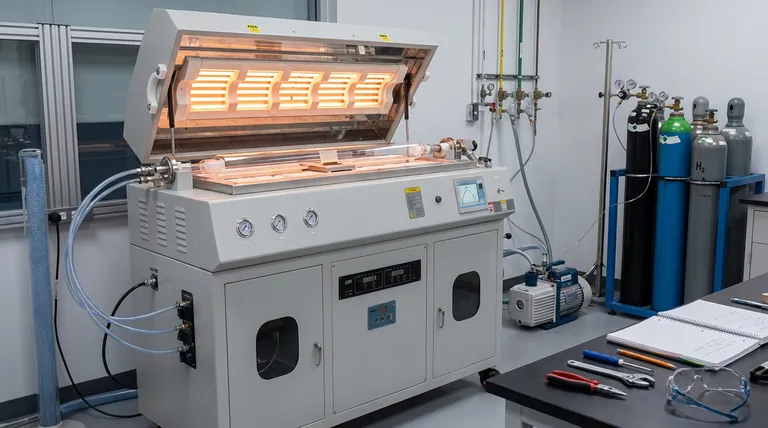
The paradox of the empty chamber
There is a distinct difference between heating something and transforming it.
A standard laboratory oven is a blunt instrument. It applies heat to a sample, hoping for a change in state or structure. It is passive.
A Chemical Vapor Deposition (CVD) tube furnace is active. It is a machine built to orchestrate a paradox: it uses a vacuum to create a void, only to fill it with the building blocks of matter.
It does not merely heat a sample. It creates a meticulously controlled ecosystem where gases interact, decompose, and settle. In this environment, the invisible becomes visible. Gases transform into solid films, layer by atomic layer.
To the engineer, this is not just equipment. It is a reactor.
Anatomy of a Reactor
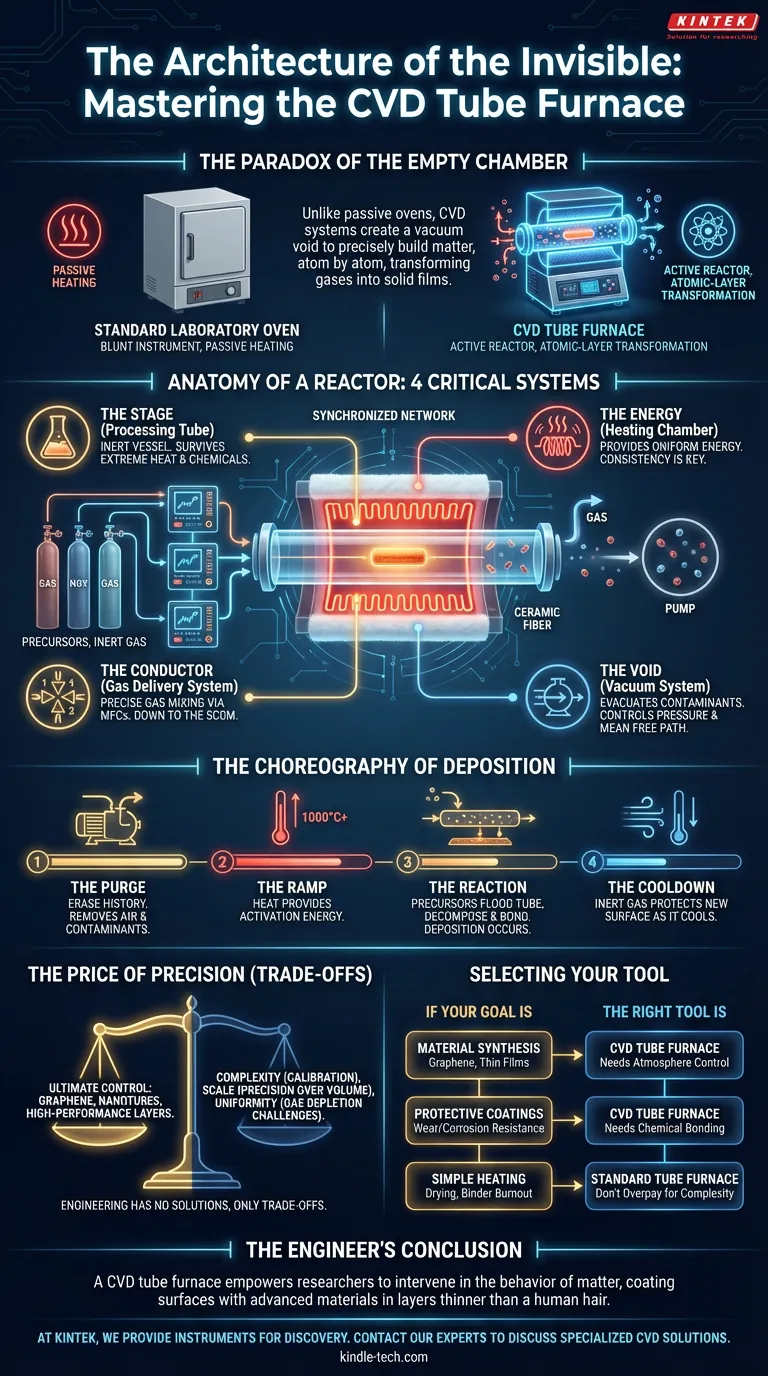
To understand the capability of a CVD system, you must stop viewing it as a furnace. You must view it as a synchronized network of four critical systems.
If one fails, the physics fail.
1. The Stage (The Processing Tube)
At the heart lies the tube. Usually crafted from quartz for lower temperatures or alumina for extreme heat, this is the only part of the machine that touches your sample.
It must be chemically inert. It must survive thermal shock. It is the vessel where the reaction occurs.
2. The Energy (The Heating Chamber)
Surrounding the tube is the heating element, typically insulated with alumina ceramic fiber.
Its job is not just to get hot. Its job is to provide uniform energy. Without thermal consistency, chemical reactions vary across the substrate, leading to structural failure in the coating.
3. The Conductor (The Gas Delivery System)
This is the defining feature of CVD.
Using Mass Flow Controllers (MFCs)—high-precision digital valves—the system introduces precursor gases. It does not guess. It measures flow rates down to the standard cubic centimeter. This allows for the precise mixing required to trigger specific chemical behaviors.
4. The Void (The Vacuum System)
Before you can build, you must clear the site.
The vacuum pump evacuates the tube. It removes oxygen, water vapor, and ambient contaminants. By controlling the pressure, the system dictates the mean free path of gas molecules, influencing the purity and quality of the final film.
The Choreography of Deposition
The process of Chemical Vapor Deposition is a sequence of events where timing is everything.
The Purge First, we erase history. The substrate is placed in the tube, and the vacuum pump removes the ambient air. A single stray molecule of oxygen can ruin a semiconductor layer. The environment must be pristine.
The Ramp The temperature rises, often exceeding 1,000°C. This heat provides the activation energy necessary for the chemical reaction.
The Reaction The MFCs open. Precursor gases flood the tube. Upon hitting the heated zone, they decompose. The atoms do not just float; they bond to the surface of the substrate. This is deposition. It is slow, deliberate, and invisible to the naked eye.
The Cooldown Once the film reaches the desired thickness, the reactive gases stop. Inert gas (like argon) flows in to protect the new surface as it cools.
The Price of Precision
In engineering, there are no solutions, only trade-offs.
The CVD tube furnace offers the ultimate control over material synthesis. It allows for the creation of graphene, carbon nanotubes, and high-performance semiconductor layers.
But this control comes with a cost:
- Complexity: This is not a "plug and play" device. It requires calibration of vacuum levels, gas flows, and thermal gradients.
- Scale: These systems favor precision over volume. They are designed for high-value, small-batch R&D or specialized coating, not mass manufacturing without significant scaling engineering.
- Uniformity: The physics of gas flow means that depletion occurs as gas travels down the tube. Achieving perfect uniformity across a long substrate requires mastery of the process parameters.
Selecting Your Tool
The decision to invest in a CVD system comes down to your objective.
| If your goal is... | The right tool is... |
|---|---|
| Material Synthesis (Graphene, Thin Films) | CVD Tube Furnace. You need the atmosphere control. |
| Protective Coatings (Wear/Corrosion resistance) | CVD Tube Furnace. You need the chemical bonding. |
| Simple Heating (Drying, Binder Burnout) | Standard Tube Furnace. Don't pay for complex gas systems you won't use. |
The Engineer's Conclusion
A CVD tube furnace allows you to intervene in the behavior of matter. It empowers researchers to coat surfaces with materials that are harder than steel or more conductive than copper, all within a layer thinner than a human hair.
It is complex, yes. But for those pushing the boundaries of material science, it is essential.
At KINTEK, we understand the nuance of this equipment. We do not just sell furnaces; we provide the instruments for discovery.
Contact Our Experts today to discuss how our specialized CVD solutions can bring precision to your laboratory.
Visual Guide
Related Products
- Customer Made Versatile CVD Tube Furnace Chemical Vapor Deposition Chamber System Equipment
- Split Chamber CVD Tube Furnace with Vacuum Station Chemical Vapor Deposition System Equipment Machine
- Multi Heating Zones CVD Tube Furnace Machine Chemical Vapor Deposition Chamber System Equipment
- Chemical Vapor Deposition CVD Equipment System Chamber Slide PECVD Tube Furnace with Liquid Gasifier PECVD Machine
- Vacuum Sealed Continuous Working Rotary Tube Furnace Rotating Tube Furnace



















