The Tyranny of the Atmosphere
At room temperature, the air around us feels benign. It’s a mixture of gases we rarely think about. But apply a few hundred degrees of heat, and that invisible, passive environment becomes an aggressive chemical agent.
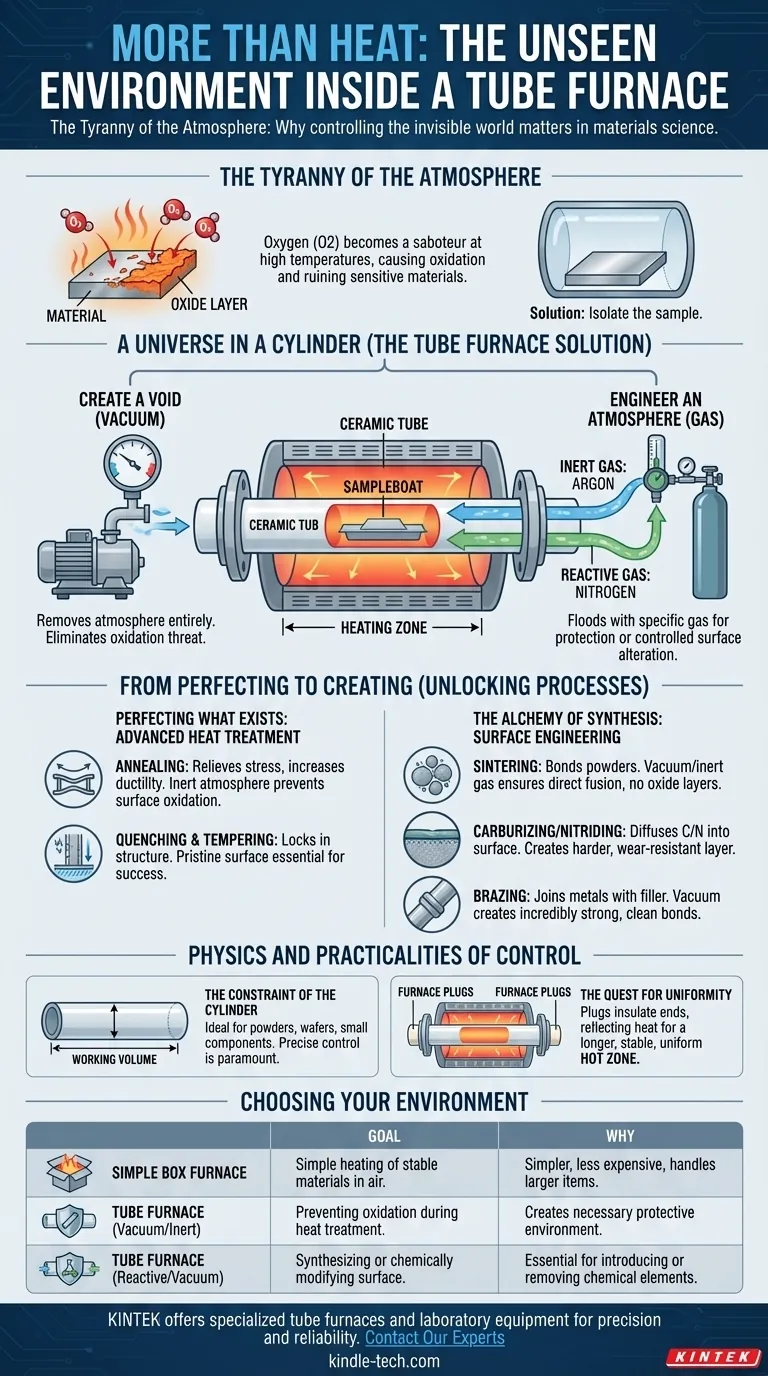
Oxygen, essential for life, becomes a saboteur in materials science. It eagerly reacts with hot surfaces, forming brittle oxide layers, ruining sensitive alloys, and preventing powders from bonding. This is the central challenge in high-temperature processing: it's not just about reaching a target temperature, but about protecting the material from the very air in the room.
This is why the tube furnace was invented. Its true genius is not its ability to get hot, but its ability to create a controlled world in miniature.
A Universe in a Cylinder
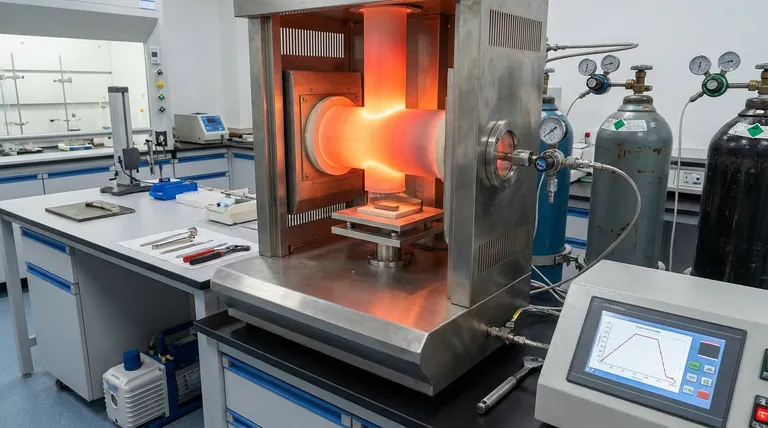
A standard oven heats things in air. A tube furnace fundamentally changes the game by isolating the sample inside a ceramic or quartz tube. This simple design is a gateway to profound control.
By sealing the ends of the tube, an operator can do one of two things:
- Create a Void: Use a vacuum pump to remove the atmosphere entirely, eliminating the threat of oxidation and other unwanted reactions.
- Engineer an Atmosphere: Flood the tube with a specific gas—an inert one like argon to simply protect the sample, or a reactive one like nitrogen to intentionally alter its surface.
This transforms the furnace from a simple heater into a precision instrument for material manipulation. The environment surrounding the sample becomes just as important a variable as the temperature itself.
From Perfecting to Creating
This level of control unlocks processes that are simply impossible in an open-air furnace. We can group them into two categories: perfecting existing materials and creating entirely new ones.
Perfecting What Exists: Advanced Heat Treatment
Many processes aim to refine a material's internal structure to enhance its properties. Performing them in a controlled atmosphere is non-negotiable.
- Annealing: When heating a metal to relieve internal stresses and increase its ductility, an inert atmosphere prevents surface oxidation that would compromise the final product.
- Quenching & Tempering: Rapidly cooling a material to lock in a specific crystalline structure requires a pristine surface. Any oxidation introduced during the heating phase can create failure points.
The Alchemy of Synthesis: Surface Engineering
Here, the tube furnace becomes a tool for creation. By introducing specific gases, we can program the very surface of a material.
- Sintering: Compressing powders and heating them until they bond requires perfectly clean particle surfaces. A vacuum or inert gas environment ensures the particles fuse directly, without a weak oxide layer forming between them.
- Carburizing/Nitriding: This is true surface alchemy. By heating steel in a carbon or nitrogen-rich atmosphere, those elements diffuse into the surface, creating a dramatically harder, wear-resistant outer layer.
- Brazing: Joining metals with a filler material in a vacuum creates an incredibly strong, clean bond because there are no oxides to interfere with the metallurgical connection.
The Physics and Practicalities of Control
The elegant design of a tube furnace comes with specific considerations. These aren't limitations so much as they are consequences of its specialized purpose.
The Constraint of the Cylinder
The tube's diameter defines the working volume. This makes it ideal for processing powders, wafers, wires, and batches of small components where precise atmospheric control is paramount. For large, bulky items where the atmosphere is less critical, a simpler box furnace is the more practical tool.
The Quest for Uniformity
Physics dictates that the ends of the furnace will always be slightly cooler than the center. To solve this, technicians employ a simple but brilliant solution: inserting ceramic furnace plugs into the ends of the tube. These plugs act as insulators, reflecting heat back into the chamber and creating a longer, more stable, and uniform hot zone in the center. It’s a perfect example of pragmatic engineering.
Choosing Your Environment
The decision between a simple box furnace and a tube furnace is a decision about what you need to control.
| Your Primary Goal | The Right Tool | Why |
|---|---|---|
| Simple heating of stable materials in air. | Box Furnace | Simpler, less expensive, and handles larger items. |
| Preventing oxidation during heat treatment. | Tube Furnace (with vacuum or inert gas) | Creates the necessary protective environment. |
| Synthesizing or chemically modifying a material's surface. | Tube Furnace (with reactive gas or vacuum) | Essential for introducing or removing specific chemical elements. |
Ultimately, a tube furnace is for those who understand that in materials science, the invisible world is often what matters most.
For labs looking to master this level of environmental control, KINTEK offers a range of specialized tube furnaces and laboratory equipment designed for precision and reliability. Contact Our Experts
Visual Guide
Related Products
- 1200℃ Controlled Atmosphere Furnace Nitrogen Inert Atmosphere Furnace
- 1700℃ Controlled Atmosphere Furnace Nitrogen Inert Atmosphere Furnace
- Controlled Nitrogen Inert Hydrogen Atmosphere Furnace
- Laboratory Vacuum Tilt Rotary Tube Furnace Rotating Tube Furnace
- Laboratory High Pressure Vacuum Tube Furnace
Related Articles
- Controlled Atmosphere Furnace: Comprehensive Guide to Advanced Heat Treatment
- The Benefits of Controlled Atmosphere Furnaces for Sintering and Annealing Processes
- How Controlled Atmosphere Furnaces Improve Quality and Consistency in Heat Treatment
- The Silent Saboteur in Your Furnace: Why Your Heat Treatment Fails and How to Fix It
- The Importance of Inert Atmosphere Gases in Furnace Atmospheres