The Paradox of Fire
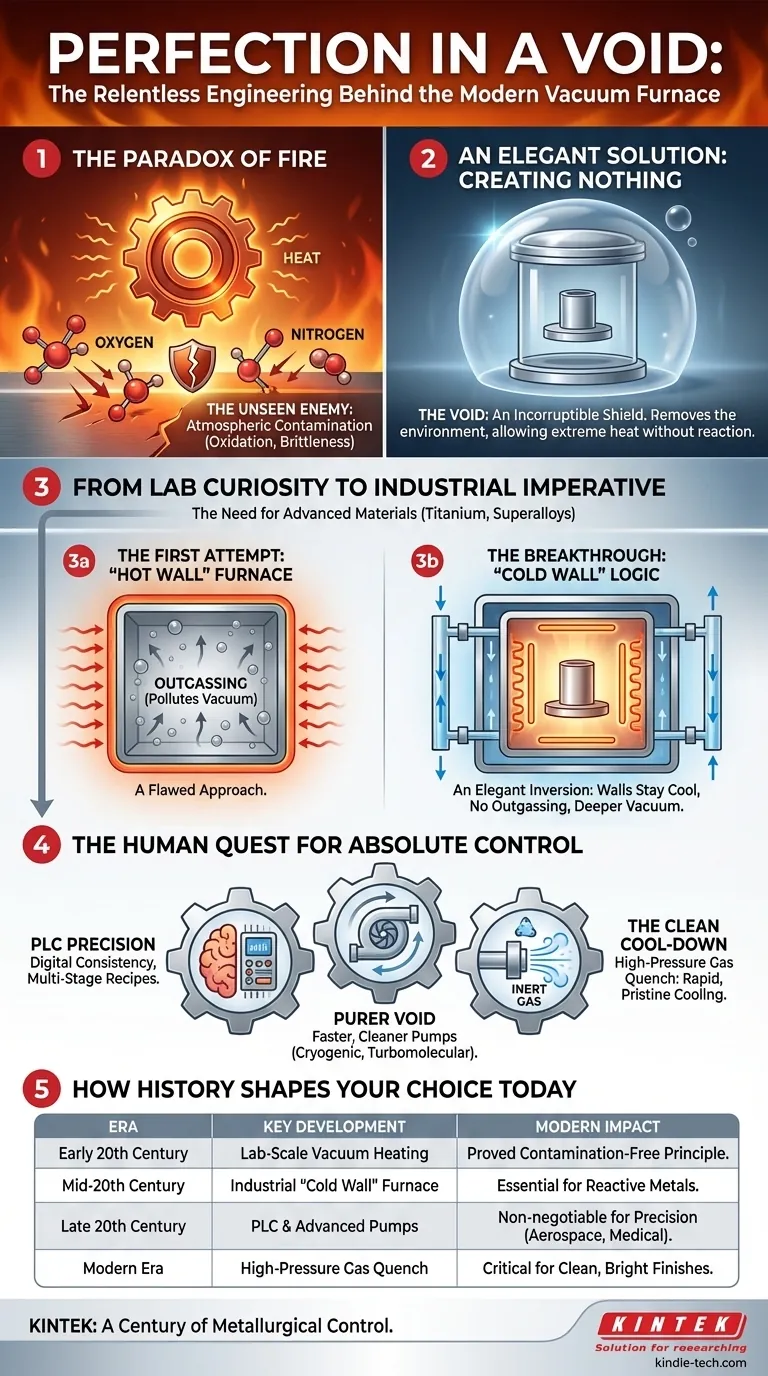
Heat is a tool of creation. It forges, tempers, and strengthens metal. But it also exposes a fundamental vulnerability. The very moment a metal becomes hot enough to be transformed, it also becomes fragile, ready to be corrupted by the air around it.
This is the central paradox that drove a century of innovation. The challenge wasn't just about getting hotter; it was about achieving that heat without letting the material be destroyed by an invisible enemy.
The Unseen Enemy in the Air
When heated to several hundred degrees, a meticulously crafted metal part becomes intensely reactive. The oxygen and nitrogen in our atmosphere, normally benign, turn into aggressive agents of contamination.
They attack the hot surface, causing oxidation—a form of high-temperature rust—and introducing impurities that can make a strong alloy brittle. For a part like a jet engine turbine blade spinning at thousands of RPM, or a surgical implant that must be biocompatible, such contamination is a catastrophic failure waiting to happen.
The problem was fundamental: how do you protect a material from the very environment it exists in?
An Elegant Solution: Creating Nothing
The answer was as radical as it was brilliant: remove the environment entirely.
By placing a part inside a sealed chamber and pumping out the air, you create a near-perfect vacuum. This void acts as an invisible, incorruptible shield. Inside it, the metal can be heated to extreme temperatures, free from the threat of atmospheric attack.
This concept, born in small scientific labs, would go on to redefine the limits of material science.
From Lab Curiosity to Industrial Imperative
The leap from a theoretical principle to an industrial workhorse was driven by necessity. The dawn of the aerospace and nuclear age in the mid-20th century created a sudden, desperate need for new materials—titanium, zirconium, and exotic superalloys.
These metals were miraculously strong and light, but they were also exceptionally reactive. Heating them in a conventional furnace was impossible; they would be ruined instantly. The laboratory vacuum chamber had to grow up, and fast.
The First Attempt: The "Hot Wall" Furnace
Early industrial designs were straightforward. Engineers built a vacuum chamber and heated it from the outside. This "hot wall" approach worked, but it had a fatal flaw.
As the chamber walls themselves got hot, they would release trapped gases—a process called outgassing—polluting the very vacuum they were meant to protect. This limited the ultimate purity and the maximum achievable temperature.
The Breakthrough: The "Cold Wall" Logic
The pivotal innovation was a beautiful piece of counter-intuitive engineering: the "cold wall" furnace.
Instead of heating the chamber, the heating elements were moved inside it. The chamber walls were kept cool with circulating water. This elegant inversion meant the walls never got hot enough to outgas, allowing for far deeper vacuums and much higher temperatures.
The solution wasn't to fight the outgassing problem; it was to design it out of existence. This "cold wall" architecture became the foundation for every modern vacuum furnace.
The Human Quest for Absolute Control
With the fundamental design established, the engineering focus shifted from possibility to perfection. It became a psychological obsession with removing every variable, every element of chance, from the process.
Removing Human Error with PLCs
Early furnaces required a technician's constant, intuitive adjustments. The development of Programmable Logic Controllers (PLCs) replaced this "art" with digital precision. Complex, multi-stage recipes for heating, soaking, and cooling could now be programmed and executed flawlessly every single time, ensuring unparalleled consistency.
Chasing a Purer Void
A furnace is only as good as its vacuum. The evolution from slower oil diffusion pumps to cleaner, faster cryogenic and turbomolecular pumps was a race toward a more perfect "nothing." Better pumps meant deeper vacuums achieved more quickly, resulting in cleaner parts and more efficient production cycles.
The Clean Cool-Down
The final step in achieving purity was to reinvent the cooling process. Traditional oil quenching was fast but messy, dirty, and a fire hazard. The introduction of high-pressure gas quenching—blasting the part with inert gas like argon or nitrogen—provided rapid cooling without any contamination. It was the final piece of the puzzle, ensuring a part emerged from the furnace as pristine as it was strong.
How History Shapes Your Choice Today
This journey from a simple lab experiment to a sophisticated industrial system reveals a clear set of engineering trade-offs. Understanding this history directly informs which tool is right for your work. The challenges of the past define the features of the present.
| Era | Key Development | Modern Application & Impact |
|---|---|---|
| Early 20th Century | Laboratory-scale vacuum heating | Proved the core principle of contamination-free processing. |
| Mid-20th Century | Industrial "Cold Wall" Furnace | Essential for reactive metals (titanium, niobium, superalloys). |
| Late 20th Century | PLC Controls & Advanced Pumps | Non-negotiable for precision in medical and aerospace parts. |
| Modern Era | High-Pressure Gas Quench & Convection | Critical for clean, bright finishes and uniform heating of tool steels. |
The modern vacuum furnace is more than a machine; it is the culmination of a century-long quest for metallurgical control. Each feature is an answer to a hard-won lesson from the past.
At KINTEK, we provide the laboratory-scale vacuum furnaces that embody this legacy. Our systems deliver the precision, purity, and repeatability that modern research and development demand, allowing you to work at the cutting edge of material science. To find the system that matches your specific goals, Contact Our Experts.
Visual Guide
Related Products
- Vacuum Hot Press Furnace Heated Vacuum Press Machine Tube Furnace
- 600T Vacuum Induction Hot Press Furnace for Heat Treat and Sintering
- Vacuum Hot Press Furnace Machine Heated Vacuum Press
- Vacuum Heat Treat Furnace and Levitation Induction Melting Furnace
- 2200 ℃ Tungsten Vacuum Heat Treat and Sintering Furnace
Related Articles
- The Purity Paradox: Choosing the Heart of Your Vacuum Hot Press Furnace
- Comprehensive Guide to Vacuum Hot Press Furnace Application
- Vacuum Hot Press Furnace: A Comprehensive Guide
- Forging Perfection in a Void: The Physics of Ultra-Dense Materials
- Defeating the Void: The Quiet Power of Vacuum Hot Pressing