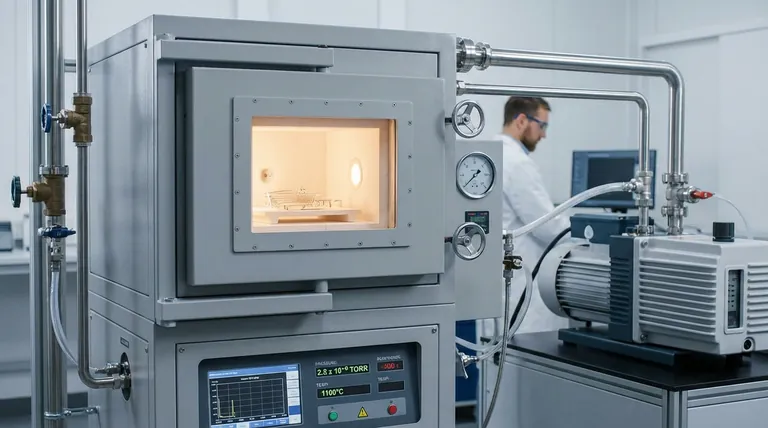
The Weight of Nothing
We tend to think of engineering in terms of addition: adding steel for strength, adding circuits for logic, adding fuel for power.
But in materials science, the most critical step is often subtraction.
In a vacuum furnace, pressure is not merely a dial to be watched. It is a precise architectural variable. It is the art of removing the atmosphere—specifically the chaotic, reactive nature of oxygen—to create a sanctuary where chemistry behaves exactly as we intend.
If you leave the "door open" to the atmosphere, even microscopically, the physics change. Materials oxidize. Bonds fail. The process collapses.
Here is how the best engineers navigate the invisible landscape of vacuum pressure.
Defining the Scale
To control an environment, you must first measure it.
In the context of a vacuum furnace, pressure is simply the force exerted by the air molecules remaining inside the chamber. We measure this in Torr.
- Standard Atmosphere: ~760 Torr (Sea level).
- The Goal: Anything lower than 760 Torr is technically a vacuum.
The "harder" the vacuum, the lower the Torr value, and the fewer molecules remain to interfere with your work.
The Three Theaters of Operation
The pressure level you select dictates the reality inside the furnace. It is not a linear progression of "better," but a specific choice based on the sensitivity of your material.
1. The Rough Vacuum (< 760 to > 1 Torr)
This is the industrial workhorse range. It is not about perfect purity; it is about bulk removal.
We use this for degassing or drying. The goal here is mechanical: get the moisture out, remove the bulk air, and prepare the stage. It is sufficient, cost-effective, and robust.
2. High to Ultra-High Vacuum (< 10⁻⁸ Torr)
This is where the physics gets interesting.
In this range, we are scrubbing the environment of almost every rogue molecule. This is reserved for the most sensitive operations:
- High-purity welding.
- Brazing complex alloys.
- Advanced materials research.
At 10⁻⁸ Torr, you are ensuring that when metal flows, it meets only metal—not oxides, not contaminants.
3. The Counter-Intuitive High Pressure (> 760 Torr)
Sometimes, the solution to a vacuum problem is positive pressure.
Advanced furnaces operate in a two-step dance:
- Pull a deep vacuum to clean the environment.
- Backfill with an inert gas (like Argon) to levels above atmospheric pressure.
This is critical for gas quenching or specific bonding cycles where heat transfer needs to be accelerated or suppressed instantly.
The Psychology of Leaks
The greatest threat to a vacuum furnace is rarely a catastrophic explosion. It is the slow, silent creep of mediocrity caused by a leak.
A negative pressure leak is insidious. It draws atmospheric air into the chamber through a faulty seal or a microscopic crack. Because the furnace is often still "working," operators might ignore the drift.
But chemistry does not ignore it.
The Cost of Drift
If a vacuum pump cannot hold its target, the process is compromised. In sensitive applications—like dental porcelain firing or aerospace brazing—a deviation of a few Torr changes the structural integrity of the final product.
The product looks fine. But inside, it is weak.
Detecting the Invisible
You cannot fix what you cannot see. Troubleshooting requires shifting perspective:
- Observation: Watch the gauge. Instability is the first red flag.
- Inversion: To find a leak, technicians often fill the chamber with a tracer gas (creating positive pressure) and scan the exterior with a helium or hydrogen detector.
Summary of Pressure Ranges
| Vacuum Level | Pressure Range (Torr) | The "Why" (Application) |
|---|---|---|
| Rough Vacuum | < 760 to > 1 | Degassing/Drying: Removing bulk air and moisture. |
| High/Ultra-High | < 10⁻⁸ | Purity: Brazing, welding, and research where oxides are fatal. |
| High Pressure | > 760 | Quenching: Backfilling with inert gas for thermal control. |
The KINTEK Standard
In the laboratory, you are battling entropy. Every variable you fail to control introduces chaos into your results.
At KINTEK, we understand that a vacuum furnace is not just a hot box—it is a precision instrument designed to hold back the weight of the atmosphere. Whether you need the rugged utility of a rough vacuum for drying or the pristine silence of an ultra-high vacuum for advanced R&D, our equipment is engineered to hold the line.
Do not let invisible leaks dictate your quality standards.
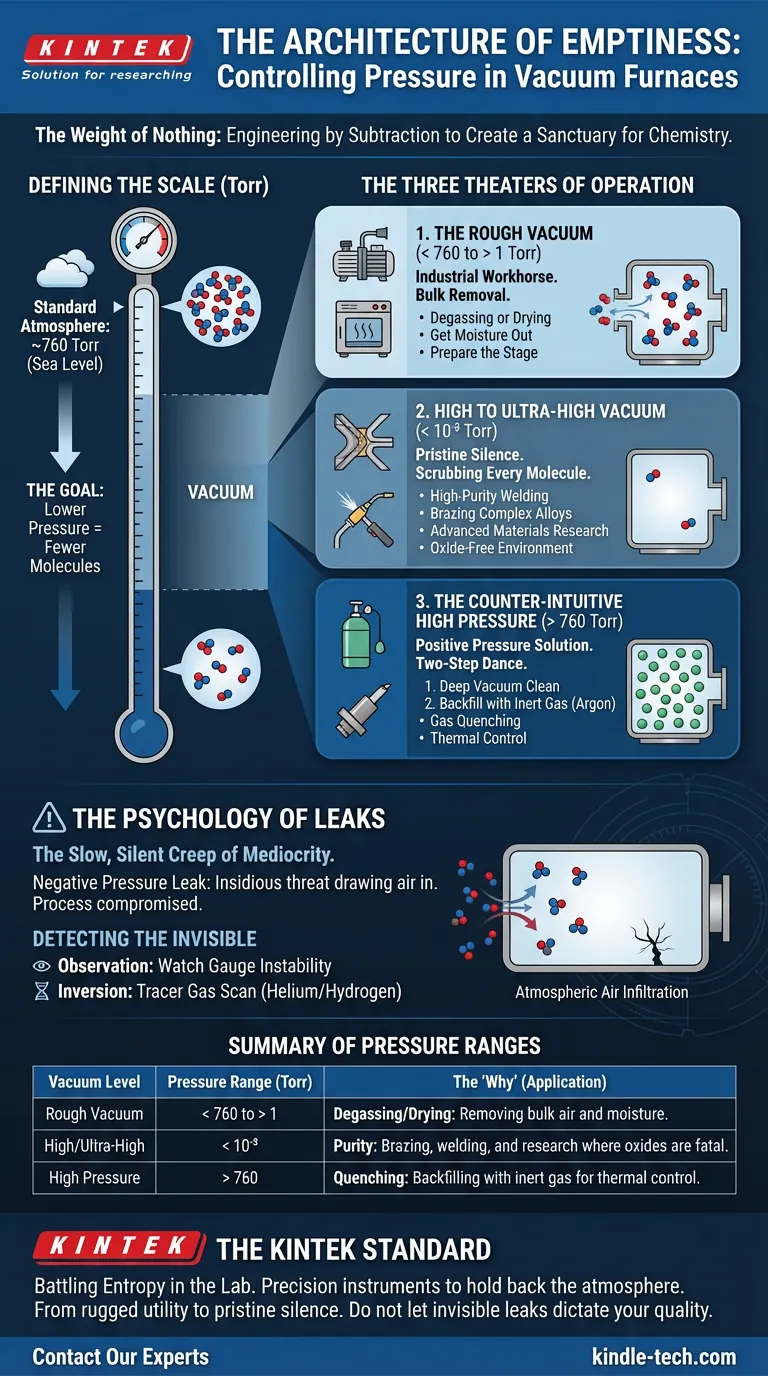
Visual Guide
Related Products
- Vacuum Hot Press Furnace Heated Vacuum Press Machine Tube Furnace
- 600T Vacuum Induction Hot Press Furnace for Heat Treat and Sintering
- Vacuum Hot Press Furnace Machine Heated Vacuum Press
- Vacuum Heat Treat Furnace and Levitation Induction Melting Furnace
- 2200 ℃ Tungsten Vacuum Heat Treat and Sintering Furnace
Related Articles
- The Purity Paradox: Choosing the Heart of Your Vacuum Hot Press Furnace
- Comprehensive Guide to Vacuum Hot Press Furnace Application
- Vacuum Hot Press Furnace: A Comprehensive Guide
- Forging Perfection in a Void: The Physics of Ultra-Dense Materials
- Defeating the Void: The Quiet Power of Vacuum Hot Pressing



















