Blog The Architecture of Silence: Why Negative Pressure Redefines Thermal Safety
The Architecture of Silence: Why Negative Pressure Redefines Thermal Safety

The Architecture of Silence: Why Negative Pressure Redefines Thermal Safety

4 hours ago

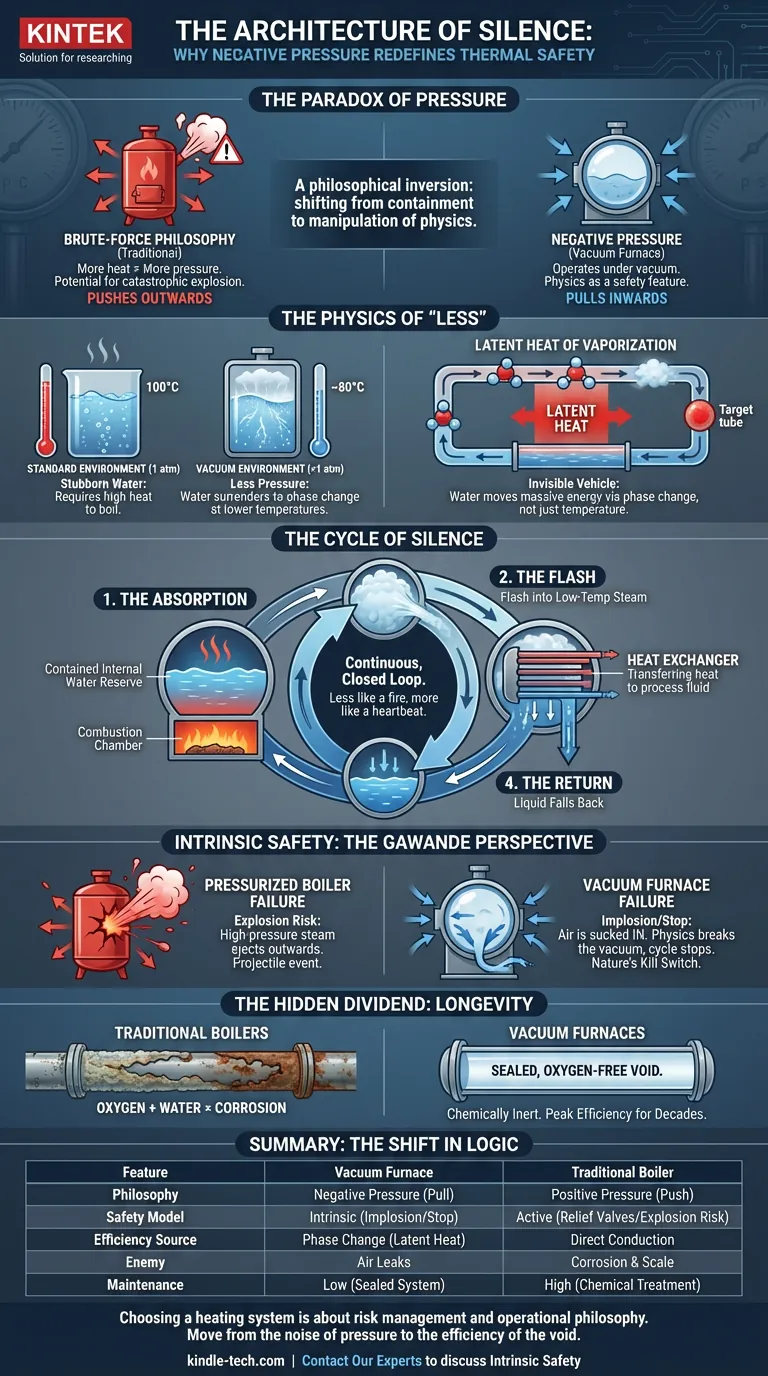
The Paradox of Pressure

In the history of thermal engineering, we have usually solved problems with force.

If we needed more heat, we added more pressure. If we needed to move energy faster, we built thicker walls to contain the potential explosion. The traditional boiler is a testament to this brute-force philosophy. It is effective, but it carries a silent, ever-present threat: the energy wants to get out.

The vacuum furnace represents a philosophical inversion.

Instead of pushing outwards, it pulls inwards. It is a system designed not around the strength of its walls, but around the manipulation of physics. By operating under negative pressure, it turns the laws of thermodynamics into a safety feature rather than a risk factor.

It is safer not because it has better sensors or thicker steel, but because the physics of the system makes a catastrophic explosion impossible.

The Physics of "Less"

To understand the genius of a vacuum furnace, you have to ignore the mechanics for a moment and look at the water.

In a standard environment, water is stubborn. It requires 100°C (212°F) to boil. To get steam that carries significant energy, you usually have to push past this boundary, pressurizing the vessel to superheat the steam.

The vacuum furnace changes the environment rather than the water.

By evacuating the air from the sealed chamber, the internal pressure drops. In this vacuum, water loses its stubbornness. It surrenders to a phase change at much lower temperatures—often around 80°C.

This is the "aha" moment: You are creating steam without the violence of high heat.

The Invisible Vehicle: Latent Heat

The water inside a vacuum furnace is not the product you are heating. It is a vehicle.

This is a critical distinction. The furnace contains a small, fixed amount of highly pure, deaerated water. It never leaves the system. It never touches your process fluid. Its only job is to pick up energy and move it.

It does this through Latent Heat of Vaporization.

When water turns to steam, it swallows a massive amount of energy to make that phase jump. It holds that energy "locked" inside the vapor. When it touches the heat exchanger, it condenses back to liquid, instantly releasing that massive packet of energy into your target system.

It is one of the most efficient transport mechanisms in nature.

The Cycle of Silence

The operation of a vacuum furnace is a continuous, closed loop. It is less like a fire and more like a heartbeat.

1. The Absorption

At the bottom of the vessel, a combustion chamber burns fuel. This heat is transferred not to the air, but to the internal water reserve.

2. The Flash

Because of the vacuum, the water doesn't slowly boil; it flashes into low-temperature steam. It expands rapidly, filling the vacuum chamber.

3. The Exchange

This steam rises and hits the heat exchanger—a bundle of tubes carrying the fluid you actually want to heat. The steam condenses instantly upon contact.

4. The Return

The water, now a liquid again, falls back to the bottom to be reheated.

Intrinsic Safety: The Gawande Perspective

In complex systems, as Atul Gawande often notes, we usually rely on checklists and vigilance to prevent disaster. In a pressurized boiler, safety relies on valves opening and sensors tripping.

A vacuum furnace relies on Intrinsic Safety.

If a pressurized boiler springs a leak, high-pressure steam explodes outward. It is a projectile event.

If a vacuum furnace springs a leak, air is sucked in.

The vacuum is broken. The pressure rises. The water stops boiling because it can no longer boil at low temperatures. The cycle simply stops. The physics that drives the system also acts as its kill switch. You don't need a sensor to tell the water to stop boiling; nature does it for you.

The Hidden Dividend: Longevity

There is a secondary psychological benefit to this system: the absence of decay.

Corrosion is the cancer of heating systems. It requires two things: water and oxygen.

  • Traditional Boilers: Constantly fighting oxygen intake and mineral scale.
  • Vacuum Furnaces: Operate in a sealed, oxygen-free void.

Without oxygen, rust cannot form. Without fresh water intake, mineral scale cannot build up. The environment inside the furnace is chemically inert. This means the equipment doesn't just last longer; it maintains its peak efficiency for decades rather than years.

The Trade-off: Integrity is Everything

No system is perfect. The vacuum furnace trades the risk of explosion for the requirement of integrity.

The seal is the system. If you lose the vacuum, you lose the heater. The vacuum pump is not an accessory; it is the heart monitor of the unit. For engineers used to brute-force heating, this requires a shift in maintenance mindset—focusing on tightness and seals rather than pressure checks and relief valves.

Summary: The Shift in Logic

Feature Vacuum Furnace Traditional Boiler
Philosophy Negative Pressure (Pull) Positive Pressure (Push)
Safety Model Intrinsic (Implosion/Stop) Active (Relief Valves/Explosion Risk)
Efficiency Source Phase Change (Latent Heat) Direct Conduction
Enemy Air Leaks Corrosion & Scale
Maintenance Low (Sealed System) High (Chemical Treatment required)

Conclusion

Choosing a heating system is rarely just about BTUs. It is about risk management and operational philosophy.

If your goal is to simply heat a substance, any boiler will do. But if your goal is to design out risk, eliminate the chemistry of corrosion, and utilize the elegance of phase-change physics, the vacuum furnace is the superior answer. It is a move away from the noise and danger of pressure, toward the efficiency of the void.

At KINTEK, we understand that the best laboratory equipment doesn't just work; it solves the invisible problems of safety and longevity before they ever arise. Contact Our Experts to discuss how our vacuum furnace solutions can bring this intrinsic safety to your laboratory.

Visual Guide
The Architecture of Silence: Why Negative Pressure Redefines Thermal Safety Visual Guide

Related Products

Related Articles

Related Products

Vacuum Heat Treat Sintering Brazing Furnace

Vacuum Heat Treat Sintering Brazing Furnace

A vacuum brazing furnace is a type of industrial furnace used for brazing, a metalworking process that joins two pieces of metal using a filler metal that melts at a lower temperature than the base metals. Vacuum brazing furnaces are typically used for high-quality applications where a strong, clean joint is required.

Vacuum Heat Treat and Molybdenum Wire Sintering Furnace for Vacuum Sintering

Vacuum Heat Treat and Molybdenum Wire Sintering Furnace for Vacuum Sintering

A vacuum molybdenum wire sintering furnace is a vertical or bedroom structure, which is suitable for withdrawal, brazing, sintering and degassing of metal materials under high vacuum and high temperature conditions. It is also suitable for dehydroxylation treatment of quartz materials.

2200 ℃ Tungsten Vacuum Heat Treat and Sintering Furnace

2200 ℃ Tungsten Vacuum Heat Treat and Sintering Furnace

Experience the ultimate refractory metal furnace with our Tungsten vacuum furnace. Capable of reaching 2200℃, perfect for sintering advanced ceramics and refractory metals. Order now for high-quality results.

1200℃ Controlled Atmosphere Furnace Nitrogen Inert Atmosphere Furnace

1200℃ Controlled Atmosphere Furnace Nitrogen Inert Atmosphere Furnace

Discover our KT-12A Pro Controlled atmosphere furnace - high precision, heavy duty vacuum chamber, versatile smart touch screen controller, and excellent temperature uniformity up to 1200C. Ideal for both laboratory and industrial application.

Laboratory Vacuum Tilt Rotary Tube Furnace Rotating Tube Furnace

Laboratory Vacuum Tilt Rotary Tube Furnace Rotating Tube Furnace

Discover the versatility of Laboratory Rotary Furnace: Ideal for calcination, drying, sintering, and high-temperature reactions. Adjustable rotating and tilting functions for optimal heating. Suitable for vacuum and controlled atmosphere environments. Learn more now!

High Pressure Laboratory Vacuum Tube Furnace Quartz Tubular Furnace

High Pressure Laboratory Vacuum Tube Furnace Quartz Tubular Furnace

KT-PTF High Pressure Tube Furnace: Compact split tube furnace with strong positive pressure resistance. Working temp up to 1100°C and pressure up to 15Mpa. Also works under controller atmosphere or high vacuum.

1800℃ Muffle Oven Furnace for Laboratory

1800℃ Muffle Oven Furnace for Laboratory

KT-18 muffle furnace with Japan Al2O3 polycrystalline fibe and Silicon Molybdenum heating element, up to 1900℃, PID temperature control and 7" smart touch screen. Compact design, low heat loss, and high energy efficiency. Safety interlock system and versatile functions.

Laboratory Rapid Thermal Processing (RTP) Quartz Tube Furnace

Laboratory Rapid Thermal Processing (RTP) Quartz Tube Furnace

Get lightning-fast heating with our RTP Rapid Heating Tube Furnace. Designed for precise, high-speed heating and cooling with convenient sliding rail and TFT touch screen controller. Order now for ideal thermal processing!

Ultra-High Temperature Graphite Vacuum Graphitization Furnace

Ultra-High Temperature Graphite Vacuum Graphitization Furnace

The ultra-high temperature graphitization furnace utilizes medium frequency induction heating in a vacuum or inert gas environment. The induction coil generates an alternating magnetic field, inducing eddy currents in the graphite crucible, which heats up and radiates heat to the workpiece, bringing it to the desired temperature. This furnace is primarily used for graphitization and sintering of carbon materials, carbon fiber materials, and other composite materials.

Vacuum Dental Porcelain Sintering Furnace

Vacuum Dental Porcelain Sintering Furnace

Get precise and reliable results with KinTek's Vacuum Porcelain Furnace. Suitable for all porcelain powders, it features hyperbolic ceramic furnace function, voice prompt, and automatic temperature calibration.

1200℃ Split Tube Furnace with Quartz Tube Laboratory Tubular Furnace

1200℃ Split Tube Furnace with Quartz Tube Laboratory Tubular Furnace

KT-TF12 split tube furnace: high-purity insulation, embedded heating wire coils, and max. 1200C. Widely used for new materials and chemical vapour deposition.

Vacuum Heat Treat and Sintering Furnace with 9MPa Air Pressure

Vacuum Heat Treat and Sintering Furnace with 9MPa Air Pressure

The air pressure sintering furnace is a high-tech equipment commonly used for the sintering of advanced ceramic materials. It combines vacuum sintering and pressure sintering techniques to achieve high-density and high-strength ceramics.

1700℃ Muffle Oven Furnace for Laboratory

1700℃ Muffle Oven Furnace for Laboratory

Get superior heat control with our 1700℃ Muffle Furnace. Equipped with intelligent temperature microprocessor, TFT touch screen controller & advanced insulation materials for precise heating up to 1700C. Order now!

Horizontal High Temperature Graphite Vacuum Graphitization Furnace

Horizontal High Temperature Graphite Vacuum Graphitization Furnace

Horizontal Graphitization Furnace: This type of furnace is designed with the heating elements placed horizontally, allowing for uniform heating of the sample. It's well-suited for graphitizing large or bulky samples that require precise temperature control and uniformity.

1400℃ Laboratory High Temperature Tube Furnace with Alumina Tube

1400℃ Laboratory High Temperature Tube Furnace with Alumina Tube

Looking for a tube furnace for high-temperature applications? Our 1400℃ Tube Furnace with Alumina Tube is perfect for research and industrial use.

Vacuum Sealed Continuous Working Rotary Tube Furnace Rotating Tube Furnace

Vacuum Sealed Continuous Working Rotary Tube Furnace Rotating Tube Furnace

Experience efficient material processing with our vacuum-sealed rotary tube furnace. Perfect for experiments or industrial production, equipped with optional features for controlled feeding and optimized results. Order now.

1700℃ Laboratory High Temperature Tube Furnace with Alumina Tube

1700℃ Laboratory High Temperature Tube Furnace with Alumina Tube

Looking for a high-temperature tube furnace? Check out our 1700℃ Tube Furnace with Alumina Tube. Perfect for research and industrial applications up to 1700C.

1400℃ Muffle Oven Furnace for Laboratory

1400℃ Muffle Oven Furnace for Laboratory

Get precise high-temperature control up to 1500℃ with KT-14M Muffle furnace. Equipped with a smart touch screen controller and advanced insulation materials.

1700℃ Controlled Atmosphere Furnace Nitrogen Inert Atmosphere Furnace

1700℃ Controlled Atmosphere Furnace Nitrogen Inert Atmosphere Furnace

KT-17A Controlled atmosphere furnace: 1700℃ heating, vacuum sealing technology, PID temperature control, and versatile TFT smart touch screen controller for laboratory and industrial use.

Laboratory Muffle Oven Furnace Bottom Lifting Muffle Furnace

Laboratory Muffle Oven Furnace Bottom Lifting Muffle Furnace

Efficiently produce batches with excellent temperature uniformity using our Bottom Lifting Furnace. Features two electric lifting stages and advanced temperature control up to 1600℃.


Leave Your Message



















