Blog Why Your Brazed Joints Fail: The Truth About Furnace Temperature and How to Master It
Why Your Brazed Joints Fail: The Truth About Furnace Temperature and How to Master It

Why Your Brazed Joints Fail: The Truth About Furnace Temperature and How to Master It

2 hours ago

You know the feeling. A batch of meticulously prepared components emerges from the brazing furnace. But under inspection, the joints are weak, the filler hasn't flowed correctly, or worse, the base parts are distorted. Another expensive, time-consuming batch is destined for the scrap bin, and you're left wondering what went wrong.

Was the furnace too hot? Too cold? Did you hold it at temperature for too long? It’s a frustrating cycle of guesswork that many labs and production floors know all too well.

The Costly Cycle of Trial and Error

This isn't just a minor technical glitch; it's a significant business problem. When brazing fails, the consequences ripple outwards:

  • Wasted Resources: Expensive materials and hours of skilled labor are lost with every failed batch.
  • Project Delays: Troubleshooting pushes timelines back, delaying product development and delivery schedules.
  • Unreliable Quality: Inconsistent joints create a risk of product failure in the field, damaging your company's reputation and potentially leading to costly recalls.

The common response is to tweak the furnace settings. "Let's add 20 degrees," or "Let's try holding it for five more minutes." Sometimes it seems to work, but the problem always returns. This is because these "solutions" are treating a symptom, not the underlying disease.

The Real Culprit: A Fundamental Misunderstanding of 'Temperature'

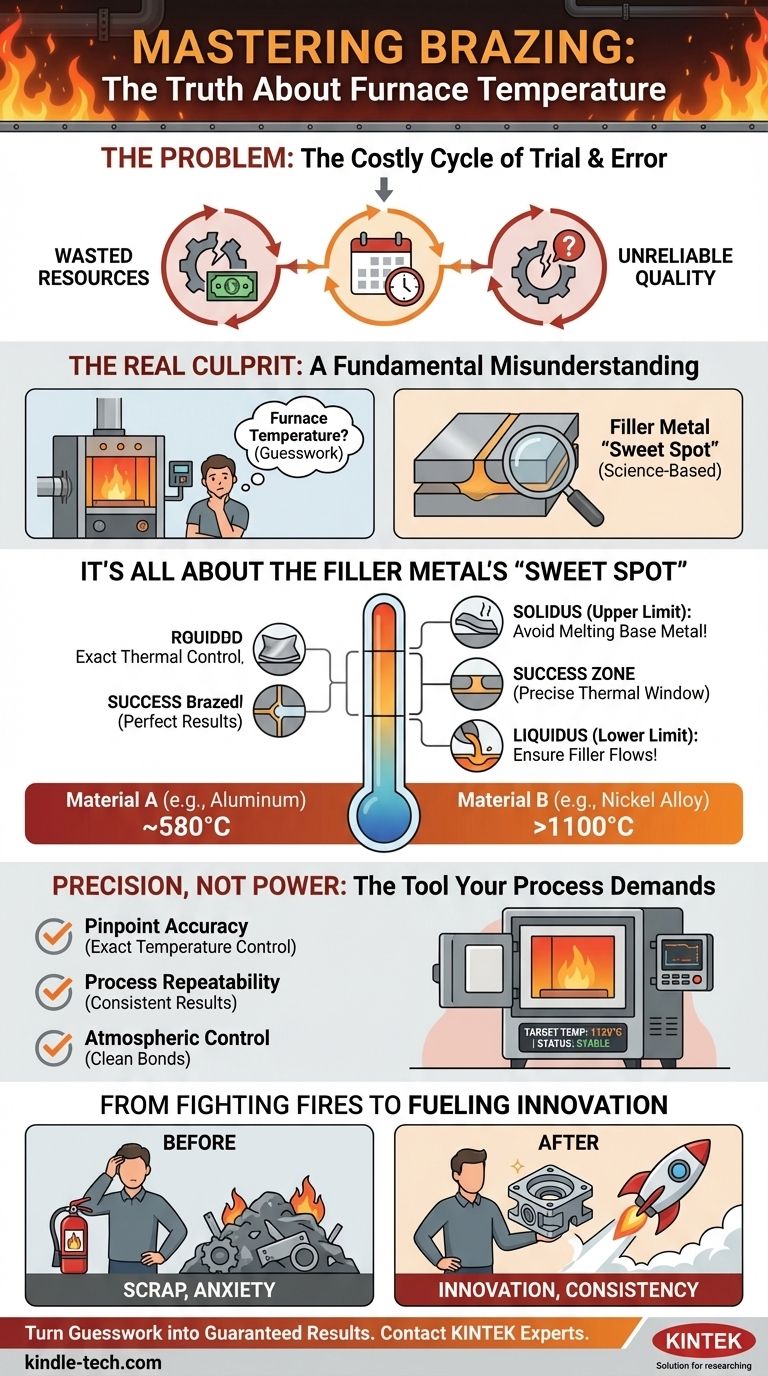
The core reason so many brazing operations struggle is a simple but profound misunderstanding. We ask, "What is the temperature of a brazing furnace?" when we should be asking, "What is the correct melting temperature for my specific filler metal?"

There is no single "correct" temperature for a brazing furnace. The furnace is merely the tool; the materials dictate the process.

It's All About the Filler Metal's "Sweet Spot"

Successful brazing happens in a precise thermal window, defined by two critical points:

  1. The Lower Limit (Liquidus): The furnace must be hot enough to get the filler metal above its liquidus temperature—the point where it becomes fully molten and can flow into the joint via capillary action. If you're too cold, the filler remains slushy, creating voids and a weak bond.

  2. The Upper Limit (Solidus): The temperature must remain safely below the solidus temperature of the base metals you are joining. If you get too hot, you risk melting, warping, or eroding the parts themselves.

Think of it like this: an aluminum alloy filler melts around 580°C, while a high-strength nickel alloy for aerospace needs over 1100°C. Using the same furnace setting for both would be a recipe for guaranteed failure. The "right" temperature is entirely dependent on the materials in your hands.

The reason the trial-and-error approach fails is that it ignores this fundamental principle. You're trying to find a magic number for the tool, instead of listening to what the materials require.

Precision, Not Power: The Tool Your Process Demands

To escape this cycle and achieve flawless, repeatable results, you don't need a furnace that gets hotter. You need a furnace that is smarter and more precise. You need a tool designed to master the material's specific thermal window.

This is precisely why KINTEK's laboratory and industrial furnaces are engineered for exacting thermal control. They are not just heating chambers; they are sophisticated thermal management systems built on a deep understanding of materials science.

  • Pinpoint Accuracy: Our furnaces allow you to set and hold the specific temperature your filler metal demands, ensuring you operate perfectly within that critical liquidus-solidus window. No more guesswork.
  • Process Repeatability: Whether you're brazing aluminum at 600°C or a nickel alloy at 1120°C, you can program the precise thermal profile and repeat it perfectly, batch after batch.
  • Atmospheric Control: Many high-performance brazing operations require a vacuum or inert gas to prevent oxidation. Our furnaces provide this controlled environment, ensuring the filler metal can bond cleanly and effectively with the base materials.

KINTEK equipment isn't just a solution; it's the embodiment of the correct approach to brazing—one that puts material science first.

From Fighting Fires to Fueling Innovation

When you finally solve this persistent problem, you do more than just reduce scrap. You unlock new potential for your entire operation.

Instead of being limited to a few "safe" alloys you've managed to get working, you can confidently explore a wider range of materials to meet more demanding product specifications. Prototyping accelerates from weeks of uncertain tinkering to days of predictable execution. Your production line transforms from a source of anxiety into a model of consistency and reliability. You can take on more complex projects, manufacture higher-value components, and build a powerful reputation for quality.

Don't let the brazing temperature myth hold your projects back any longer. By understanding the core principles and using the right tools, you can turn one of your most frustrating challenges into a competitive advantage. If you're ready to move from guesswork to guaranteed results, our team is here to help you configure the perfect thermal solution for your unique materials and goals. Contact Our Experts.

Visual Guide
Why Your Brazed Joints Fail: The Truth About Furnace Temperature and How to Master It Visual Guide

Related Products

Related Articles

Related Products

Vacuum Heat Treat Sintering Brazing Furnace

Vacuum Heat Treat Sintering Brazing Furnace

A vacuum brazing furnace is a type of industrial furnace used for brazing, a metalworking process that joins two pieces of metal using a filler metal that melts at a lower temperature than the base metals. Vacuum brazing furnaces are typically used for high-quality applications where a strong, clean joint is required.

2200 ℃ Tungsten Vacuum Heat Treat and Sintering Furnace

2200 ℃ Tungsten Vacuum Heat Treat and Sintering Furnace

Experience the ultimate refractory metal furnace with our Tungsten vacuum furnace. Capable of reaching 2200℃, perfect for sintering advanced ceramics and refractory metals. Order now for high-quality results.

Vacuum Heat Treat Furnace with Ceramic Fiber Liner

Vacuum Heat Treat Furnace with Ceramic Fiber Liner

Vacuum furnace with polycrystalline ceramic fiber insulation liner for excellent heat insulation and uniform temperature field. Choose from 1200℃ or 1700℃ max. working temperature with high vacuum performance and precise temperature control.

Graphite Vacuum Furnace High Thermal Conductivity Film Graphitization Furnace

Graphite Vacuum Furnace High Thermal Conductivity Film Graphitization Furnace

The high thermal conductivity film graphitization furnace has uniform temperature, low energy consumption and can operate continuously.

Vacuum Heat Treat and Molybdenum Wire Sintering Furnace for Vacuum Sintering

Vacuum Heat Treat and Molybdenum Wire Sintering Furnace for Vacuum Sintering

A vacuum molybdenum wire sintering furnace is a vertical or bedroom structure, which is suitable for withdrawal, brazing, sintering and degassing of metal materials under high vacuum and high temperature conditions. It is also suitable for dehydroxylation treatment of quartz materials.

Laboratory Quartz Tube Furnace Tubular RTP Heating Furnace

Laboratory Quartz Tube Furnace Tubular RTP Heating Furnace

Get lightning-fast heating with our RTP Rapid Heating Tube Furnace. Designed for precise, high-speed heating and cooling with convenient sliding rail and TFT touch screen controller. Order now for ideal thermal processing!

600T Vacuum Induction Hot Press Furnace for Heat Treat and Sintering

600T Vacuum Induction Hot Press Furnace for Heat Treat and Sintering

Discover the 600T Vacuum Induction Hot Press Furnace, designed for high-temperature sintering experiments in vacuum or protected atmospheres. Its precise temperature and pressure control, adjustable working pressure, and advanced safety features make it ideal for nonmetal materials, carbon composites, ceramics, and metal powders.

Vacuum Dental Porcelain Sintering Furnace

Vacuum Dental Porcelain Sintering Furnace

Get precise and reliable results with KinTek's Vacuum Porcelain Furnace. Suitable for all porcelain powders, it features hyperbolic ceramic furnace function, voice prompt, and automatic temperature calibration.

Small Vacuum Heat Treat and Tungsten Wire Sintering Furnace

Small Vacuum Heat Treat and Tungsten Wire Sintering Furnace

The small vacuum tungsten wire sintering furnace is a compact experimental vacuum furnace specially designed for universities and scientific research institutes. The furnace features a CNC welded shell and vacuum piping to ensure leak-free operation. Quick-connect electrical connections facilitate relocation and debugging, and the standard electrical control cabinet is safe and convenient to operate.

Ultra-High Temperature Graphite Vacuum Graphitization Furnace

Ultra-High Temperature Graphite Vacuum Graphitization Furnace

The ultra-high temperature graphitization furnace utilizes medium frequency induction heating in a vacuum or inert gas environment. The induction coil generates an alternating magnetic field, inducing eddy currents in the graphite crucible, which heats up and radiates heat to the workpiece, bringing it to the desired temperature. This furnace is primarily used for graphitization and sintering of carbon materials, carbon fiber materials, and other composite materials.

1700℃ Laboratory Quartz Tube Furnace with Alumina Tube Tubular Furnace

1700℃ Laboratory Quartz Tube Furnace with Alumina Tube Tubular Furnace

Looking for a high-temperature tube furnace? Check out our 1700℃ Tube Furnace with Alumina Tube. Perfect for research and industrial applications up to 1700C.

Vacuum Hot Press Furnace Machine for Lamination and Heating

Vacuum Hot Press Furnace Machine for Lamination and Heating

Experience clean and precise lamination with Vacuum Lamination Press. Perfect for wafer bonding, thin-film transformations, and LCP lamination. Order now!

Graphite Vacuum Furnace IGBT Experimental Graphitization Furnace

Graphite Vacuum Furnace IGBT Experimental Graphitization Furnace

IGBT experimental graphitization furnace, a tailored solution for universities and research institutions, with high heating efficiency, user-friendliness, and precise temperature control.

1700℃ Muffle Oven Furnace for Laboratory

1700℃ Muffle Oven Furnace for Laboratory

Get superior heat control with our 1700℃ Muffle Furnace. Equipped with intelligent temperature microprocessor, TFT touch screen controller & advanced insulation materials for precise heating up to 1700C. Order now!

Dental Porcelain Zirconia Sintering Ceramic Furnace Chairside with Transformer

Dental Porcelain Zirconia Sintering Ceramic Furnace Chairside with Transformer

Experience top-notch sintering with Chairside Sintering Furnace with Transformer. Easy to operate, noise-free pallet, and automatic temperature calibration. Order now!

Engineering Advanced Fine Ceramics Aluminum Oxide Al2O3 Heat Sink for Insulation

Engineering Advanced Fine Ceramics Aluminum Oxide Al2O3 Heat Sink for Insulation

The hole structure of the ceramic heat sink increases the heat dissipation area in contact with the air, which greatly enhances the heat dissipation effect, and the heat dissipation effect is better than that of super copper and aluminum.

HFCVD Machine System Equipment for Drawing Die Nano-Diamond Coating

HFCVD Machine System Equipment for Drawing Die Nano-Diamond Coating

The nano-diamond composite coating drawing die uses cemented carbide (WC-Co) as the substrate, and uses the chemical vapor phase method ( CVD method for short ) to coat the conventional diamond and nano-diamond composite coating on the surface of the inner hole of the mold.

Laboratory Sterilizer Lab Autoclave Pulse Vacuum Lifting Sterilizer

Laboratory Sterilizer Lab Autoclave Pulse Vacuum Lifting Sterilizer

The pulse vacuum lifting sterilizer is a state-of-the-art equipment for efficient and precise sterilization. It uses pulsating vacuum technology, customizable cycles, and a user-friendly design for easy operation and safety.

Benchtop Laboratory Vacuum Freeze Dryer

Benchtop Laboratory Vacuum Freeze Dryer

Benchtop laboratory freeze dryer for efficient lyophilization of biological, pharmaceutical, and food samples. Features intuitive touchscreen, high-performance refrigeration, and durable design. Preserve sample integrity—consult now!

Laboratory Sterilizer Lab Autoclave Vertical Pressure Steam Sterilizer for Liquid Crystal Display Automatic Type

Laboratory Sterilizer Lab Autoclave Vertical Pressure Steam Sterilizer for Liquid Crystal Display Automatic Type

Liquid crystal display automatic vertical sterilizer is a safe, reliable and automatic control sterilization equipment, which is composed of heating system, microcomputer control system and overheating and overvoltage protection system.


Leave Your Message