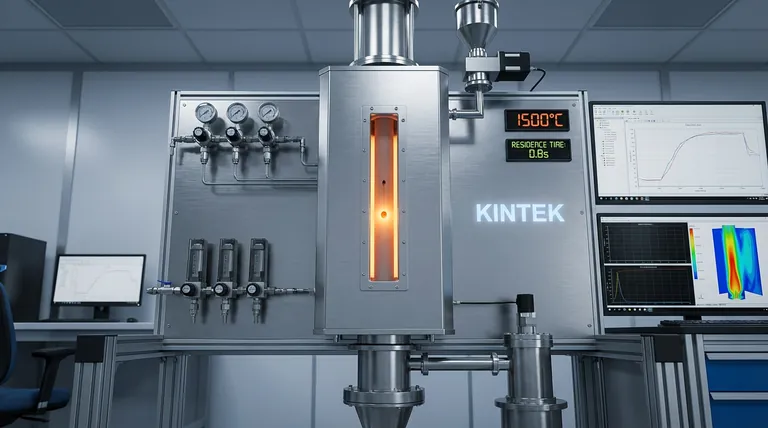
The Chaos of the Boiler
Imagine standing inside the combustion chamber of a commercial power plant. It is a hurricane of fire.
Millions of fuel particles are swirling in turbulent chaos. Heat transfer is non-linear. Fluid dynamics are unpredictable. In this environment, trying to understand the physics of a single particle is like trying to study the aerodynamics of a butterfly inside a tornado.
Yet, the efficiency of that massive system depends entirely on what happens to that single particle.
This creates a fundamental engineering paradox: To understand the massive, you must isolate the microscopic.
Enter the Drop Tube Furnace (DTF).
This is not a tool for production. It is a tool for truth. It strips away the turbulence and noise of the industrial world, leaving only the pure physics of reaction kinetics.
The Engineering Romance of the Vertical Drop
At its core, the DTF is an exercise in gravity and timing.
It is a specialized reactor designed to answer a specific question: What happens to a piece of matter when it falls through hell for exactly one second?
The design is deceptively simple but technically rigorous.
The Theatre of Reaction
The heart of the system is a vertical ceramic tube, often made of alumina. It is surrounded by heating elements capable of maintaining temperatures up to 1500°C.
This is the stage.
The Actor: The Particle
At the top, a precision feeder introduces a micro-stream of powder—coal, biomass, or chemical precursors.
The Atmosphere
Gas inlets flood the tube with a carefully composed atmosphere. It might be inert nitrogen for pyrolysis. It might be oxygen-enriched air for combustion.
As the particle falls, it is not touching walls. It is suspended in the gas, reacting in freefall. This mimics the exact conditions inside a fluidized bed or a pulverized fuel boiler, but without the chaotic interference of neighbors.
Why Time is the Critical Variable
In engineering, time is usually a constraint. In a DTF, time is the product.
The defining characteristic of a drop tube furnace is the residence time.
Gravity pulls the sample through the heated zone in milliseconds to a few seconds. This is critical because high-temperature events—like flash pyrolysis or ignition—happen in the blink of an eye.
If you put these samples in a standard oven, the slow ramp-up rate would ruin the data. You would measure the slow roast, not the flash burn.
The DTF captures the violence of the reaction in real-time.
Bridging the Gap: From Lab to Plant
Data without context is just noise. The DTF provides the context needed to build the world’s largest systems.
Combustion and Emissions
Engineers use DTFs to predict how a specific batch of coal will behave before they buy 50,000 tons of it. They measure char burnout rates and the formation of pollutants like NOx.
Gasification
By removing oxygen from the tube, researchers simulate the creation of syngas. This is vital for the waste-to-energy sector, where understanding how trash turns into fuel at the molecular level dictates the design of the entire plant.
Material Science
Beyond energy, the DTF is used to synthesize advanced ceramics. The rapid heating and cooling cycles can lock in material phases that would revert to lower-energy states if cooled slowly.
The Psychology of Limitations
Every sophisticated tool has a blind spot. Acknowledging the limitation is the mark of a serious engineer.
1. It ignores the crowd. The DTF studies the individual. It cannot simulate particle-to-particle collisions or the heat transfer between a dense cloud of particles. It is an idealized model, not a reality simulator.
2. It refuses to slow down. You cannot force gravity to pause. If your reaction takes 10 minutes, the DTF is useless. The particle will have fallen out of the hot zone long before the reaction finishes.
3. It demands expertise. This is not a "set and forget" benchtop oven. It requires precise calibration of gas flows, feed rates, and collection systems. It is an instrument for the specialist.
Selecting the Right Tool
Understanding your goal is more important than understanding the machine.
Use the logic below to determine if the DTF aligns with your research objectives:
- The Goal is Speed: If you are studying fast kinetics (ignition, flash pyrolysis), the DTF is your only option.
- The Goal is Modelling: If you need data to feed into Computational Fluid Dynamics (CFD) software for boiler design, the DTF provides the necessary intrinsic inputs.
- The Goal is Bulk: If you need to process kilograms of material, stop. Look at a rotary kiln.
- The Goal is Patience: If the reaction is slow (roasting, sintering over hours), use a TGA or a muffle furnace.
Summary of Capabilities
| Feature | Specification |
|---|---|
| Primary Value | Isolation of single-particle kinetics |
| Temperature | Up to 1500°C+ |
| Time Scale | Milliseconds to Seconds |
| Atmosphere | Inert, Oxidizing, or Reducing |
| Best Application | Combustion, Gasification, Rapid Synthesis |
The KINTEK Approach
There is a certain elegance in precision.
At KINTEK, we understand that the quality of your industrial solution depends on the quality of your laboratory data. We do not just sell furnaces; we provide the instruments that allow you to isolate the variable and see the truth.
Whether you are optimizing a gigawatt power plant or developing new ceramic precursors, the right equipment turns theory into result.
Let's discuss how a drop tube furnace can power your research. Contact Our Experts
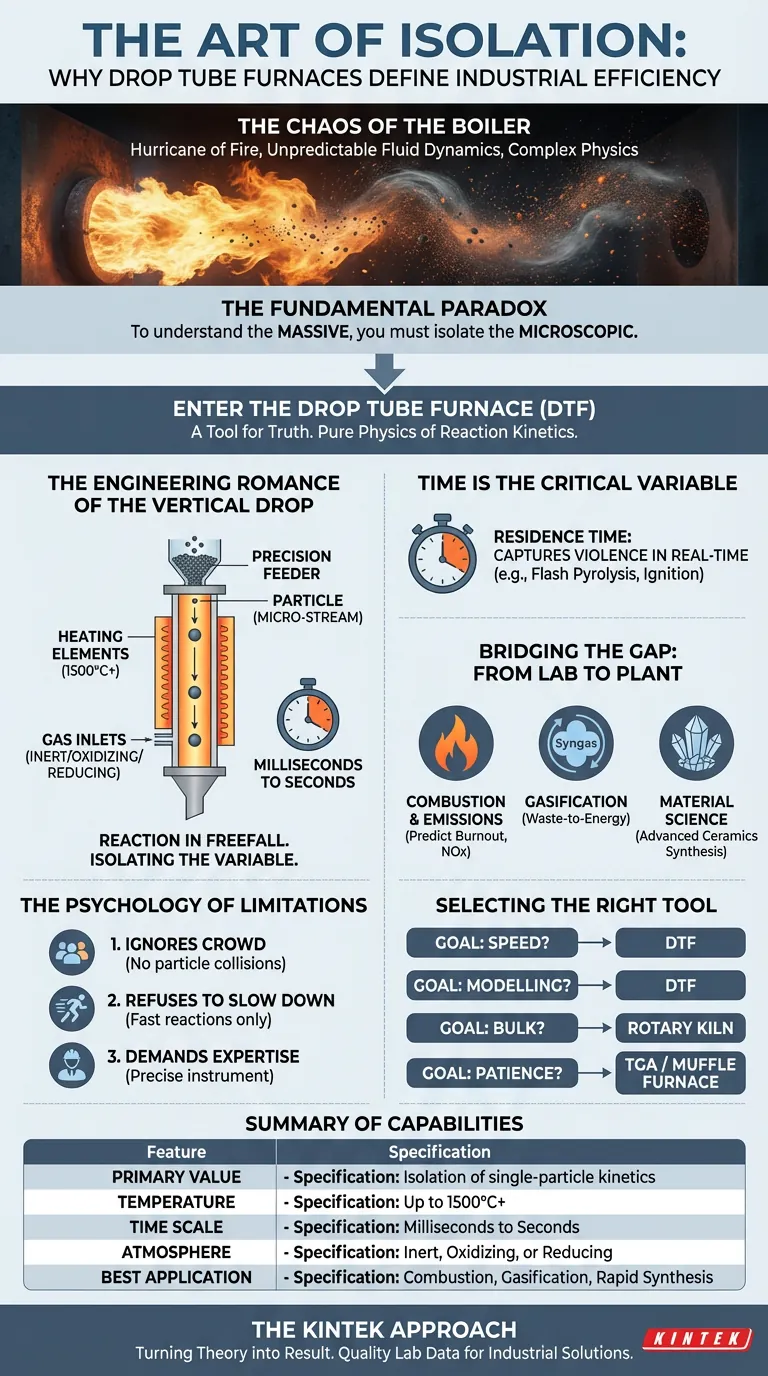
Visual Guide
Related Products
- Rotary Tube Furnace Split Multi Heating Zone Rotating Tube Furnace
- Laboratory Vacuum Tilt Rotary Tube Furnace Rotating Tube Furnace
- Vacuum Sealed Continuous Working Rotary Tube Furnace Rotating Tube Furnace
- 1200℃ Split Tube Furnace with Quartz Tube Laboratory Tubular Furnace
- 1700℃ Laboratory High Temperature Tube Furnace with Alumina Tube
Related Articles
- The Geometry of Heat: Why Motion Matters in Material Synthesis
- Exploring the Functions and Advantages of Rotary Tube Furnaces
- Exploring the Benefits and Applications of Rotary Furnaces: A Comprehensive Guide
- The Physics of Perfection: How Rotary Furnaces Eliminate Randomness in Material Processing
- The Geometry of Heat: Engineering the Perfect Thermal Environment



















