There is a profound difference between a machine’s maximum rating and its sustainable reality.
In the world of high-temperature material science, 1450°C is a critical threshold. It is the point where physics begins to argue with engineering.
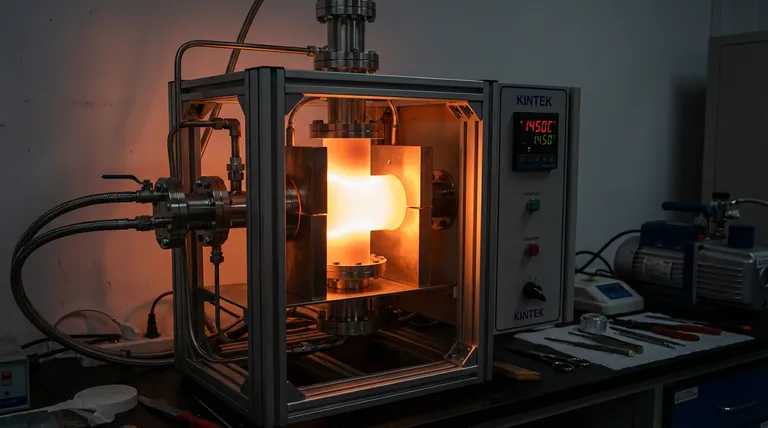
When you push a vacuum tube furnace to this temperature, the fundamental nature of the equipment changes. You are no longer operating a static tool; you are managing a decaying asset.
The furnace doesn't just get hotter. It changes its identity.
The Architecture of Fragility
The central component of these furnaces is the work tube, typically fashioned from high-purity ceramics like alumina. At 1000°C, this tube is a durable structural component—a part of the "house."
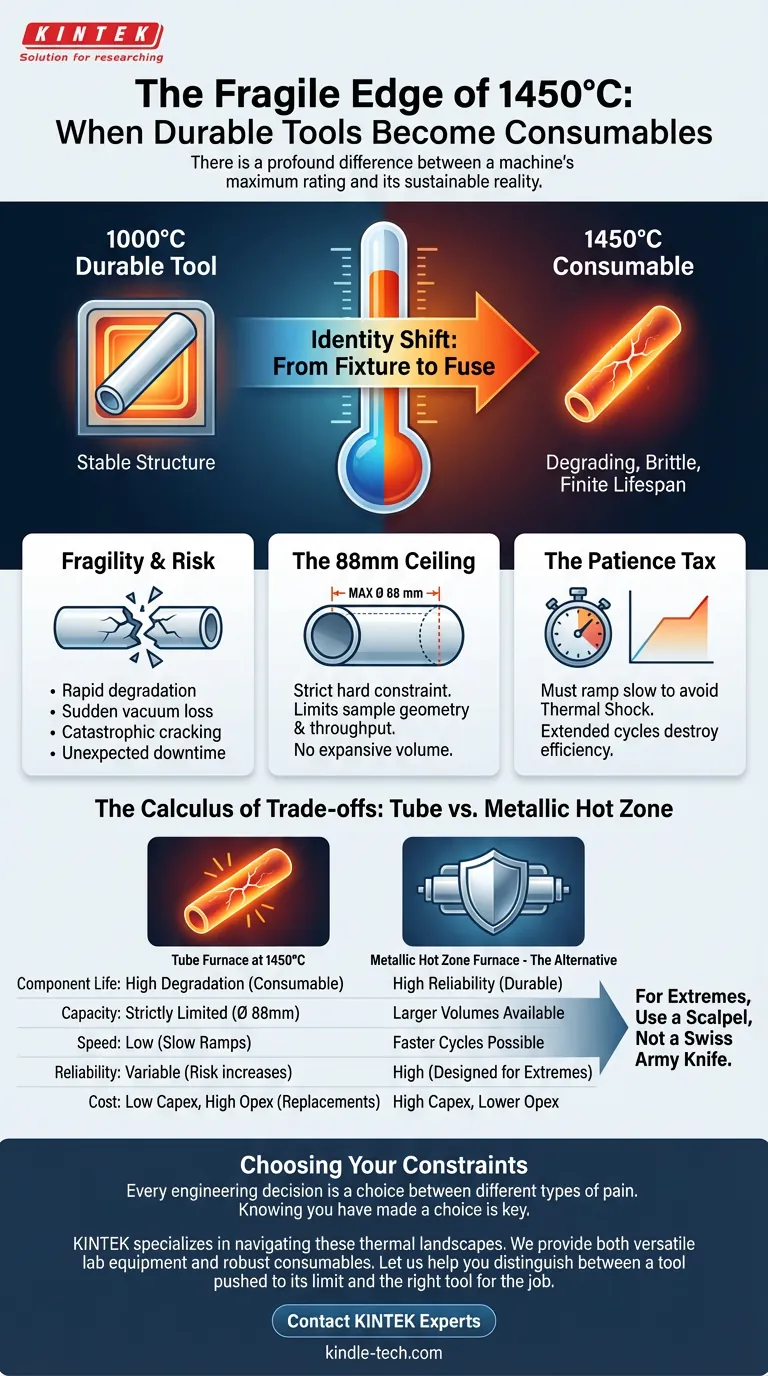
At 1450°C, the tube becomes a consumable.
The thermal load is so extreme that the material structure begins to degrade rapidly. It becomes brittle. It loses its resilience.
The psychological shift for the operator is significant. You must stop viewing the tube as a permanent fixture and start viewing it like a fuse or a filter—something with a finite, predictable lifespan.
If you fail to plan for this mortality, you face:
- Unexpected downtime.
- Sudden vacuum loss.
- Catastrophic cracking during a run.
The 88 Millimeter Ceiling
Stress requires compensation. To survive the intensity of 1450°C, the geometry of the tube must be conservative.
There is no room for expansive volume here. The physics of thermal stress dictate a strict size limitation: a maximum inner diameter of 88 mm.
This is a hard constraint.
It limits the geometry of your samples. It limits your throughput. It forces a trade-off between the temperature you need and the volume you desire. If your application requires processing large components, the tube furnace is not just inefficient; it is physically incapable.
The Patience Tax
High temperature demands slow time.
The most common cause of tube failure isn't the heat itself; it's the change in heat. Thermal shock is the silent killer of ceramics.
To mitigate the stress on a tube that is already near its breaking point, you cannot ramp up quickly. You certainly cannot cool down quickly.
You must pay a "patience tax."
Cycles must be extended. Ramps must be shallow. This protects the equipment, but it destroys efficiency. For a research lab running one experiment a week, this is acceptable. For a production line requiring rapid quenching or high turnover, it is a dealbreaker.
The Calculus of Trade-offs
We often choose tube furnaces because they are versatile generalists. They are the Swiss Army Knives of the lab.
But at 1450°C, you don't need a Swiss Army Knife. You need a scalpel.
When the limitations of the tube furnace become obstructions, the solution is often a Metallic Hot Zone Furnace.
Built with molybdenum and reflective shielding rather than fiber insulation, these systems are designed for the extremes. They provide a purer vacuum and handle heat without the degradation issues of ceramics. They replace "versatility" with "reliability."
Here is how the trade-offs look when laid out:
| Feature | Tube Furnace at 1450°C | The Reality |
|---|---|---|
| Component Life | High degradation | The tube is a consumable item. |
| Capacity | Strictly limited | Max inner diameter of 88 mm. |
| Speed | Low | Requires slow thermal ramping to prevent cracking. |
| Reliability | Variable | Risk of failure increases with every cycle. |
| Cost | Low Capex, High Opex | Replacement tubes drive up long-term costs. |
Choosing Your Constraints
Every engineering decision is a choice between different types of pain.
You can choose the pain of higher initial investment (a metallic hot zone furnace) to gain reliability and volume.
Or, you can choose the pain of operational limitations (the tube furnace) to save on upfront costs, provided you accept the small sample sizes and the consumable nature of the tube.
The danger lies in not knowing you have made a choice.
At KINTEK, we specialize in navigating these thermal landscapes. We provide both the versatile lab equipment for research and the robust consumables required to keep them running. We help you distinguish between a tool that is pushed to its limit and the right tool for the job.
Don't let physics surprise you. Contact Our Experts today to discuss whether your process needs a new tube or a new approach.
Visual Guide
Related Products
- Vacuum Sealed Continuous Working Rotary Tube Furnace Rotating Tube Furnace
- Laboratory High Pressure Vacuum Tube Furnace
- Laboratory Vacuum Tilt Rotary Tube Furnace Rotating Tube Furnace
- Split Chamber CVD Tube Furnace with Vacuum Station Chemical Vapor Deposition System Equipment Machine
- 1200℃ Controlled Atmosphere Furnace Nitrogen Inert Atmosphere Furnace
Related Articles
- Unlocking Efficiency: The Ultimate Guide to Rotary Tube Furnaces
- Unlocking Efficiency: Exploring the Advantages and Applications of Rotary Tube Furnaces
- Exploring Rotary Tube Furnaces: A Comprehensive Guide
- Exploring the Functions and Advantages of Rotary Tube Furnaces
- The Geometry of Heat: Engineering the Perfect Thermal Environment