An aerospace engineer inspects a newly forged turbine blade. A biomedical technician validates a batch of sterile titanium implants. In both scenarios, success isn't just about shaping material; it's about achieving atomic-level integrity. The invisible force ensuring this perfection resides deep inside the vacuum furnace, in a component known as the hot zone.
The hot zone isn't merely the part of the furnace that gets hot. That's a dramatic understatement. It is an engineered thermal system—a furnace within a furnace—designed with a singular, elegant purpose: to create a perfect, isolated universe of heat.
The Island of Fire in a Sea of Cold
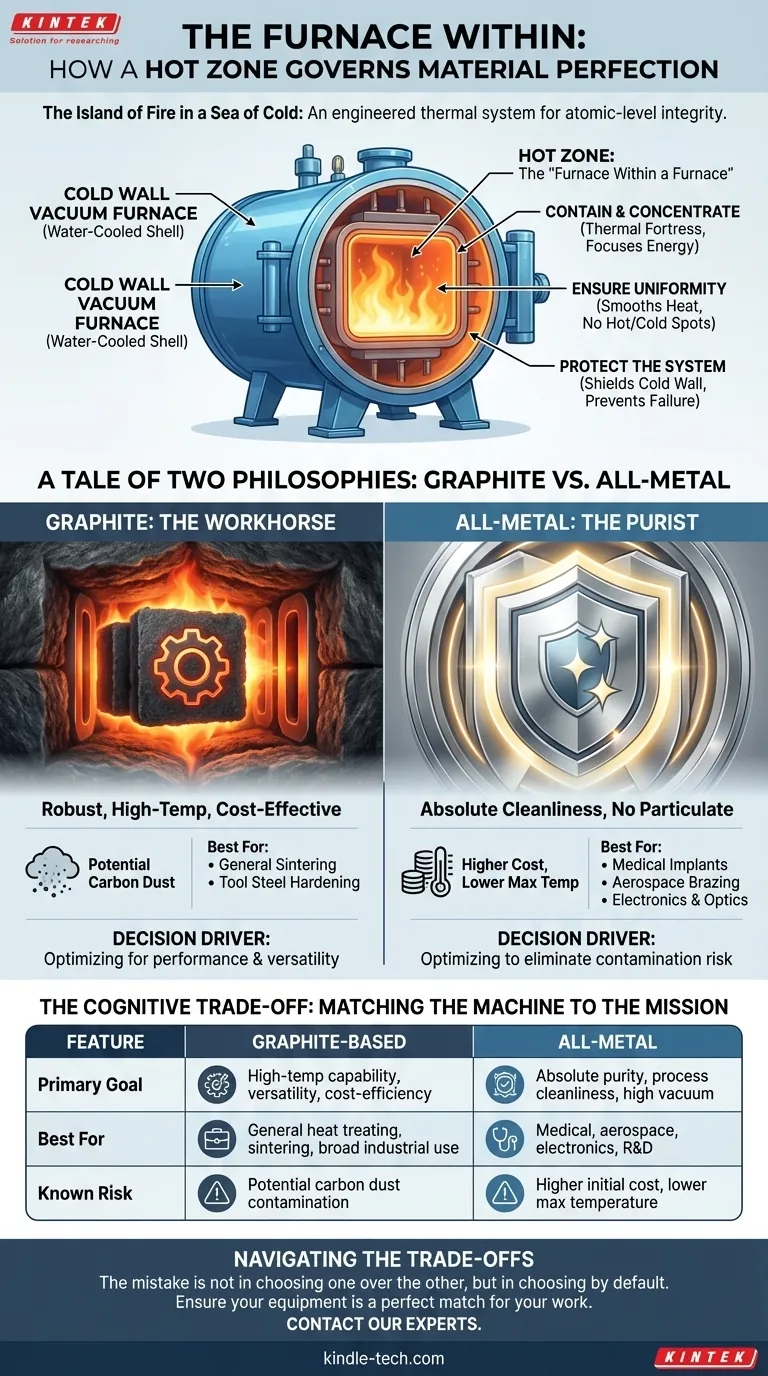
A vacuum furnace is, by necessity, a "cold wall" vessel. Its outer steel shell is water-cooled to maintain structural integrity and protect the vacuum seals from thousands of degrees of internal heat.
Suspended inside this cold void is the hot zone. This internal chamber is a masterpiece of thermal engineering, tasked with three critical functions:
- Contain & Concentrate: It acts as a thermal fortress. Layers of advanced insulation reflect and trap radiant energy, focusing every watt generated by the heating elements directly onto the workpiece. This efficiency is the key to reaching extreme temperatures.
- Ensure Uniformity: By containing this energy, the hot zone creates a stable thermal environment. It smooths out hot spots and cold spots, bathing the entire workpiece in a uniform, predictable heat. For processes like annealing or brazing, this isn't a luxury; it's the fundamental requirement for success.
- Protect the System: Most importantly, it serves as a shield. The hot zone protects the larger furnace structure from the brutal temperatures within, preventing catastrophic failure and ensuring the entire system can operate reliably.
A Tale of Two Philosophies: Graphite vs. All-Metal
The materials used to build this internal furnace represent two distinct engineering philosophies. This choice is the most consequential decision you will make, as it dictates the furnace's capabilities, cleanliness, and ultimately, its suitability for your mission.
The Workhorse: The Case for Graphite
Graphite-based hot zones, using rigid felt insulation and graphite heating elements, are the industry standard for a reason. They are robust, exceptionally capable at high temperatures, and cost-effective. They are the reliable workhorses for countless applications like tool steel hardening and general sintering.
But this power comes with a known compromise: the potential for fine carbon dust. For many, this is a non-issue. For some, it is a deal-breaker. This isn't a flaw; it's a characteristic of the material that must be factored into the risk equation.
The Purist: The Case for an All-Metal Design
All-metal hot zones are built from layers of reflective metals like molybdenum and tungsten. They don't insulate by trapping heat in a mass, but by reflecting it with mirrored efficiency.
Their core philosophy is absolute cleanliness.
They produce no particulate matter, making them the only choice for applications where even microscopic contamination is unacceptable:
- Medical Implants: Where any foreign particle could cause a biological rejection.
- Aerospace Brazing: Where carbon could compromise the integrity of a critical alloy joint.
- Electronics & Optics: Where purity is essential for performance.
This purity comes at a higher initial cost and typically a lower maximum operating temperature. It is a specialized tool for when "good enough" is the sworn enemy of perfect.
The Cognitive Trade-Off: Matching the Machine to the Mission
Choosing a hot zone isn't just about reading a spec sheet. It's a psychological exercise in defining your priorities and understanding second-order consequences. The decision hinges on one question: What is the true cost of failure for your specific application?
| Feature | Graphite-Based Hot Zone | All-Metal Hot Zone |
|---|---|---|
| Primary Goal | High-temperature capability, versatility, cost-efficiency. | Absolute purity, process cleanliness, high vacuum. |
| Best For | General heat treating, sintering, broad industrial use. | Medical, aerospace, electronics, R&D. |
| Known Risk | Potential for carbon dust contamination. | Higher initial cost, lower maximum temperature. |
| Decision Driver | You are optimizing for performance across a wide range of tasks. | You are optimizing to eliminate a specific contamination risk. |
The mistake is not in choosing one over the other, but in choosing by default. An engineer who defaults to a graphite system for a sensitive medical alloy is unknowingly betting against contamination. An R&D lab that over-specifies an all-metal system for basic steel treatment is sacrificing budget and temperature range for a level of purity it doesn't need.
The hot zone is the heart of your thermal process. Its design philosophy must align perfectly with your own goals for material perfection. Navigating these trade-offs requires a deep understanding of both the materials and the mission.
To ensure your equipment is a perfect match for your work, Contact Our Experts.
Visual Guide
Related Products
- 2200 ℃ Tungsten Vacuum Heat Treat and Sintering Furnace
- Vacuum Hot Press Furnace Heated Vacuum Press Machine Tube Furnace
- Vacuum Hot Press Furnace Machine Heated Vacuum Press
- 600T Vacuum Induction Hot Press Furnace for Heat Treat and Sintering
- Vacuum Heat Treat and Pressure Sintering Furnace for High Temperature Applications
Related Articles
- The Architecture of Extremes: Mastering the Thermal Ceiling
- Exploring Tungsten Vacuum Furnaces: Operation, Applications, and Advantages
- Your Tungsten Furnace Is Failing. The Culprit Isn't What You Think.
- Classification, Applications, and Components of High-Temperature Vacuum Furnaces
- High-Temperature Vacuum Furnace: Classification, Applications, and Components