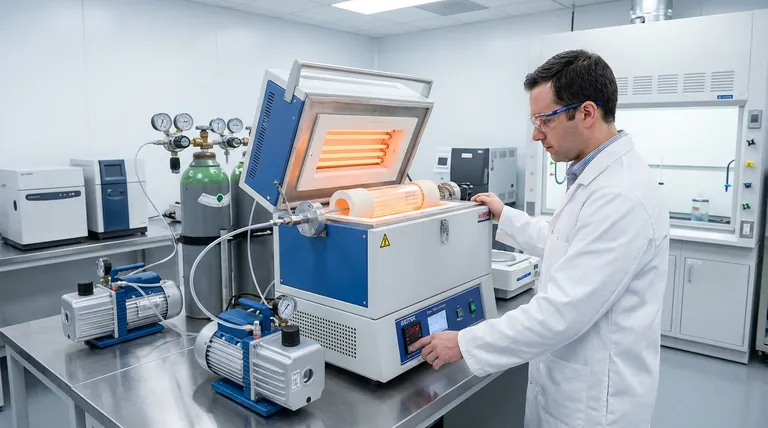
The Illusion of Power
In engineering, we often mistake power for precision.
We assume that to change a material, we simply need to blast it with energy. But in the microscopic world of material science, brute force is rarely the answer. Heat is easy. Anyone can build a fire.
Control is hard.
The difference between a lump of charcoal and a synthetic diamond isn't just temperature. It is the environment in which that temperature is applied.
This is the engineer’s romance with the tube furnace. It is not merely an oven; it is a sanctuary. It is a device designed to isolate a small piece of the universe and impose strict order upon it.
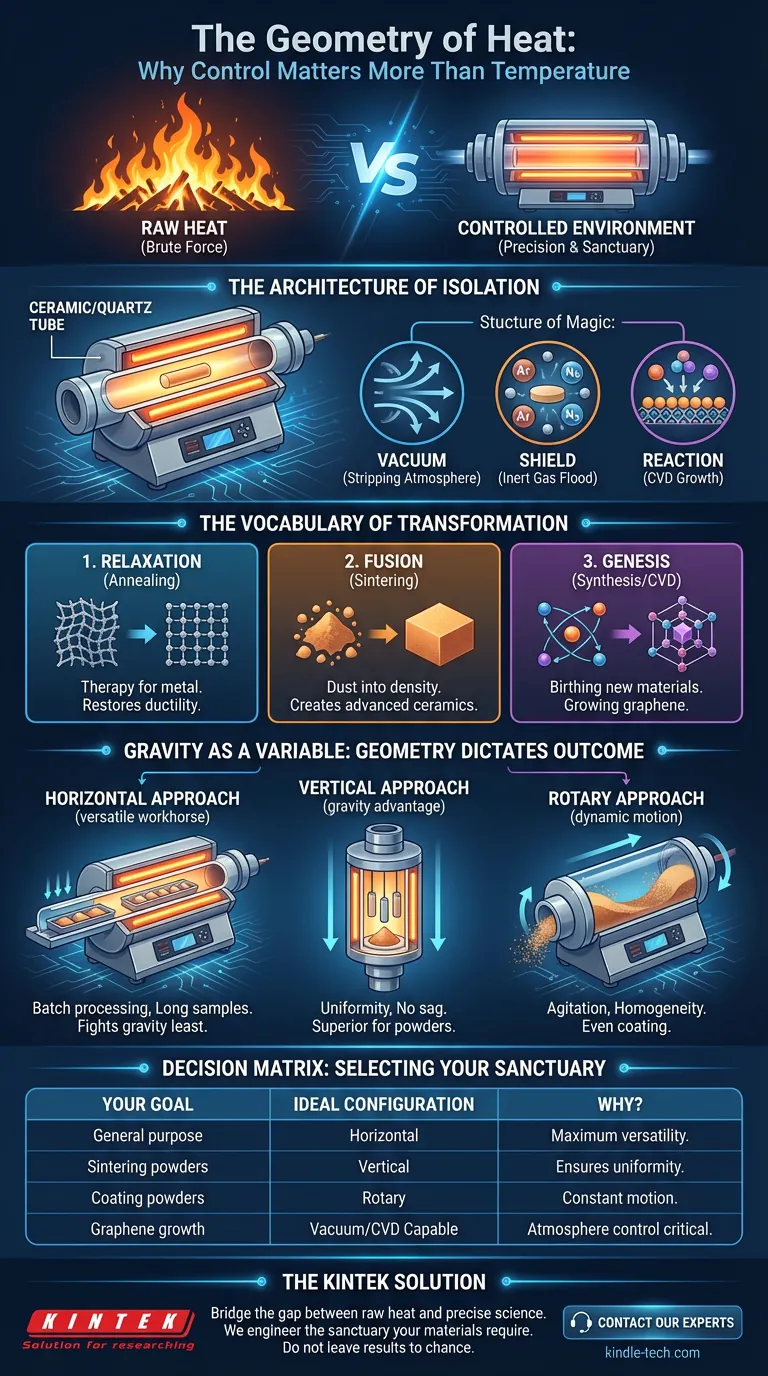
The Architecture of Isolation
At its core, a tube furnace solves a fundamental problem: Contamination.
When you heat a metal in the open air, oxygen attacks it. When you sinter a ceramic in an uncontrolled environment, impurities drift in. The world is dirty, and chemistry is sensitive.
The tube furnace inserts a physical barrier—typically ceramic, quartz, or metal—between the heating elements and the sample.
This separation allows for a kind of magic:
- The Vacuum: Stripping away the atmosphere entirely to degas a sample.
- The Shield: Flooding the chamber with Argon or Nitrogen to prevent oxidation.
- The Reaction: Introducing specific gases to grow new structures, atom by atom (Chemical Vapor Deposition).
It turns the chaotic process of heating into a precise surgical procedure.
The Vocabulary of Transformation
We use these furnaces because materials need to be coached, not just cooked. The applications are vast, but they generally fall into three psychological categories of material change:
1. Relaxation (Annealing)
Metals carry stress. After being worked, they become hard and brittle. A tube furnace heats them gently and cools them slowly, allowing the internal crystal structure to relax. It restores ductility. It is therapy for metal.
2. Fusion (Sintering)
Powders are just loose collections of potential. Sintering uses heat to fuse these particles together without melting them completely. This is how we create solid-oxide fuel cells and advanced ceramics—turning dust into density.
3. Genesis (Synthesis)
This is the realm of creation. Through processes like Chemical Vapor Deposition (CVD), researchers grow graphene or thin films. They aren't fixing old materials; they are birthing new ones that don't exist in nature.
Gravity as a Variable
Most people think of furnaces as static boxes. But the orientation of the tube changes the physics of the process.
Geometry dictates the outcome.
The Horizontal Approach This is the versatile workhorse. It fights gravity the least. It is ideal for:
- Batch processing.
- Long samples (wires, rods).
- General-purpose research where flexibility is the priority.
The Vertical Approach Here, we use gravity to our advantage. By standing the tube up, we eliminate the "sag" that can happen to samples at high temperatures.
- Uniformity: It ensures heat is distributed evenly around the circumference.
- Powder Logic: It is superior for sintering powders, preventing the segregation that happens when materials settle sideways.
The Rotary Approach Sometimes, a sample needs to move to evolve. Rotary furnaces spin the tube, tumbling the material inside.
- Agitation: Essential for coating powders evenly.
- Homogeneity: It ensures the chemical reaction penetrates the entire bulk of the material, not just the surface.
Decision Matrix: Selecting Your Sanctuary
Choosing a furnace is not about picking the hottest one. It is about understanding the relationship between your sample and its environment.
Here is how the variables stack up:
| Your Goal | The Ideal Configuration | Why? |
|---|---|---|
| General purpose / Long samples | Horizontal | Maximum versatility and ease of loading. |
| Sintering powders / Crystal growth | Vertical | Uses gravity to ensure uniformity and prevent segregation. |
| Coating powders / Bulk reactions | Rotary | Constant motion ensures every particle is treated equally. |
| Graphene growth / Thin films | Vacuum/CVD Capable | Atmosphere control is the only variable that matters here. |
The KINTEK Solution
In the end, the quality of your research or production often comes down to the quality of your isolation.
You are not just buying a heater. You are buying a controlled environment—a guarantee that the only variables acting on your material are the ones you chose.
KINTEK understands this nuance. We specialize in laboratory equipment that bridges the gap between raw heat and precise science. Whether you need the gravitational logic of a vertical furnace or the dynamic mixing of a rotary system, we engineer the sanctuary your materials require.
Do not leave your results to chance.
Visual Guide
Related Products
- Rotary Tube Furnace Split Multi Heating Zone Rotating Tube Furnace
- Laboratory Vacuum Tilt Rotary Tube Furnace Rotating Tube Furnace
- 1200℃ Split Tube Furnace with Quartz Tube Laboratory Tubular Furnace
- 1400℃ Laboratory High Temperature Tube Furnace with Alumina Tube
- 1700℃ Laboratory High Temperature Tube Furnace with Alumina Tube
Related Articles
- The Geometry of Heat: Why Motion Matters in Material Synthesis
- Exploring the Advantages of Rotary Tube Furnaces in Industrial and Laboratory Applications
- The Geometry of Heat: Engineering the Perfect Thermal Environment
- The Physics of Perfection: How Rotary Furnaces Eliminate Randomness in Material Processing
- Exploring Rotary Tube Furnaces: A Comprehensive Guide



















