Blog The Geometry of Heat: Why Your Furnace Tube Material Dictates Your Science
The Geometry of Heat: Why Your Furnace Tube Material Dictates Your Science

The Geometry of Heat: Why Your Furnace Tube Material Dictates Your Science

3 days ago

The Invisible Boundary

In any complex system, the most critical component is often the one you notice the least.

In surgery, it isn't always the scalpel; it is the sterile field. In thermal processing, it isn't always the heating element or the PID controller; it is the work tube.

The tube is the boundary condition. It is the physical negotiation between the violence of extreme heat and the delicate chemistry of your sample.

Engineers often view the tube furnace as a simple heater. But the material of that central tube—ceramic, glass, or alloy—is the single most deterministic factor in what your lab can achieve. It defines the limits of your temperature, the purity of your atmosphere, and ultimately, the integrity of your data.

The Psychology of Material Selection

When selecting equipment, we are often seduced by specifications we can control: ramp rates, dwell times, and software interfaces.

However, the choice of the tube material forces us to confront specifications we cannot negotiate with: Physics and Chemistry.

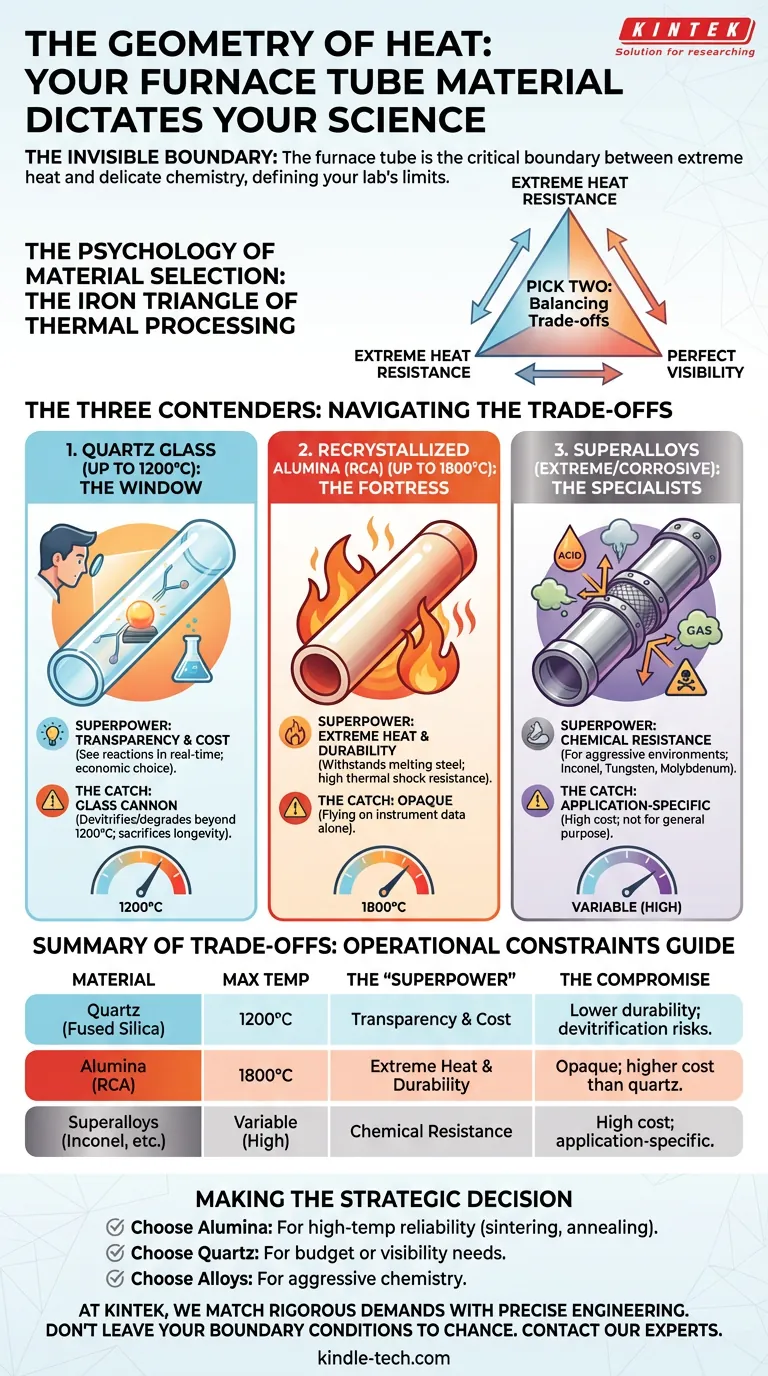
It is an exercise in managing trade-offs. You generally want three things:

  1. Extreme heat resistance.
  2. Perfect visibility.
  3. Low cost.

The reality of materials science dictates that you can rarely pick more than two. Understanding this "Iron Triangle" of thermal processing is the first step toward reliable results.

The Three Contenders

To navigate these trade-offs, we must look at the three primary classes of materials used in modern laboratories. Each represents a different philosophy of protection.

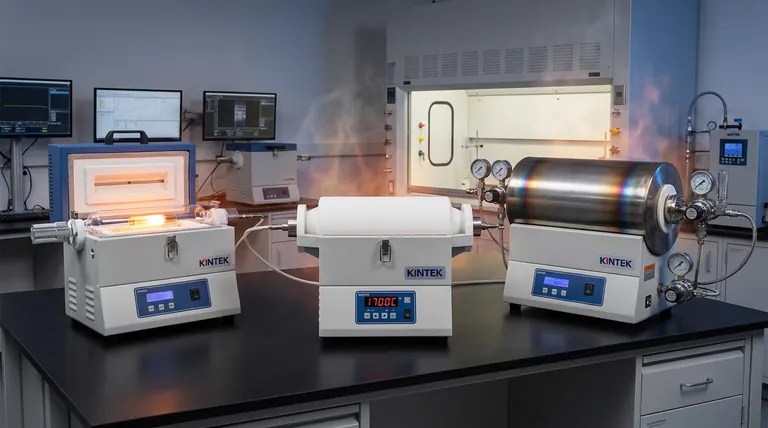
1. Quartz Glass: The Window (Up to 1200°C)

Fused quartz is the choice of the observer.

Its superpower is transparency. In processes where phase changes or reactions need to be visually monitored, quartz is irreplaceable. It allows you to see the science happening in real-time.

It is also the economic choice for "moderate" temperatures.

The Catch: Quartz is a glass cannon. While it handles thermal shock reasonably well compared to standard glass, it devitrifies (crystallizes) and degrades rapidly if pushed beyond 1200°C or subjected to too many distinct heat cycles. It sacrifices longevity for visibility.

2. Recrystallized Alumina (RCA): The Fortress (Up to 1800°C)

If quartz is a window, alumina is a bunker.

Ceramic tubes made from Recrystallized Alumina are the standard for high-performance thermal processing. They are built for endurance.

  • Thermal Resilience: They withstand temperatures that would melt steel and soften glass.
  • Cycle Life: They are highly resistant to thermal shock, surviving hundreds of heating and cooling cycles.

The Catch: They are opaque. Once the sample is inside, you are flying on instrument data alone. You are trading your eyes for the assurance that the tube will not fail at 1700°C.

3. Superalloys: The Specialists (Extreme/Corrosive)

Sometimes, the environment inside the tube is more dangerous than the heat itself.

For rocket engine research or the processing of aggressive chemicals, standard ceramics might react and contaminate the sample. Here, we turn to refractory metals and superalloys.

  • Inconel: For specific high-temperature oxidation resistance.
  • Tungsten/Molybdenum: For extreme chemical inertness against corrosive vapors.

These are not general-purpose tools; they are precision instruments for specific, hostile environments.

The Hidden Cost of Compatibility

The most expensive mistake in a lab is not buying the wrong furnace; it is ruining months of samples because of chemical incompatibility.

A tube is not a passive observer. At high temperatures, materials become reactive.

  • Moisture and Volatiles: Samples containing organic binders or high moisture can outgas, creating corrosive atmospheres that eat through standard tubes.
  • Chemical Attack: Certain vapors will attack the grain structure of alumina or etch quartz, leading to catastrophic failure or, worse, subtle contamination of your results.

Before you heat, you must verify that your vessel is inert relative to your chemistry.

Summary of Trade-offs

We have compiled the operational constraints of these materials into a simplified guide.

Material Max Temperature The "Superpower" The Compromise
Quartz (Fused Silica) 1200°C Transparency & Cost Lower durability; devitrification risks.
Alumina (RCA) 1800°C Extreme Heat & Durability Opaque; higher cost than quartz.
Superalloys (Inconel, etc.) Variable (High) Chemical Resistance High cost; application-specific.

Making the Strategic Decision

Your furnace is a long-term investment in your lab's capability. The tube you choose should not be an afterthought—it should be a reflection of your scientific goals.

  • Choose Alumina if you need a workhorse for high-temperature sintering or annealing where reliability is paramount.
  • Choose Quartz if you are on a budget or if the ability to witness the reaction is critical to your hypothesis.
  • Choose Alloys if your chemistry is aggressive and demands a specialized shield.

At KINTEK, we understand that you aren't just buying a tube; you are buying the certainty that your equipment won't be the variable that ruins the experiment.

We specialize in matching the rigorous demands of your research with the precise engineering of our lab equipment. Don't leave your boundary conditions to chance.

Contact Our Experts

Visual Guide

The Geometry of Heat: Why Your Furnace Tube Material Dictates Your Science Visual Guide

Related Products

Related Articles

Related Products

1700℃ Laboratory High Temperature Tube Furnace with Alumina Tube

1700℃ Laboratory High Temperature Tube Furnace with Alumina Tube

Looking for a high-temperature tube furnace? Check out our 1700℃ Tube Furnace with Alumina Tube. Perfect for research and industrial applications up to 1700C.

1400℃ Laboratory High Temperature Tube Furnace with Alumina Tube

1400℃ Laboratory High Temperature Tube Furnace with Alumina Tube

Looking for a tube furnace for high-temperature applications? Our 1400℃ Tube Furnace with Alumina Tube is perfect for research and industrial use.

Laboratory Rapid Thermal Processing (RTP) Quartz Tube Furnace

Laboratory Rapid Thermal Processing (RTP) Quartz Tube Furnace

Get lightning-fast heating with our RTP Rapid Heating Tube Furnace. Designed for precise, high-speed heating and cooling with convenient sliding rail and TFT touch screen controller. Order now for ideal thermal processing!

1200℃ Split Tube Furnace with Quartz Tube Laboratory Tubular Furnace

1200℃ Split Tube Furnace with Quartz Tube Laboratory Tubular Furnace

KT-TF12 split tube furnace: high-purity insulation, embedded heating wire coils, and max. 1200C. Widely used for new materials and chemical vapour deposition.

High Temperature Alumina (Al2O3) Furnace Tube for Engineering Advanced Fine Ceramics

High Temperature Alumina (Al2O3) Furnace Tube for Engineering Advanced Fine Ceramics

High temperature alumina furnace tube combines the advantages of high hardness of alumina, good chemical inertness and steel, and has excellent wear resistance, thermal shock resistance and mechanical shock resistance.

Laboratory Vacuum Tilt Rotary Tube Furnace Rotating Tube Furnace

Laboratory Vacuum Tilt Rotary Tube Furnace Rotating Tube Furnace

Discover the versatility of Laboratory Rotary Furnace: Ideal for calcination, drying, sintering, and high-temperature reactions. Adjustable rotating and tilting functions for optimal heating. Suitable for vacuum and controlled atmosphere environments. Learn more now!

1800℃ Muffle Oven Furnace for Laboratory

1800℃ Muffle Oven Furnace for Laboratory

KT-18 muffle furnace with Japan Al2O3 polycrystalline fibe and Silicon Molybdenum heating element, up to 1900℃, PID temperature control and 7" smart touch screen. Compact design, low heat loss, and high energy efficiency. Safety interlock system and versatile functions.

Multi-zone Laboratory Tube Furnace

Multi-zone Laboratory Tube Furnace

Experience precise, efficient thermal testing with our Multi Zone Tube Furnace. Independent heating zones and temperature sensors allow for controlled high-temperature gradient heating fields. Order now for advanced thermal analysis!

High Pressure Laboratory Vacuum Tube Furnace Quartz Tubular Furnace

High Pressure Laboratory Vacuum Tube Furnace Quartz Tubular Furnace

KT-PTF High Pressure Tube Furnace: Compact split tube furnace with strong positive pressure resistance. Working temp up to 1100°C and pressure up to 15Mpa. Also works under controller atmosphere or high vacuum.

Small Vacuum Heat Treat and Tungsten Wire Sintering Furnace

Small Vacuum Heat Treat and Tungsten Wire Sintering Furnace

The small vacuum tungsten wire sintering furnace is a compact experimental vacuum furnace specially designed for universities and scientific research institutes. The furnace features a CNC welded shell and vacuum piping to ensure leak-free operation. Quick-connect electrical connections facilitate relocation and debugging, and the standard electrical control cabinet is safe and convenient to operate.

Vacuum Sealed Continuous Working Rotary Tube Furnace Rotating Tube Furnace

Vacuum Sealed Continuous Working Rotary Tube Furnace Rotating Tube Furnace

Experience efficient material processing with our vacuum-sealed rotary tube furnace. Perfect for experiments or industrial production, equipped with optional features for controlled feeding and optimized results. Order now.

Hexagonal Boron Nitride HBN Thermocouple Protection Tube

Hexagonal Boron Nitride HBN Thermocouple Protection Tube

Hexagonal boron nitride ceramics is an emerging industrial material. Because of its similar structure to graphite and many similarities in performance, it is also called "white graphite".

Graphite Vacuum Furnace IGBT Experimental Graphitization Furnace

Graphite Vacuum Furnace IGBT Experimental Graphitization Furnace

IGBT experimental graphitization furnace, a tailored solution for universities and research institutions, with high heating efficiency, user-friendliness, and precise temperature control.

1400℃ Muffle Oven Furnace for Laboratory

1400℃ Muffle Oven Furnace for Laboratory

Get precise high-temperature control up to 1500℃ with KT-14M Muffle furnace. Equipped with a smart touch screen controller and advanced insulation materials.

1700℃ Muffle Oven Furnace for Laboratory

1700℃ Muffle Oven Furnace for Laboratory

Get superior heat control with our 1700℃ Muffle Furnace. Equipped with intelligent temperature microprocessor, TFT touch screen controller & advanced insulation materials for precise heating up to 1700C. Order now!

Multi Heating Zones CVD Tube Furnace Machine Chemical Vapor Deposition Chamber System Equipment

Multi Heating Zones CVD Tube Furnace Machine Chemical Vapor Deposition Chamber System Equipment

KT-CTF14 Multi Heating Zones CVD Furnace - Precise Temperature Control and Gas Flow for Advanced Applications. Max temp up to 1200℃, 4 channels MFC mass flow meter, and 7" TFT touch screen controller.

Horizontal High Temperature Graphite Vacuum Graphitization Furnace

Horizontal High Temperature Graphite Vacuum Graphitization Furnace

Horizontal Graphitization Furnace: This type of furnace is designed with the heating elements placed horizontally, allowing for uniform heating of the sample. It's well-suited for graphitizing large or bulky samples that require precise temperature control and uniformity.

Controlled Nitrogen Inert Hydrogen Atmosphere Furnace

Controlled Nitrogen Inert Hydrogen Atmosphere Furnace

KT-AH Hydrogen atmosphere furnace - induction gas furnace for sintering/annealing with built-in safety features, dual housing design, and energy-saving efficiency. Ideal for lab and industrial use.

Ultra-High Temperature Graphite Vacuum Graphitization Furnace

Ultra-High Temperature Graphite Vacuum Graphitization Furnace

The ultra-high temperature graphitization furnace utilizes medium frequency induction heating in a vacuum or inert gas environment. The induction coil generates an alternating magnetic field, inducing eddy currents in the graphite crucible, which heats up and radiates heat to the workpiece, bringing it to the desired temperature. This furnace is primarily used for graphitization and sintering of carbon materials, carbon fiber materials, and other composite materials.

Graphite Vacuum Furnace High Thermal Conductivity Film Graphitization Furnace

Graphite Vacuum Furnace High Thermal Conductivity Film Graphitization Furnace

The high thermal conductivity film graphitization furnace has uniform temperature, low energy consumption and can operate continuously.


Leave Your Message