Blog The Integrity of the Void: A Systems Approach to Cleaning Tube Furnace Tubes
The Integrity of the Void: A Systems Approach to Cleaning Tube Furnace Tubes

The Integrity of the Void: A Systems Approach to Cleaning Tube Furnace Tubes

2 hours ago

The Unseen Contaminant

In materials science and high-temperature research, the most devastating variable is often invisible. It's the ghost of the last experiment—a microscopic film of carbon, a faint metallic residue—clinging to the inner wall of your process tube.

This unseen layer can subtly alter gas atmospheres, poison catalysts, or compromise the purity of a crystal. The failure doesn't appear as a catastrophic event, but as skewed data and non-repeatable results, costing weeks of work.

The urge is to find a quick cleaning fix and move on. But treating the symptom ignores the system. Cleaning a furnace tube isn't a chore; it's a diagnostic process that safeguards the integrity of your next experiment.

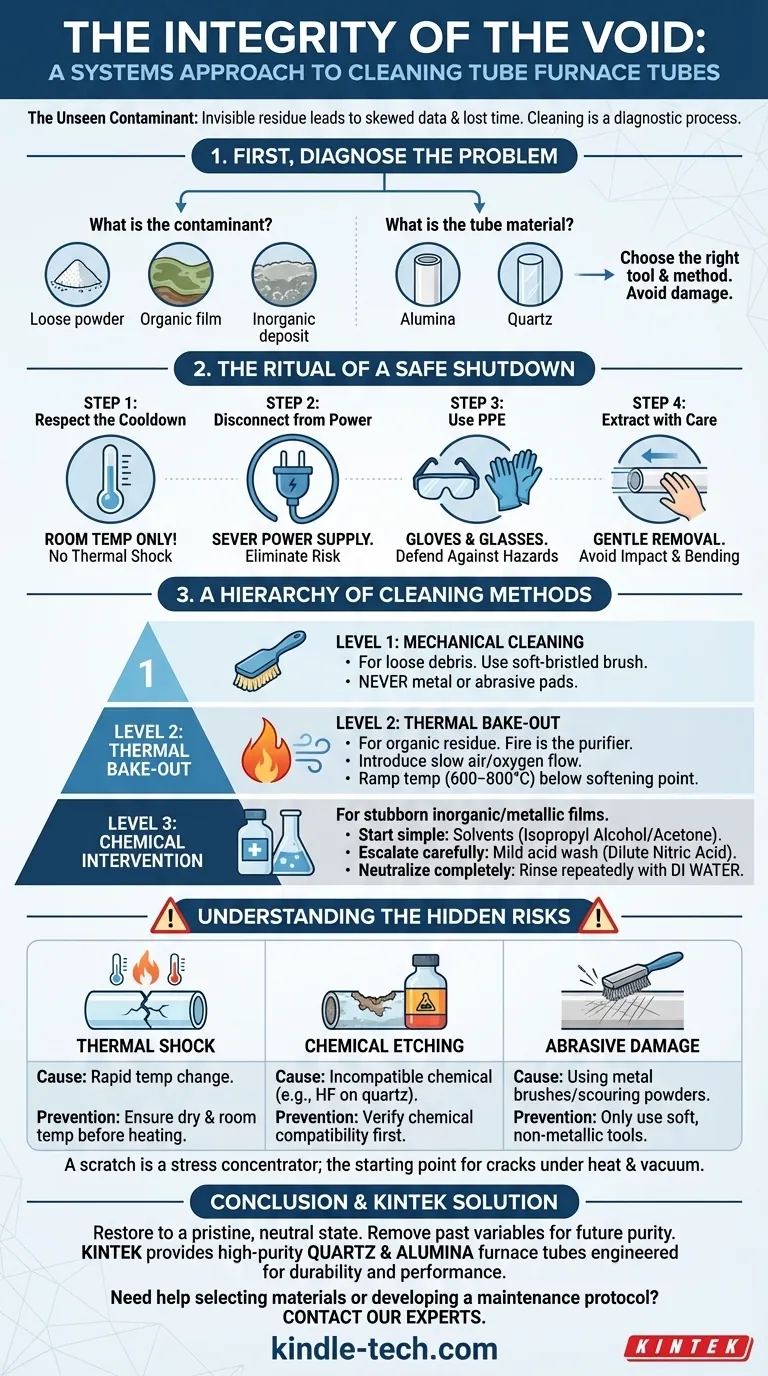
First, Diagnose the Problem

The core principle is simple: you cannot choose the right tool until you understand the problem. The cleaning method is a consequence of your diagnosis, not a default procedure.

Before you act, ask two questions:

  1. What is the contaminant? Is it loose powder, a burnt organic film, or a stubborn inorganic deposit?
  2. What is the tube material? Is it robust alumina or chemically-sensitive quartz?

Answering these questions prevents you from using a chemical that etches your quartz tube or an abrasive that creates a stress point for future failure.

The Ritual of a Safe Shutdown

Haste is the enemy of precision. Before any cleaning can begin, the system must be brought to a safe, inert state. Rushing this is the most common path to equipment damage or injury.

Step 1: Respect the Cooldown

The furnace must be at room temperature. Even below 200°C, the tube holds enough thermal energy to cause severe burns or, worse, to crack from thermal shock if it contacts a cooler liquid. Patience here is a tool.

Step 2: Disconnect from Power

Completely sever the main power supply. This eliminates any risk of accidental heating while you are handling the equipment. It's a simple step that removes a complex danger.

Step 3: Use Personal Protective Equipment (PPE)

Always wear heat-resistant gloves and safety glasses. A tube that looks cool can have hot spots, and brittle materials like quartz can fracture unexpectedly. PPE is your defense against the unknown.

Step 4: Extract with Care

Gently remove the end flanges and seals. Slide the tube out with slow, steady force. Avoid any impact or bending. You are handling the very heart of your experimental environment; treat it accordingly.

A Hierarchy of Cleaning Methods

Always start with the least aggressive method that can solve your problem. This preserves the tube's lifespan and structural integrity.

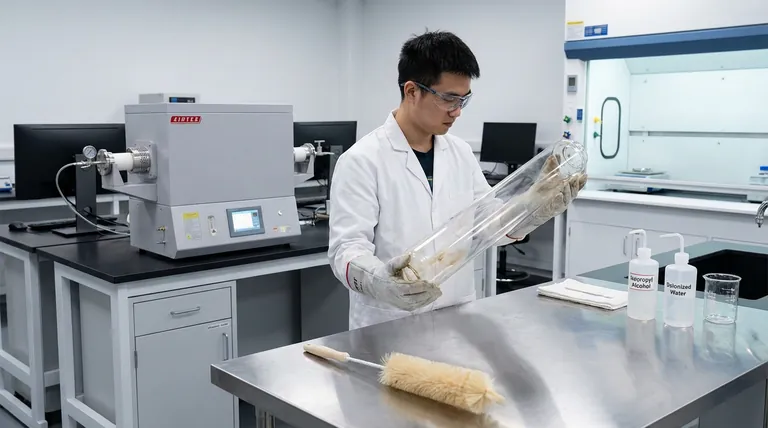
Level 1: Mechanical Cleaning

For loose debris, soot, or powders, a physical approach is best.

  • Use a long-handled, soft-bristled brush.
  • Never use metal brushes, steel wool, or abrasive pads. Scratches become failure points under heat and vacuum.

Level 2: Thermal Bake-Out

For organic residue or heavy carbon deposits, fire is the best purifier.

  • Place the empty tube back in the furnace.
  • Introduce a slow flow of air or oxygen.
  • Ramp the temperature to combust the residue (e.g., 600-800°C), staying well below the tube's softening point. This incinerates the contaminants, leaving only a clean surface.

Level 3: Chemical Intervention

For stubborn inorganic or metallic films, a chemical wash is the final option.

  1. Start simple: Use solvents like isopropyl alcohol or acetone.
  2. Escalate carefully: A mild acid wash (e.g., dilute nitric acid) can dissolve many metallic residues.
  3. Neutralize completely: After any chemical wash, rinse the tube repeatedly with deionized (DI) water. Any remaining acid can become a contaminant in your next run.

Understanding the Hidden Risks

An aggressive cleaning method, misapplied, can cause more damage than the original contaminant. Understanding these trade-offs is critical.

Risk Cause Prevention
Thermal Shock Rapid temperature change (e.g., a wet tube in a hot furnace). Ensure the tube is completely dry and at room temperature before heating.
Chemical Etching Using an incompatible chemical (e.g., HF acid on a quartz tube). Always verify chemical compatibility with your tube material first.
Abrasive Damage Using metal brushes or scouring powders that scratch the surface. Only use soft, non-metallic tools for mechanical cleaning.

A scratch is not just a cosmetic flaw; it is a stress concentrator. Under the immense pressures of high temperature and vacuum, that tiny scratch is where a crack begins.

The goal of cleaning is to restore the tube to a pristine, neutral state. It is an act of control—removing the variables of the past to ensure the purity of the future. This requires not only the right process but also robust, high-quality equipment designed to withstand these cycles. A superior furnace tube isn't just a component; it's an investment in repeatable, reliable results.

At KINTEK, we provide high-purity quartz and alumina furnace tubes engineered for durability and performance, giving you a reliable foundation for your most critical work. If you need help selecting the right materials or developing a maintenance protocol, Contact Our Experts.

Visual Guide
The Integrity of the Void: A Systems Approach to Cleaning Tube Furnace Tubes Visual Guide

Related Products

Related Articles

Related Products

High Temperature Alumina (Al2O3) Furnace Tube for Engineering Advanced Fine Ceramics

High Temperature Alumina (Al2O3) Furnace Tube for Engineering Advanced Fine Ceramics

High temperature alumina furnace tube combines the advantages of high hardness of alumina, good chemical inertness and steel, and has excellent wear resistance, thermal shock resistance and mechanical shock resistance.

1400℃ Laboratory High Temperature Tube Furnace with Alumina Tube

1400℃ Laboratory High Temperature Tube Furnace with Alumina Tube

Looking for a tube furnace for high-temperature applications? Our 1400℃ Tube Furnace with Alumina Tube is perfect for research and industrial use.

Rotary Tube Furnace Split Multi Heating Zone Rotating Tube Furnace

Rotary Tube Furnace Split Multi Heating Zone Rotating Tube Furnace

Multi zone rotary furnace for high-precision temperature control with 2-8 independent heating zones. Ideal for lithium ion battery electrode materials and high-temperature reactions. Can work under vacuum and controlled atmosphere.

1700℃ Laboratory High Temperature Tube Furnace with Alumina Tube

1700℃ Laboratory High Temperature Tube Furnace with Alumina Tube

Looking for a high-temperature tube furnace? Check out our 1700℃ Tube Furnace with Alumina Tube. Perfect for research and industrial applications up to 1700C.

Laboratory Vacuum Tilt Rotary Tube Furnace Rotating Tube Furnace

Laboratory Vacuum Tilt Rotary Tube Furnace Rotating Tube Furnace

Discover the versatility of Laboratory Rotary Furnace: Ideal for calcination, drying, sintering, and high-temperature reactions. Adjustable rotating and tilting functions for optimal heating. Suitable for vacuum and controlled atmosphere environments. Learn more now!

1200℃ Split Tube Furnace with Quartz Tube Laboratory Tubular Furnace

1200℃ Split Tube Furnace with Quartz Tube Laboratory Tubular Furnace

KT-TF12 split tube furnace: high-purity insulation, embedded heating wire coils, and max. 1200C. Widely used for new materials and chemical vapour deposition.

Vacuum Sealed Continuous Working Rotary Tube Furnace Rotating Tube Furnace

Vacuum Sealed Continuous Working Rotary Tube Furnace Rotating Tube Furnace

Experience efficient material processing with our vacuum-sealed rotary tube furnace. Perfect for experiments or industrial production, equipped with optional features for controlled feeding and optimized results. Order now.

Laboratory High Pressure Vacuum Tube Furnace

Laboratory High Pressure Vacuum Tube Furnace

KT-PTF High Pressure Tube Furnace: Compact split tube furnace with strong positive pressure resistance. Working temp up to 1100°C and pressure up to 15Mpa. Also works under controller atmosphere or high vacuum.

Customer Made Versatile CVD Tube Furnace Chemical Vapor Deposition Chamber System Equipment

Customer Made Versatile CVD Tube Furnace Chemical Vapor Deposition Chamber System Equipment

Get your exclusive CVD furnace with KT-CTF16 Customer Made Versatile Furnace. Customizable sliding, rotating, and tilting functions for precise reactions. Order now!

Vertical Laboratory Tube Furnace

Vertical Laboratory Tube Furnace

Elevate your experiments with our Vertical Tube Furnace. Versatile design allows for operation under various environments and heat treatment applications. Order now for precise results!

Laboratory Rapid Thermal Processing (RTP) Quartz Tube Furnace

Laboratory Rapid Thermal Processing (RTP) Quartz Tube Furnace

Get lightning-fast heating with our RTP Rapid Heating Tube Furnace. Designed for precise, high-speed heating and cooling with convenient sliding rail and TFT touch screen controller. Order now for ideal thermal processing!

Multi-zone Laboratory Tube Furnace

Multi-zone Laboratory Tube Furnace

Experience precise, efficient thermal testing with our Multi Zone Tube Furnace. Independent heating zones and temperature sensors allow for controlled high-temperature gradient heating fields. Order now for advanced thermal analysis!

Multi Heating Zones CVD Tube Furnace Machine Chemical Vapor Deposition Chamber System Equipment

Multi Heating Zones CVD Tube Furnace Machine Chemical Vapor Deposition Chamber System Equipment

KT-CTF14 Multi Heating Zones CVD Furnace - Precise Temperature Control and Gas Flow for Advanced Applications. Max temp up to 1200℃, 4 channels MFC mass flow meter, and 7" TFT touch screen controller.

1700℃ Controlled Atmosphere Furnace Nitrogen Inert Atmosphere Furnace

1700℃ Controlled Atmosphere Furnace Nitrogen Inert Atmosphere Furnace

KT-17A Controlled atmosphere furnace: 1700℃ heating, vacuum sealing technology, PID temperature control, and versatile TFT smart touch screen controller for laboratory and industrial use.

1400℃ Muffle Oven Furnace for Laboratory

1400℃ Muffle Oven Furnace for Laboratory

Get precise high-temperature control up to 1500℃ with KT-14M Muffle furnace. Equipped with a smart touch screen controller and advanced insulation materials.

Boron Nitride (BN) Ceramic Tube

Boron Nitride (BN) Ceramic Tube

Boron nitride (BN) is known for its high thermal stability, excellent electrical insulating properties and lubricating properties.

Vacuum Heat Treat and Molybdenum Wire Sintering Furnace for Vacuum Sintering

Vacuum Heat Treat and Molybdenum Wire Sintering Furnace for Vacuum Sintering

A vacuum molybdenum wire sintering furnace is a vertical or bedroom structure, which is suitable for withdrawal, brazing, sintering and degassing of metal materials under high vacuum and high temperature conditions. It is also suitable for dehydroxylation treatment of quartz materials.

Molybdenum Vacuum Heat Treat Furnace

Molybdenum Vacuum Heat Treat Furnace

Discover the benefits of a high-configuration molybdenum vacuum furnace with heat shield insulation. Ideal for high-purity, vacuum environments like sapphire crystal growth and heat treatment.

Hexagonal Boron Nitride HBN Thermocouple Protection Tube

Hexagonal Boron Nitride HBN Thermocouple Protection Tube

Hexagonal boron nitride ceramics is an emerging industrial material. Because of its similar structure to graphite and many similarities in performance, it is also called "white graphite".

Graphite Vacuum Furnace Bottom Discharge Graphitization Furnace for Carbon Materials

Graphite Vacuum Furnace Bottom Discharge Graphitization Furnace for Carbon Materials

Bottom-out graphitization furnace for carbon materials, ultra-high temperature furnace up to 3100°C, suitable for graphitization and sintering of carbon rods and carbon blocks. Vertical design, bottom discharging, convenient feeding and discharging, high temperature uniformity, low energy consumption, good stability, hydraulic lifting system, convenient loading and unloading.


Leave Your Message