Blog The Inverted Trap: Why Hot Argon in Open Furnaces is a Silent Killer
The Inverted Trap: Why Hot Argon in Open Furnaces is a Silent Killer

The Inverted Trap: Why Hot Argon in Open Furnaces is a Silent Killer

4 hours ago

The Anatomy of a Routine Mistake

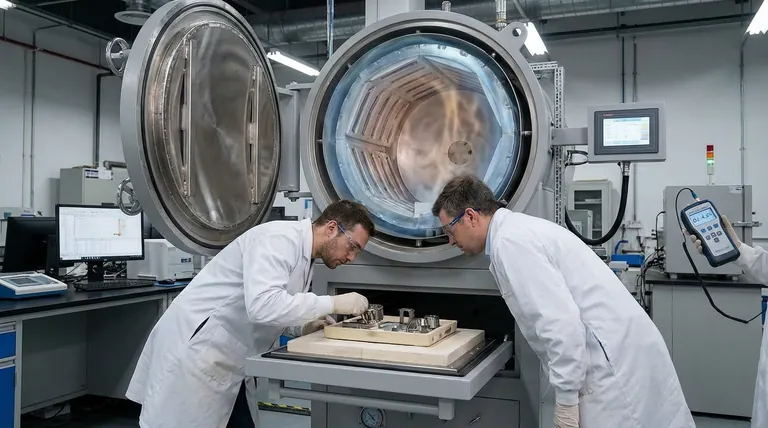
The cycle is complete. The heating elements are off, the alarms are silent, and the heavy bottom of the vacuum furnace has been lowered, opening the chamber to the ambient air of the lab. Everything about the scene signals safety.

An operator, focused on retrieving the treated parts, leans in to inspect the work. It’s a move made a hundred times before. But this time, it’s fatal.

This isn't a failure of the machine. It’s a failure to understand a quiet, counter-intuitive principle of physics—one that turns a state-of-the-art furnace into an invisible trap. The danger isn't what you can see, but the unseen pocket of gas governed by laws we too often forget.

The Physics of the Invisible Pocket

The lethal hazard in a bottom-loading furnace doesn't come from a chemical reaction or toxic substance. It comes from the simple, elegant, and unforgiving behavior of heated gas.

A Simple Law of Density

All gases obey a fundamental rule: when heated, they expand and become less dense. When cooled, they contract and become denser. Hot air rises; this is a principle we understand instinctively.

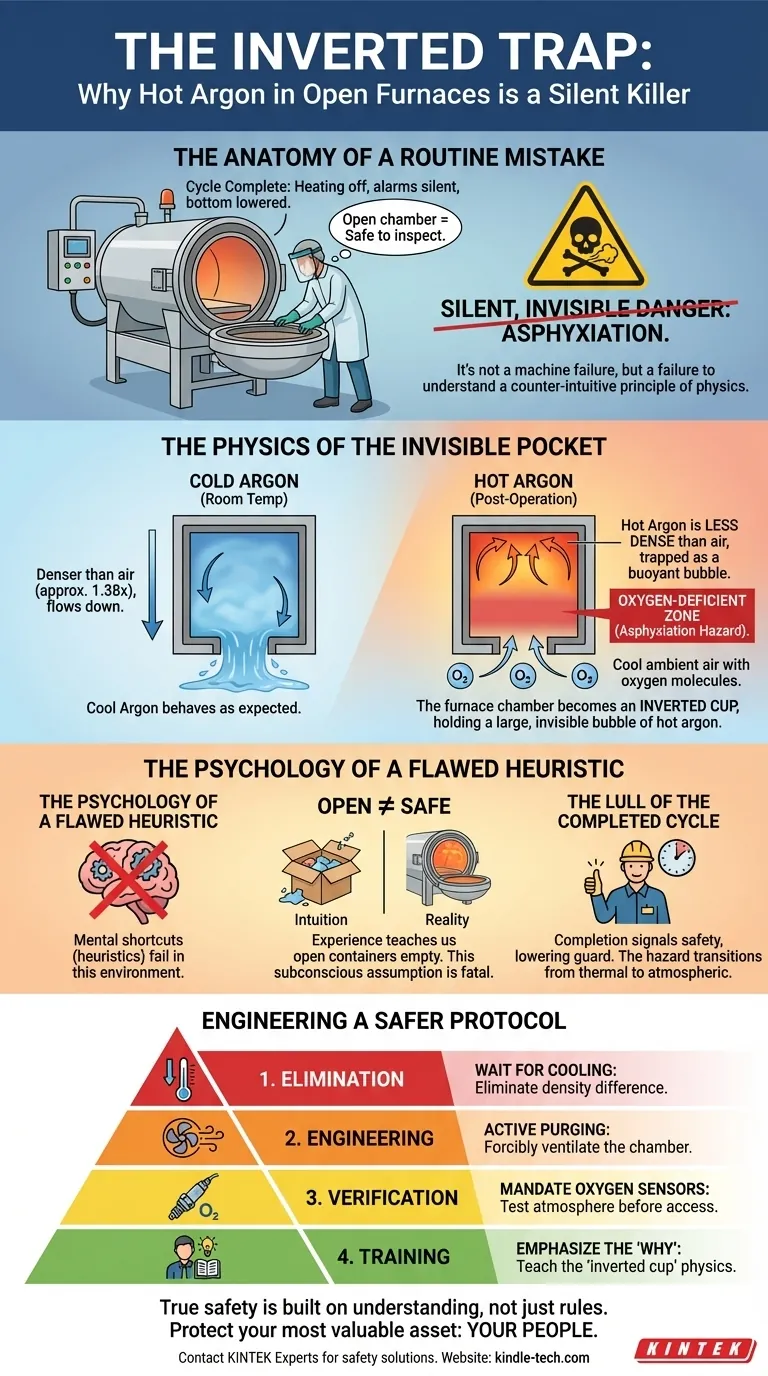
Argon gas, used to backfill the furnace and prevent oxidation, is no exception. At room temperature, argon is about 38% denser than air. If it were cool, it would spill from the open bottom of the furnace like water from a glass.

But when hot, it becomes a different beast entirely.

How the Furnace Becomes an Inverted Cup

Inside a recently-operated furnace, the argon is extremely hot and therefore significantly less dense than the cool, ambient air in the lab.

Instead of flowing out, this buoyant argon "floats" on top of the denser air pushing in from below. The furnace chamber effectively becomes an inverted cup, holding a large, invisible bubble of hot argon captive right at head height. The open bottom is sealed not by a door, but by a barrier of air density.

The Silent Nature of Asphyxiation

Argon itself isn't poisonous. The danger is that it displaces oxygen. Air is about 21% oxygen; our bodies need it to function.

When an operator puts their head into this trapped pocket of argon, they enter an atmosphere with almost no oxygen. The human body has no internal alarm for a lack of oxygen—only for a buildup of carbon dioxide. In an argon atmosphere, you continue to exhale CO2, so there's no choking, no gasping for air, no burning sensation.

Unconsciousness arrives in seconds, without warning. It is a silent, immediate, and utterly preventable event.

The Psychology of a Flawed Heuristic

The most dangerous risks are the ones that violate our intuition. Our brains use mental shortcuts—heuristics—to assess safety, but these shortcuts fail dramatically in the environment of a bottom-loading furnace.

"Open" Doesn't Mean "Safe"

Our entire life experience teaches us that an open container will empty. We see the furnace chamber open to the room and our mind registers it as clear. This powerful, subconscious assumption is what makes the hot argon trap so effective. We fail to account for the invisible forces—temperature and density—that defy our expectations.

The Lull of the Completed Cycle

Every signal suggests the process is over. The machinery has stopped its high-temperature, high-risk work. This creates a powerful false sense of security, lowering the guard of even experienced personnel. The hazard has simply transitioned from an obvious thermal one to an invisible atmospheric one.

Engineering a Safer Protocol

True safety isn't built on rules alone, but on a deep understanding of the principles behind them. Mitigating this risk requires building protocols that account for the physics and psychology at play.

This means moving beyond simple warnings and implementing robust, verifiable procedures.

A Hierarchy of Controls

Control Type Action The Principle Addressed
1. Elimination Wait for Cooling: Do not open or access the chamber until the hot zone has cooled significantly. Eliminates the density difference that creates the argon trap.
2. Engineering Active Purging: Use a fan or compressed air to forcibly ventilate the chamber after opening. Physically removes the trapped argon, not relying on passive diffusion.
3. Verification Mandate Oxygen Sensors: Before breaking the plane of the opening, test the atmosphere inside with a calibrated sensor. Replaces assumption with data. Trust, but verify.
4. Training Emphasize the "Why": Use analogies like the "inverted cup" to make the counter-intuitive physics stick. Builds a resilient safety culture based on true understanding.

By designing processes that respect the underlying science, we create a workplace where safety is systematic, not just assumed. At KINTEK, our deep knowledge of laboratory processes informs the design and integration of our vacuum furnaces and other essential equipment. We believe that the best equipment is only part of the solution; a true partnership involves sharing the knowledge to operate it safely.

If you are looking to enhance the safety and efficiency of your thermal processing operations, we can help you implement systems that protect your most valuable asset: your people. Contact Our Experts

Visual Guide
The Inverted Trap: Why Hot Argon in Open Furnaces is a Silent Killer Visual Guide

Related Products

Related Articles

Related Products

Laboratory Muffle Oven Furnace Bottom Lifting Muffle Furnace

Laboratory Muffle Oven Furnace Bottom Lifting Muffle Furnace

Efficiently produce batches with excellent temperature uniformity using our Bottom Lifting Furnace. Features two electric lifting stages and advanced temperature control up to 1600℃.

Graphite Vacuum Furnace Bottom Discharge Graphitization Furnace for Carbon Materials

Graphite Vacuum Furnace Bottom Discharge Graphitization Furnace for Carbon Materials

Bottom-out graphitization furnace for carbon materials, ultra-high temperature furnace up to 3100°C, suitable for graphitization and sintering of carbon rods and carbon blocks. Vertical design, bottom discharging, convenient feeding and discharging, high temperature uniformity, low energy consumption, good stability, hydraulic lifting system, convenient loading and unloading.

High Temperature Muffle Oven Furnace for Laboratory Debinding and Pre Sintering

High Temperature Muffle Oven Furnace for Laboratory Debinding and Pre Sintering

KT-MD High temperature debinding and pre-sintering furnace for ceramic materials with various molding processes. Ideal for electronic components such as MLCC and NFC.

Graphite Vacuum Furnace High Thermal Conductivity Film Graphitization Furnace

Graphite Vacuum Furnace High Thermal Conductivity Film Graphitization Furnace

The high thermal conductivity film graphitization furnace has uniform temperature, low energy consumption and can operate continuously.

Spark Plasma Sintering Furnace SPS Furnace

Spark Plasma Sintering Furnace SPS Furnace

Discover the benefits of Spark Plasma Sintering Furnaces for rapid, low-temperature material preparation. Uniform heating, low cost & eco-friendly.

Mesh belt controlled atmosphere furnace

Mesh belt controlled atmosphere furnace

Discover our KT-MB mesh belt sintering furnace - perfect for high-temperature sintering of electronic components & glass insulators. Available for open air or controlled atmosphere environments.

Vacuum Heat Treat and Pressure Sintering Furnace for High Temperature Applications

Vacuum Heat Treat and Pressure Sintering Furnace for High Temperature Applications

Vacuum pressure sintering furnaces are designed for high temperature hot pressing applications in metal and ceramic sintering. Its advanced features ensure precise temperature control, reliable pressure maintenance, and a robust design for seamless operation.

Controlled Nitrogen Inert Hydrogen Atmosphere Furnace

Controlled Nitrogen Inert Hydrogen Atmosphere Furnace

KT-AH Hydrogen atmosphere furnace - induction gas furnace for sintering/annealing with built-in safety features, dual housing design, and energy-saving efficiency. Ideal for lab and industrial use.

Rotary Tube Furnace Split Multi Heating Zone Rotating Tube Furnace

Rotary Tube Furnace Split Multi Heating Zone Rotating Tube Furnace

Multi zone rotary furnace for high-precision temperature control with 2-8 independent heating zones. Ideal for lithium ion battery electrode materials and high-temperature reactions. Can work under vacuum and controlled atmosphere.

Non Consumable Vacuum Arc Induction Melting Furnace

Non Consumable Vacuum Arc Induction Melting Furnace

Explore the benefits of Non-Consumable Vacuum Arc Furnace with high melting point electrodes. Small, easy to operate & eco-friendly. Ideal for laboratory research on refractory metals & carbides.

Multi Heating Zones CVD Tube Furnace Machine Chemical Vapor Deposition Chamber System Equipment

Multi Heating Zones CVD Tube Furnace Machine Chemical Vapor Deposition Chamber System Equipment

KT-CTF14 Multi Heating Zones CVD Furnace - Precise Temperature Control and Gas Flow for Advanced Applications. Max temp up to 1200℃, 4 channels MFC mass flow meter, and 7" TFT touch screen controller.

Vacuum Heat Treat and Molybdenum Wire Sintering Furnace for Vacuum Sintering

Vacuum Heat Treat and Molybdenum Wire Sintering Furnace for Vacuum Sintering

A vacuum molybdenum wire sintering furnace is a vertical or bedroom structure, which is suitable for withdrawal, brazing, sintering and degassing of metal materials under high vacuum and high temperature conditions. It is also suitable for dehydroxylation treatment of quartz materials.

600T Vacuum Induction Hot Press Furnace for Heat Treat and Sintering

600T Vacuum Induction Hot Press Furnace for Heat Treat and Sintering

Discover the 600T Vacuum Induction Hot Press Furnace, designed for high-temperature sintering experiments in vacuum or protected atmospheres. Its precise temperature and pressure control, adjustable working pressure, and advanced safety features make it ideal for nonmetal materials, carbon composites, ceramics, and metal powders.

Vertical Laboratory Tube Furnace

Vertical Laboratory Tube Furnace

Elevate your experiments with our Vertical Tube Furnace. Versatile design allows for operation under various environments and heat treatment applications. Order now for precise results!

Vacuum Arc Induction Melting Furnace

Vacuum Arc Induction Melting Furnace

Discover the power of Vacuum Arc Furnace for melting active & refractory metals. High-speed, remarkable degassing effect, and free of contamination. Learn more now!

Vacuum Heat Treat Furnace with Ceramic Fiber Liner

Vacuum Heat Treat Furnace with Ceramic Fiber Liner

Vacuum furnace with polycrystalline ceramic fiber insulation liner for excellent heat insulation and uniform temperature field. Choose from 1200℃ or 1700℃ max. working temperature with high vacuum performance and precise temperature control.

Vacuum Sealed Continuous Working Rotary Tube Furnace Rotating Tube Furnace

Vacuum Sealed Continuous Working Rotary Tube Furnace Rotating Tube Furnace

Experience efficient material processing with our vacuum-sealed rotary tube furnace. Perfect for experiments or industrial production, equipped with optional features for controlled feeding and optimized results. Order now.

Horizontal High Temperature Graphite Vacuum Graphitization Furnace

Horizontal High Temperature Graphite Vacuum Graphitization Furnace

Horizontal Graphitization Furnace: This type of furnace is designed with the heating elements placed horizontally, allowing for uniform heating of the sample. It's well-suited for graphitizing large or bulky samples that require precise temperature control and uniformity.

Small Vacuum Heat Treat and Tungsten Wire Sintering Furnace

Small Vacuum Heat Treat and Tungsten Wire Sintering Furnace

The small vacuum tungsten wire sintering furnace is a compact experimental vacuum furnace specially designed for universities and scientific research institutes. The furnace features a CNC welded shell and vacuum piping to ensure leak-free operation. Quick-connect electrical connections facilitate relocation and debugging, and the standard electrical control cabinet is safe and convenient to operate.

Electric Rotary Kiln Pyrolysis Furnace Plant Machine Calciner Small Rotary Kiln Rotating Furnace

Electric Rotary Kiln Pyrolysis Furnace Plant Machine Calciner Small Rotary Kiln Rotating Furnace

Electric rotary kiln - precisely controlled, it's ideal for calcination and drying of materials like lithium cobalate, rare earths, and non-ferrous metals.


Leave Your Message



















