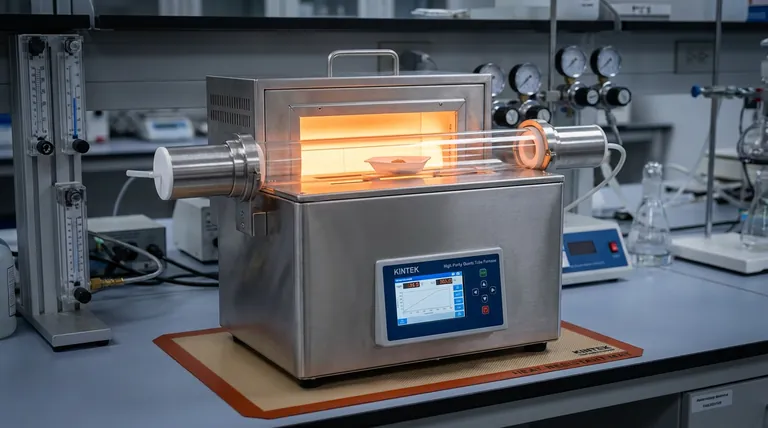
Blog The Invisible Contaminant: A Guide to Preserving the Heart of Your Furnace
The Invisible Contaminant: A Guide to Preserving the Heart of Your Furnace

The Invisible Contaminant: A Guide to Preserving the Heart of Your Furnace

9 hours ago

The Memory of a Surface

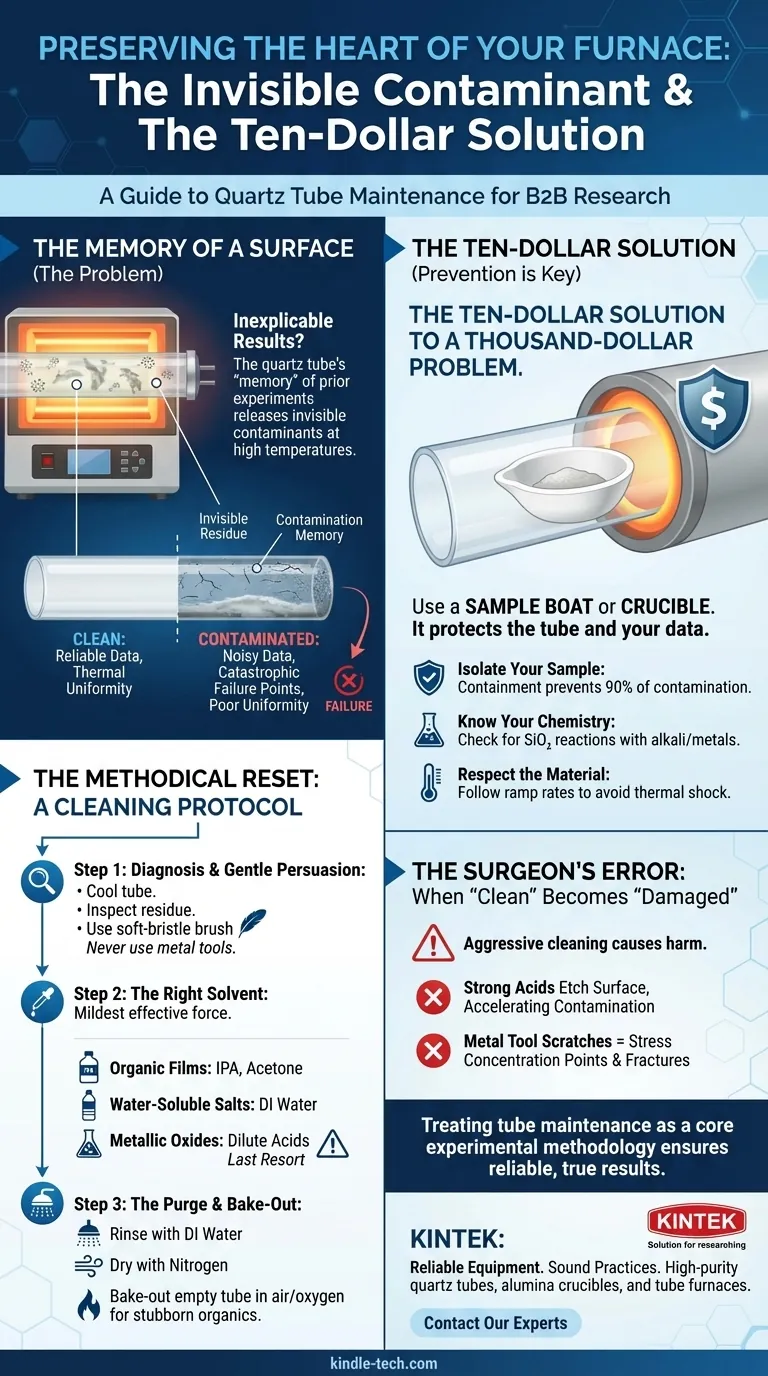
Imagine a series of experiments over several weeks, each yielding slightly inexplicable results. The data is noisy. The reactions don't proceed to completion. You check the gas flow, calibrate the temperature controller, and verify your precursors. Everything seems perfect.

The culprit is often the one thing we look through, but rarely look at: the quartz tube.

It isn't just a piece of glass; it's the controlled universe where your work happens. And like any universe, it has a memory. Residue from a prior experiment, invisible to the naked eye, can vaporize at high temperatures, introducing a variable you never accounted for. This is the invisible contaminant.

This contamination is more than just a source of error. Certain materials can etch the silicon dioxide surface, creating microscopic flaws that become catastrophic failure points under thermal stress. A layer of residue can also act as an insulator, destroying the thermal uniformity that is critical for your process.

The Ten-Dollar Solution to a Thousand-Dollar Problem

There’s a cognitive bias where we focus intensely on the complex, active parts of a problem—the chemical reaction, the heating profile—while neglecting the simple, passive foundations.

The most effective strategy for maintaining the integrity of your quartz tube furnace is not a heroic cleaning effort. It's a boring, routine, and incredibly effective preventative measure: using a sample boat or crucible.

Placing your material in an appropriate container (like an alumina boat) is the single most important protocol. It's the ten-dollar component that protects the thousand-dollar tube and the priceless data it helps generate.

A Philosophy of Prevention

This proactive mindset extends beyond just using a crucible. It involves a deeper respect for the materials and their limits.

  • Isolate Your Sample: The first rule is containment. Never let the sample touch the tube wall. This simple discipline prevents 90% of all contamination issues.
  • Know Your Chemistry: Before heating, ask: Will this material react with SiO₂ at my target temperature? Alkali compounds and certain metals can be particularly aggressive, causing permanent damage. A moment of research saves hours of cleaning and the cost of a replacement.
  • Respect the Material: Quartz is incredibly resilient to heat, but brittle when it comes to thermal shock. Rapid temperature changes create immense internal stress. Adhering to recommended ramp rates is not just about the process; it's about preserving the integrity of the chamber itself.

The Methodical Reset: A Cleaning Protocol

When cleaning becomes unavoidable, the goal is not to be aggressive but to be methodical. The approach should feel less like scrubbing a pot and more like performing a delicate procedure.

Step 1: Diagnosis and Gentle Persuasion

Once the tube is cool, inspect the residue. Is it a light powder or soot? Often, tilting the tube or using a long, soft-bristled brush is all that's needed. The cardinal rule: never use metal tools. A single scratch creates a stress concentration point, a seed for a future crack.

Step 2: The Right Solvent for the Sin

Chemical cleaning should follow a principle of minimum effective force.

  • For organic films: Start with simple solvents like isopropyl alcohol (IPA) or acetone.
  • For water-soluble salts: Use high-purity deionized (DI) water.
  • For metallic oxides: This may require dilute acids, but should be a last resort, performed with extreme caution and proper PPE.

Step 3: The Purge and The Bake-Out

After any chemical wash, rinse the tube repeatedly with DI water to remove every trace of the cleaning agent. Dry it with a gentle stream of clean nitrogen.

For stubborn organic traces, a final "bake-out" can be performed. Place the empty tube back in the furnace and heat it in the presence of air or oxygen to pyrolyze any remaining carbon-based residue.

Stage Action Rationale
1. Prevention Always use a sample boat/crucible. Isolates sample, preventing direct contact.
2. Assessment Inspect residue type (powder, film, etc.). Determines the least aggressive cleaning method.
3. Mechanical Use a soft brush for loose material. Removes debris without scratching the surface.
4. Chemical Apply mildest effective solvent (IPA, DI H₂O). Dissolves residue with minimal risk to quartz.
5. Final Rinse with DI water and perform a bake-out. Removes all chemical and organic traces.

The Surgeon's Error: When "Clean" Becomes "Damaged"

The desire for a perfectly pristine tube can lead to its destruction. Aggressive cleaning is a classic surgeon's error—an intervention where the "cure" causes more harm than the disease.

Strong acids can leave the tube looking immaculate, but they do so by etching the surface, creating a microscopic texture that actually accelerates future contamination and weakens the tube.

A scratch from a metal tool might seem trivial, but upon heating, the thermal stress will focus on that tiny flaw until it propagates into a complete fracture.

The foundation of reliable science is controlling variables. The state of your quartz tube is one of the most fundamental, yet easily overlooked, variables in any high-temperature process. Treating its maintenance as a core part of your experimental methodology is the only way to ensure your results are a true reflection of your work, and not the ghost of an experiment past.

At KINTEK, we understand that great results come from reliable equipment and sound practices. Our high-purity quartz tubes, alumina crucibles, and tube furnaces are designed for precision and durability, empowering you to focus on your research with confidence. If you need to improve your lab's workflow or select the right consumables for your process, we're here to help. Contact Our Experts.

Visual Guide
The Invisible Contaminant: A Guide to Preserving the Heart of Your Furnace Visual Guide

Related Products

Related Articles

Related Products

Laboratory Rapid Thermal Processing (RTP) Quartz Tube Furnace

Laboratory Rapid Thermal Processing (RTP) Quartz Tube Furnace

Get lightning-fast heating with our RTP Rapid Heating Tube Furnace. Designed for precise, high-speed heating and cooling with convenient sliding rail and TFT touch screen controller. Order now for ideal thermal processing!

1200℃ Split Tube Furnace with Quartz Tube Laboratory Tubular Furnace

1200℃ Split Tube Furnace with Quartz Tube Laboratory Tubular Furnace

KT-TF12 split tube furnace: high-purity insulation, embedded heating wire coils, and max. 1200C. Widely used for new materials and chemical vapour deposition.

1400℃ Laboratory High Temperature Tube Furnace with Alumina Tube

1400℃ Laboratory High Temperature Tube Furnace with Alumina Tube

Looking for a tube furnace for high-temperature applications? Our 1400℃ Tube Furnace with Alumina Tube is perfect for research and industrial use.

Rotary Tube Furnace Split Multi Heating Zone Rotating Tube Furnace

Rotary Tube Furnace Split Multi Heating Zone Rotating Tube Furnace

Multi zone rotary furnace for high-precision temperature control with 2-8 independent heating zones. Ideal for lithium ion battery electrode materials and high-temperature reactions. Can work under vacuum and controlled atmosphere.

1700℃ Laboratory High Temperature Tube Furnace with Alumina Tube

1700℃ Laboratory High Temperature Tube Furnace with Alumina Tube

Looking for a high-temperature tube furnace? Check out our 1700℃ Tube Furnace with Alumina Tube. Perfect for research and industrial applications up to 1700C.

Laboratory Vacuum Tilt Rotary Tube Furnace Rotating Tube Furnace

Laboratory Vacuum Tilt Rotary Tube Furnace Rotating Tube Furnace

Discover the versatility of Laboratory Rotary Furnace: Ideal for calcination, drying, sintering, and high-temperature reactions. Adjustable rotating and tilting functions for optimal heating. Suitable for vacuum and controlled atmosphere environments. Learn more now!

Vacuum Sealed Continuous Working Rotary Tube Furnace Rotating Tube Furnace

Vacuum Sealed Continuous Working Rotary Tube Furnace Rotating Tube Furnace

Experience efficient material processing with our vacuum-sealed rotary tube furnace. Perfect for experiments or industrial production, equipped with optional features for controlled feeding and optimized results. Order now.

Laboratory High Pressure Vacuum Tube Furnace

Laboratory High Pressure Vacuum Tube Furnace

KT-PTF High Pressure Tube Furnace: Compact split tube furnace with strong positive pressure resistance. Working temp up to 1100°C and pressure up to 15Mpa. Also works under controller atmosphere or high vacuum.

High Temperature Alumina (Al2O3) Furnace Tube for Engineering Advanced Fine Ceramics

High Temperature Alumina (Al2O3) Furnace Tube for Engineering Advanced Fine Ceramics

High temperature alumina furnace tube combines the advantages of high hardness of alumina, good chemical inertness and steel, and has excellent wear resistance, thermal shock resistance and mechanical shock resistance.

Multi Heating Zones CVD Tube Furnace Machine Chemical Vapor Deposition Chamber System Equipment

Multi Heating Zones CVD Tube Furnace Machine Chemical Vapor Deposition Chamber System Equipment

KT-CTF14 Multi Heating Zones CVD Furnace - Precise Temperature Control and Gas Flow for Advanced Applications. Max temp up to 1200℃, 4 channels MFC mass flow meter, and 7" TFT touch screen controller.

Multi-zone Laboratory Tube Furnace

Multi-zone Laboratory Tube Furnace

Experience precise, efficient thermal testing with our Multi Zone Tube Furnace. Independent heating zones and temperature sensors allow for controlled high-temperature gradient heating fields. Order now for advanced thermal analysis!

Vertical Laboratory Tube Furnace

Vertical Laboratory Tube Furnace

Elevate your experiments with our Vertical Tube Furnace. Versatile design allows for operation under various environments and heat treatment applications. Order now for precise results!

1200℃ Controlled Atmosphere Furnace Nitrogen Inert Atmosphere Furnace

1200℃ Controlled Atmosphere Furnace Nitrogen Inert Atmosphere Furnace

Discover our KT-12A Pro Controlled atmosphere furnace - high precision, heavy duty vacuum chamber, versatile smart touch screen controller, and excellent temperature uniformity up to 1200C. Ideal for both laboratory and industrial application.

1400℃ Muffle Oven Furnace for Laboratory

1400℃ Muffle Oven Furnace for Laboratory

Get precise high-temperature control up to 1500℃ with KT-14M Muffle furnace. Equipped with a smart touch screen controller and advanced insulation materials.

1700℃ Controlled Atmosphere Furnace Nitrogen Inert Atmosphere Furnace

1700℃ Controlled Atmosphere Furnace Nitrogen Inert Atmosphere Furnace

KT-17A Controlled atmosphere furnace: 1700℃ heating, vacuum sealing technology, PID temperature control, and versatile TFT smart touch screen controller for laboratory and industrial use.

Ultra-High Temperature Graphite Vacuum Graphitization Furnace

Ultra-High Temperature Graphite Vacuum Graphitization Furnace

The ultra-high temperature graphitization furnace utilizes medium frequency induction heating in a vacuum or inert gas environment. The induction coil generates an alternating magnetic field, inducing eddy currents in the graphite crucible, which heats up and radiates heat to the workpiece, bringing it to the desired temperature. This furnace is primarily used for graphitization and sintering of carbon materials, carbon fiber materials, and other composite materials.

Horizontal High Temperature Graphite Vacuum Graphitization Furnace

Horizontal High Temperature Graphite Vacuum Graphitization Furnace

Horizontal Graphitization Furnace: This type of furnace is designed with the heating elements placed horizontally, allowing for uniform heating of the sample. It's well-suited for graphitizing large or bulky samples that require precise temperature control and uniformity.

High Temperature Muffle Oven Furnace for Laboratory Debinding and Pre Sintering

High Temperature Muffle Oven Furnace for Laboratory Debinding and Pre Sintering

KT-MD High temperature debinding and pre-sintering furnace for ceramic materials with various molding processes. Ideal for electronic components such as MLCC and NFC.

Small Vacuum Heat Treat and Tungsten Wire Sintering Furnace

Small Vacuum Heat Treat and Tungsten Wire Sintering Furnace

The small vacuum tungsten wire sintering furnace is a compact experimental vacuum furnace specially designed for universities and scientific research institutes. The furnace features a CNC welded shell and vacuum piping to ensure leak-free operation. Quick-connect electrical connections facilitate relocation and debugging, and the standard electrical control cabinet is safe and convenient to operate.

Graphite Vacuum Furnace Bottom Discharge Graphitization Furnace for Carbon Materials

Graphite Vacuum Furnace Bottom Discharge Graphitization Furnace for Carbon Materials

Bottom-out graphitization furnace for carbon materials, ultra-high temperature furnace up to 3100°C, suitable for graphitization and sintering of carbon rods and carbon blocks. Vertical design, bottom discharging, convenient feeding and discharging, high temperature uniformity, low energy consumption, good stability, hydraulic lifting system, convenient loading and unloading.


Leave Your Message



















