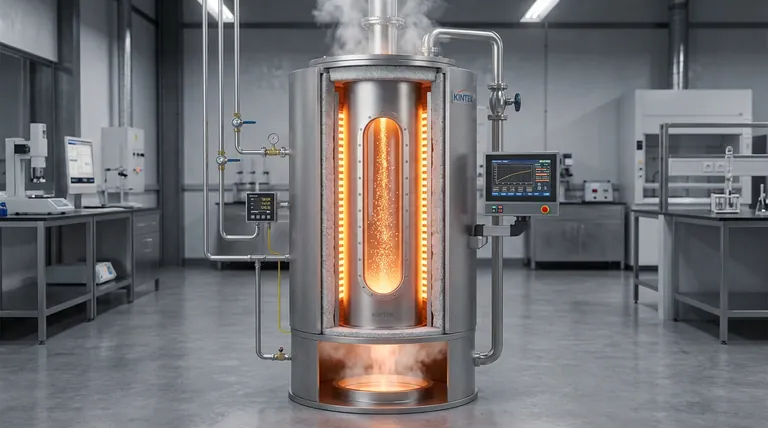
The Illusion of Scale
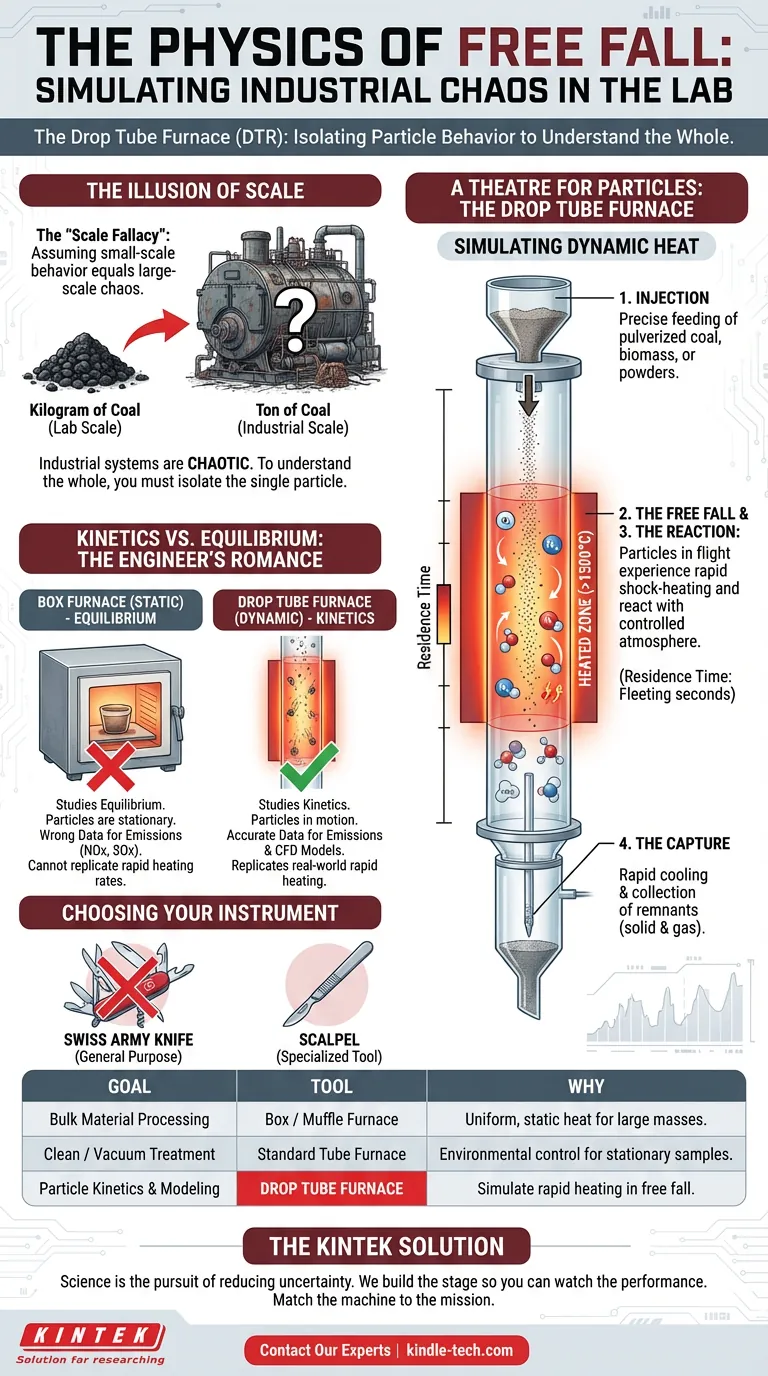
In engineering, we often fall for the "scale fallacy." We assume that if we understand how a kilogram of coal behaves in a pile, we understand how a ton of coal behaves in a boiler.
But history—and physics—teaches us otherwise.
When you scale up a system, you don't just get a bigger version of the same thing. you get a new set of behaviors entirely. Industrial boilers, gasifiers, and reactors are chaotic environments. They are messy. They are hard to measure.
To understand the chaos of the whole, you must isolate the behavior of the unit. You have to look at the single particle.
This is where the Drop Tube Furnace (DTR) enters the picture. It is not designed to heat things up; it is designed to slow the world down.
A Theatre for Particles
Most laboratory furnaces are ovens. You put a sample in, close the door, and wait. The sample sits still. It cooks.
A drop tube furnace is different. It is a simulator.
The design is elegant in its specific utility: a long, vertical tube, externally heated to extreme temperatures (often exceeding 1500°C).
The process is a choreography of physics:
- The Injection: A precise feeding mechanism introduces a fine stream of particles—pulverized coal, biomass, or mineral powders—at the top.
- The Free Fall: The particles fall through the heated column. They are not stationary. They are in flight.
- The Reaction: For a few fleeting seconds (the "residence time"), the particle experiences shock-heating and reacts with the controlled atmosphere (oxygen, nitrogen, or steam).
- The Capture: At the bottom, a sampling probe rapidly cools and collects the remnants—both solid and gas.
It mimics the life cycle of fuel in an industrial reactor, but in a setting where every variable is under your control.
The Engineer’s Romance: Why We Need "Dynamic" Heat
Why go through this trouble? Why not just use a standard box furnace?
Because a box furnace studies equilibrium. A drop tube furnace studies kinetics.
In the real world of power generation and chemical processing, particles don't sit still. They fly through combustion zones at high speeds. They experience rapid heating rates that static furnaces cannot replicate.
If you are trying to model how a power plant generates emissions like NOx or SOx, a static test will give you the wrong data. You need to see the chemical transformation as it happens in motion.
The DTR allows researchers to:
- Isolate variables: Change the gas mixture without changing the temperature.
- Measure rates: Determine exactly how fast a particle burns or gasifies.
- Validate models: Provide the raw data that feeds computational fluid dynamics (CFD) models for massive industrial builds.
The Psychology of Tool Selection
There is a tendency in laboratory procurement to look for the "Swiss Army Knife"—a tool that does everything reasonably well.
The drop tube furnace is the opposite of a Swiss Army Knife. It is a scalpel.
It is terrible at general tasks. You cannot use it to anneal a large metal part. You cannot use it to process kilograms of material. It is complex to operate, requiring a precise balance of gas flow, temperature profiles, and feed rates.
But for its specific purpose—analyzing rapid, high-temperature reactions of fine particles—it has no equal.
Choosing Your Instrument
To select the right equipment, you must be honest about your objective.
| If your goal is... | Then you need... | Because... |
|---|---|---|
| Bulk Material Processing | Box / Muffle Furnace | You need uniform, static heat for large masses. |
| Clean/Vacuum Treatment | Standard Tube Furnace | You need environmental control for stationary samples. |
| Particle Kinetics & Modeling | Drop Tube Furnace | You need to simulate rapid heating in free fall. |
The KINTEK Solution
Science is the pursuit of reducing uncertainty.
When you are designing the next generation of biofuels or trying to make coal combustion cleaner, you cannot afford to guess what is happening inside the reactor. You need to know.
At KINTEK, we understand that specialized research requires specialized tools. Our equipment isn't just about reaching high temperatures; it's about providing the stability and control necessary to capture data from the chaotic split-second of a chemical reaction.
We build the stage so you can watch the performance.
Whether you need the rapid heating simulation of a Drop Tube Furnace or the reliable stability of a standard lab unit, we help you match the machine to the mission.
Visual Guide
Related Products
- Rotary Tube Furnace Split Multi Heating Zone Rotating Tube Furnace
- Vacuum Sealed Continuous Working Rotary Tube Furnace Rotating Tube Furnace
- Laboratory Vacuum Tilt Rotary Tube Furnace Rotating Tube Furnace
- 1200℃ Split Tube Furnace with Quartz Tube Laboratory Tubular Furnace
- 1700℃ Laboratory High Temperature Tube Furnace with Alumina Tube
Related Articles
- The Geometry of Heat: Why Motion Matters in Material Synthesis
- Exploring the Advantages of Rotary Tube Furnaces in Industrial and Laboratory Applications
- The Geometry of Heat: Engineering the Perfect Thermal Environment
- Exploring the Functions and Advantages of Rotary Tube Furnaces
- Exploring Rotary Tube Furnaces: A Comprehensive Guide



















