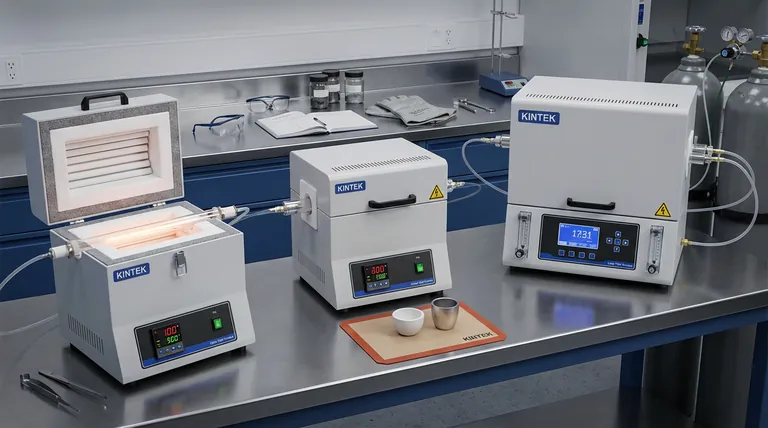
The Experiment That Shouldn't Have Failed
Imagine a materials science lab. A researcher is attempting to grow a single, perfect crystal. The protocol is flawless, the precursor materials are of the highest purity, and the new tube furnace is set to a precise 1450°C.
Yet, the results are consistently flawed. The sample comes out with imperfections—part of it is beautifully crystalline, while the ends are a disordered, amorphous mess. The equipment is new, the controller reads a stable temperature, yet the outcome is a failure.
This isn't a story of faulty hardware. It's a story of a hidden variable, a cognitive trap that snares even experienced scientists: focusing on the wrong number.
The Seduction of the Peak Number
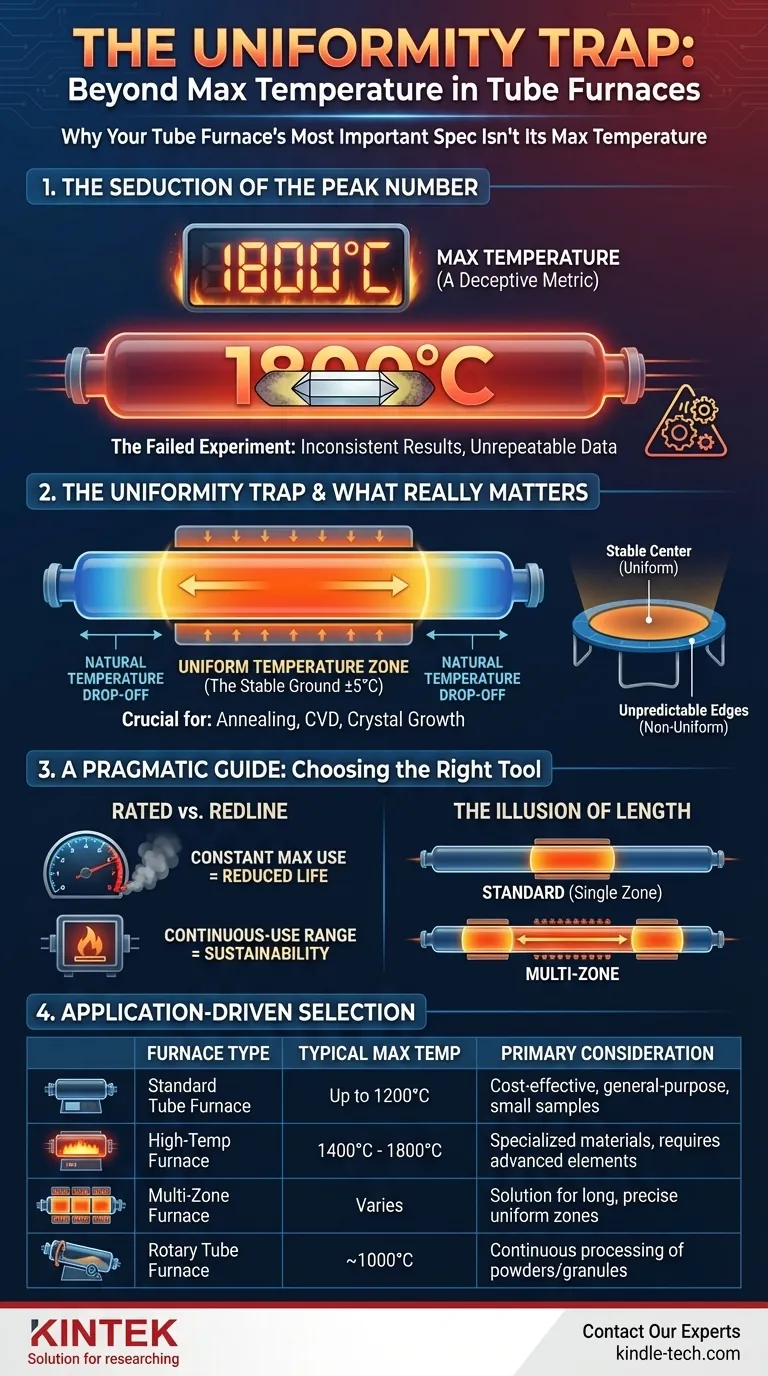
When we evaluate tools, our brains crave simplicity. For a tube furnace, the most prominent number on the spec sheet is its maximum temperature—1200°C, 1500°C, 1800°C. It’s a simple, impressive metric that feels like the primary measure of capability.
But a furnace isn’t a simple oven. It's a dynamic thermal environment. The peak temperature is merely a potential, not a guarantee of performance. The real work—the work that ensures your experiment is repeatable and reliable—happens in a much more subtle and critical space.
What Really Governs a Furnace’s Heat
The maximum temperature is not an arbitrary rating. It's the result of deliberate engineering choices.
The Heart of the Heat: Heating Elements
The single biggest constraint is the material of the heating element. Standard Kanthal (FeCrAl) wires work reliably up to about 1200°C. To reach the 1800°C required for advanced ceramics or novel alloys, you need fundamentally different materials, like molybdenum disilicide (MoSi2) elements. The material science of the element itself sets the ceiling.
Form Follows Function
The furnace's design is tailored to its task. A rotary tube furnace, designed for continuously processing powders, is optimized for motion and material flow, often limiting its practical temperature to around 1000°C. A static furnace for high-temperature synthesis is built differently, prioritizing insulation and thermal stability to safely reach its peak.
The Watchful Eye: Thermocouple Control
A thermocouple acts as the furnace's nervous system. It constantly measures the heat and reports back to a PID controller, which then modulates power to the heating elements. This feedback loop is what allows you to maintain a setpoint with incredible precision.
But here’s the crucial point: the thermocouple measures the temperature at a single point. And that point might be the only place in the entire furnace that is exactly at your target temperature.
The Uniformity Trap: Your Experiment's Silent Killer
This brings us back to our failed crystal growth experiment. The problem wasn't the furnace's ability to reach 1450°C. The problem was its ability to sustain 1450°C across the entire length of the sample.
Defining the Stable Ground
Every tube furnace has a uniform temperature zone. This is the physical region inside the tube where the temperature is stable and consistent, typically specified within a tight tolerance (e.g., ±5°C). Outside this zone, near the ends of the tube, the temperature inevitably drops off.
Think of it like the calm, flat center of a trampoline. The advertised "bounce" happens there. Near the edges, the surface is sloped and unpredictable.
Why Inconsistency Is Failure
If your sample is longer than this uniform zone, you are not running one experiment; you are running several at once. The center of the sample might be at a perfect 1450°C, while the ends are at 1420°C or lower.
For processes like annealing, chemical vapor deposition (CVD), or crystal growth, this gradient is catastrophic. It introduces uncontrolled variables, making your results inconsistent and, worse, unrepeatable. The researcher's failure was caused by a sample too large for the furnace's stable thermal ground.
A Pragmatic Guide to Choosing the Right Furnace
Escaping the uniformity trap requires a shift in perspective. You must move from asking "How hot can it get?" to "How stable is the heat over the area my sample needs?"
Rated vs. Redline
Constantly operating a furnace at its absolute maximum temperature is like redlining your car's engine everywhere you go. It will drastically shorten the life of the heating elements and insulation. Sound engineering practice involves choosing a furnace where your target operating temperature is well within its rated, continuous-use range.
The Illusion of Length
A longer heated tube does not guarantee a longer uniform zone. In fact, achieving a long, highly uniform zone is a significant engineering challenge. It often requires advanced designs with multiple, independently controlled heating zones that work in concert to counteract the natural temperature drop-off at the ends.
Your selection process should be driven by the demands of your application.
| Furnace Type | Typical Max Temp. | Primary Consideration |
|---|---|---|
| Standard Tube Furnace | Up to 1200°C | Cost-effective for general-purpose heating, small samples |
| High-Temp Furnace | 1400°C - 1800°C | Essential for specialized materials, requires advanced elements |
| Multi-Zone Furnace | Varies | The solution for creating a long, precise uniform zone |
| Rotary Tube Furnace | ~1000°C | Optimized for continuous processing of powders and granules |
Ultimately, the goal is to create a predictable, controlled environment. The success of your work depends not on a single peak number, but on the quiet, stable, and uniform platform where your science happens.
At KINTEK, we specialize in providing laboratory equipment that delivers on the specifications that matter. We understand that reliable results come from instruments engineered for precision and uniformity. Whether you need a high-temperature system for pioneering new materials or a multi-zone furnace for perfect process control, we can help you find the right tool for the job. Contact Our Experts
Visual Guide
Related Products
- Rotary Tube Furnace Split Multi Heating Zone Rotating Tube Furnace
- Laboratory Vacuum Tilt Rotary Tube Furnace Rotating Tube Furnace
- 1200℃ Split Tube Furnace with Quartz Tube Laboratory Tubular Furnace
- 1400℃ Laboratory High Temperature Tube Furnace with Alumina Tube
- 1700℃ Laboratory High Temperature Tube Furnace with Alumina Tube
Related Articles
- The Geometry of Heat: Why Motion Matters in Material Synthesis
- The Geometry of Heat: Engineering the Perfect Thermal Environment
- Exploring the Functions and Advantages of Rotary Tube Furnaces
- Exploring Rotary Tube Furnaces: A Comprehensive Guide
- Exploring the Advantages of Rotary Tube Furnaces in Industrial and Laboratory Applications



















