The Engineer's Dilemma
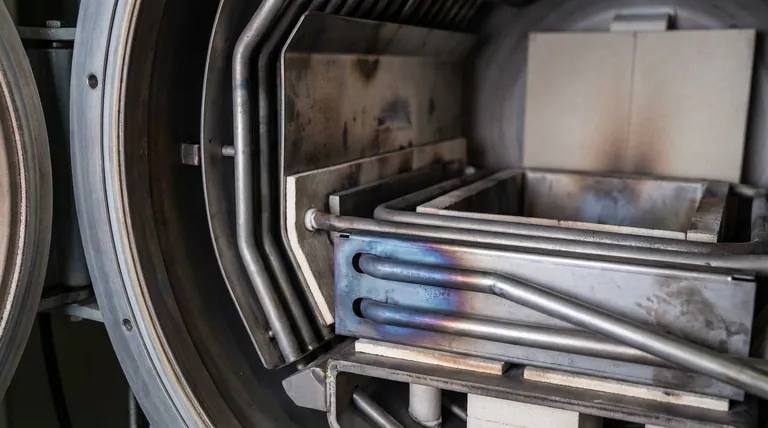
An operator peers into the cooled chamber of a vacuum furnace. Tucked away in the corner, a faint blueish tint has appeared on a molybdenum heat shield that was pristine silver just a week ago.
It’s subtle. It seems purely cosmetic. The immediate temptation is to log it as a minor observation and move on. The production schedule is tight, and the furnace appears to be functioning perfectly.
This is a critical moment. It's a psychological fork in the road. Dismissing this small signal is easy, but understanding what it truly represents is the difference between routine maintenance and catastrophic, multi-day downtime.
The Anatomy of a Failure
The hot zone is the heart of a vacuum furnace. It's a meticulously engineered environment of heating elements and heat shields designed to generate and contain extreme temperatures with perfect uniformity in a near-perfect vacuum.
Its integrity is not a feature; it is the entire point.
The Cascading Cost of Neglect
That faint blue hue is not a cosmetic flaw. It's a forensic signpost.
It indicates that at some point during a high-temperature cycle, the vacuum was compromised. Oxygen, the enemy of refractory metals at heat, seeped into the chamber and oxidized the components. The blue color is the evidence.
Ignoring this clue means you've chosen to ignore the root cause—the leak. The next cycle will oxidize the components further. The heating elements will degrade, their electrical resistance will change, and temperature uniformity will be lost. Eventually, an element will fail, potentially causing an electrical arc that destroys a significant portion of the hot zone.
What started as a tiny, invisible leak cascades into scrapped product, emergency repairs, and immense financial loss.
A Two-Tiered System for Reliability
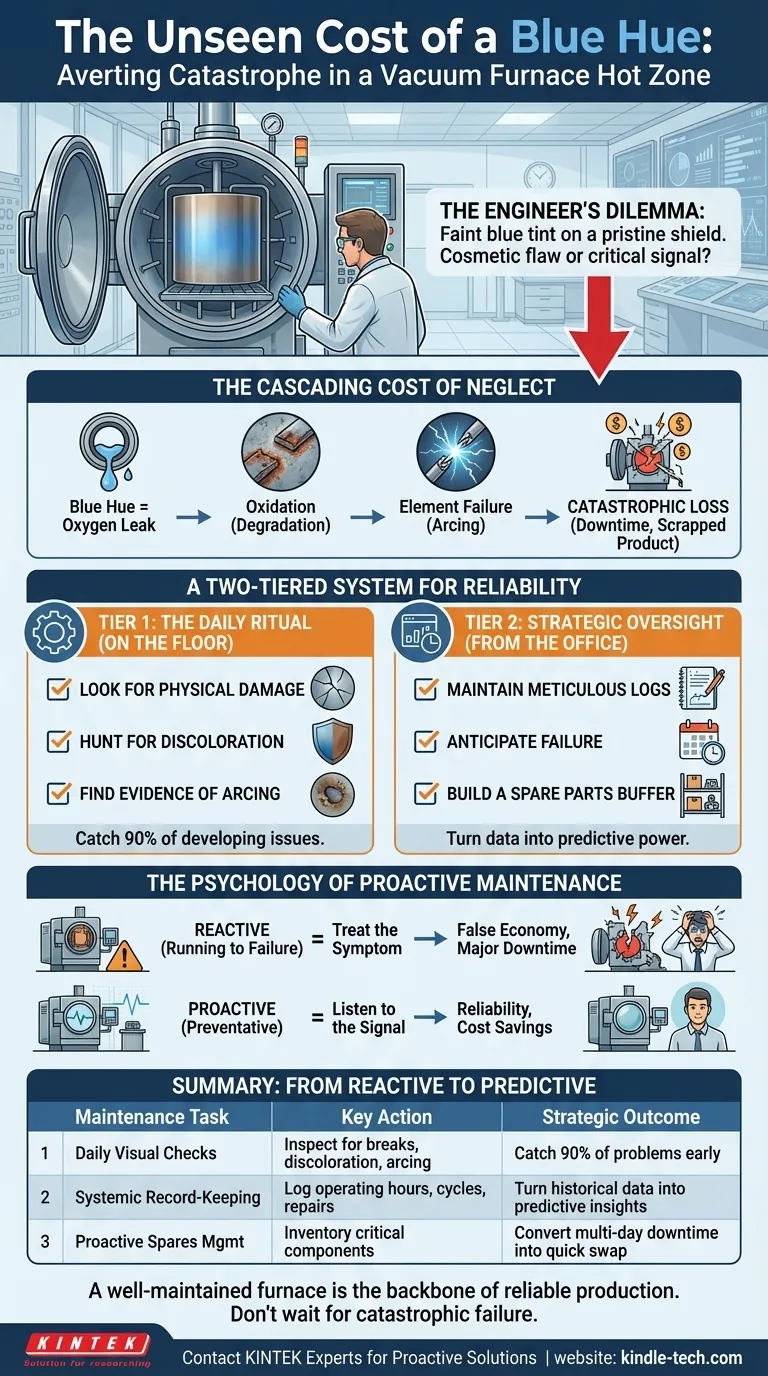
Preventing this cascade requires a disciplined, two-part strategy. It's a blend of what you see on the floor and what you plan in the office. One is useless without the other.
Tier 1: The Daily Ritual on the Floor
This is your first line of defense, a simple visual audit that can catch over 90% of developing issues.
- Look for Physical Damage: Inspect heating elements for cracks, significant sagging, or breaks. These are obvious precursors to electrical shorts and uneven heating.
- Hunt for Discoloration: This is the most critical check. Any browning or blueing on elements or shields means a vacuum leak has occurred. It's not an "if," it's a "when" and "where." The hunt for the leak source must begin immediately.
- Find Evidence of Arcing: Search for small pits, melted spots, or fused material on elements and insulators. Arcing is a violent electrical discharge that can rapidly destroy components.
Tier 2: Strategic Oversight from the Office
This is where you turn daily observations into predictive power.
- Maintain Meticulous Logs: Record everything: operating hours, cycle parameters, inspection notes, and repair histories. This data is not bureaucracy; it's the raw material for intelligent decision-making.
- Anticipate Failure: Use your logs to track the service life of your hot zone components. If a set of molybdenum elements has a typical life of 5,000 hours, you can plan their replacement at 4,800 hours, turning a potential emergency into a scheduled task.
- Build a Spare Parts Buffer: An idle furnace waiting for a part to be shipped across the country is a massive operational drain. Using your data, maintain a strategic inventory of critical spares like heating elements, insulators, and thermocouples. This can reduce downtime from weeks to hours.
The Psychology of Proactive Maintenance
We are wired to react to urgent, obvious problems. The philosophy of "if it ain't broke, don't fix it" feels efficient.
This is a cognitive trap.
The Fallacy of Running to Failure
A reactive maintenance strategy appears to save money in the short term by deferring costs. This is a false economy. The benefit of proactive maintenance is a failure that doesn't happen. Because this benefit is invisible, we tend to undervalue it.
Yet, the cost of unplanned downtime—compounded by emergency shipping fees, overtime pay, and lost production—will almost always dwarf the cost of a planned, preventative program.
Misreading the Language of the Machine
The most common mistake is to treat the symptom instead of the disease. Replacing a discolored heating element without finding and fixing the vacuum leak is a perfect example. You have fixed nothing. You have only reset the clock on the next failure.
The discoloration is the machine telling you there's a problem. The goal is to listen to that signal, not just erase the evidence.
Summary: From Reactive to Predictive
| Maintenance Task | Key Action | Strategic Outcome |
|---|---|---|
| Daily Visual Checks | Inspect for breaks, discoloration, arcing | Catch 90% of problems before they cascade |
| Systemic Record-Keeping | Log operating hours, cycles, repairs | Turn historical data into predictive insights |
| Proactive Spares Mgmt | Inventory critical components | Convert multi-day downtime into a quick swap |
A well-maintained vacuum furnace is the backbone of reliable production and research. Implementing this strategy requires more than just a checklist; it requires a partnership with a supplier who understands the critical nature of every component. Having access to high-quality, reliable consumables and spare parts is the foundation of any successful maintenance program.
At KINTEK, we specialize in providing the essential lab equipment and consumables that keep your operations running smoothly. Don't wait for a small signal to become a catastrophic failure. Contact Our Experts to build a proactive strategy for your furnace needs.
Visual Guide
Related Products
- 2200 ℃ Tungsten Vacuum Heat Treat and Sintering Furnace
- Vacuum Hot Press Furnace Heated Vacuum Press Machine Tube Furnace
- Vacuum Hot Press Furnace Machine Heated Vacuum Press
- 600T Vacuum Induction Hot Press Furnace for Heat Treat and Sintering
- Vacuum Heat Treat and Pressure Sintering Furnace for High Temperature Applications
Related Articles
- The Architecture of Extremes: Mastering the Thermal Ceiling
- Exploring Tungsten Vacuum Furnaces: Operation, Applications, and Advantages
- Your Tungsten Furnace Is Failing. The Culprit Isn't What You Think.
- Classification, Applications, and Components of High-Temperature Vacuum Furnaces
- High-Temperature Vacuum Furnace: Classification, Applications, and Components



















