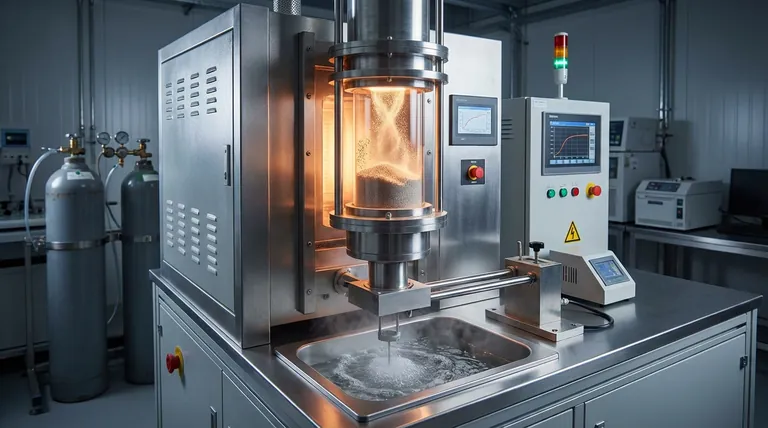
The Illusion of Simplicity
To the uninitiated, a laboratory furnace is a simple tool: a box that gets very, very hot. Our mental model defaults to the horizontal tube furnace, a familiar workhorse for annealing and heat treatment. It’s intuitive, practical, and effective for countless applications.
But this simplicity hides a subtle flaw in our thinking. We obsess over temperature, programming ramps and soaks with meticulous precision. We often forget the other constant force acting on our sample, one that can warp, bend, or ruin an entire experiment: gravity.
What happens when you must treat a material so delicate that its own weight becomes its enemy at 1200°C? What happens when you need to coat millions of individual powder grains with perfect uniformity? Suddenly, the simple "hot box" isn't enough. You need to turn gravity from a potential problem into an indispensable ally.
Why "Up" is a Deliberate Engineering Choice
The decision to orient a furnace vertically is not a matter of convenience or novelty. It is a calculated engineering solution designed to master physical forces that a horizontal furnace cannot. It’s about creating an environment of profound stability.
Eliminating a Hidden Variable: Sample Integrity
Imagine a researcher attempting to synthesize a long, thin ceramic fiber. In a horizontal furnace, as the temperature rises, the fiber begins to soften. Gravity pulls relentlessly on its midpoint, causing it to sag. The final product is bowed, its internal structure compromised. The experiment has failed before it even had a chance to succeed.
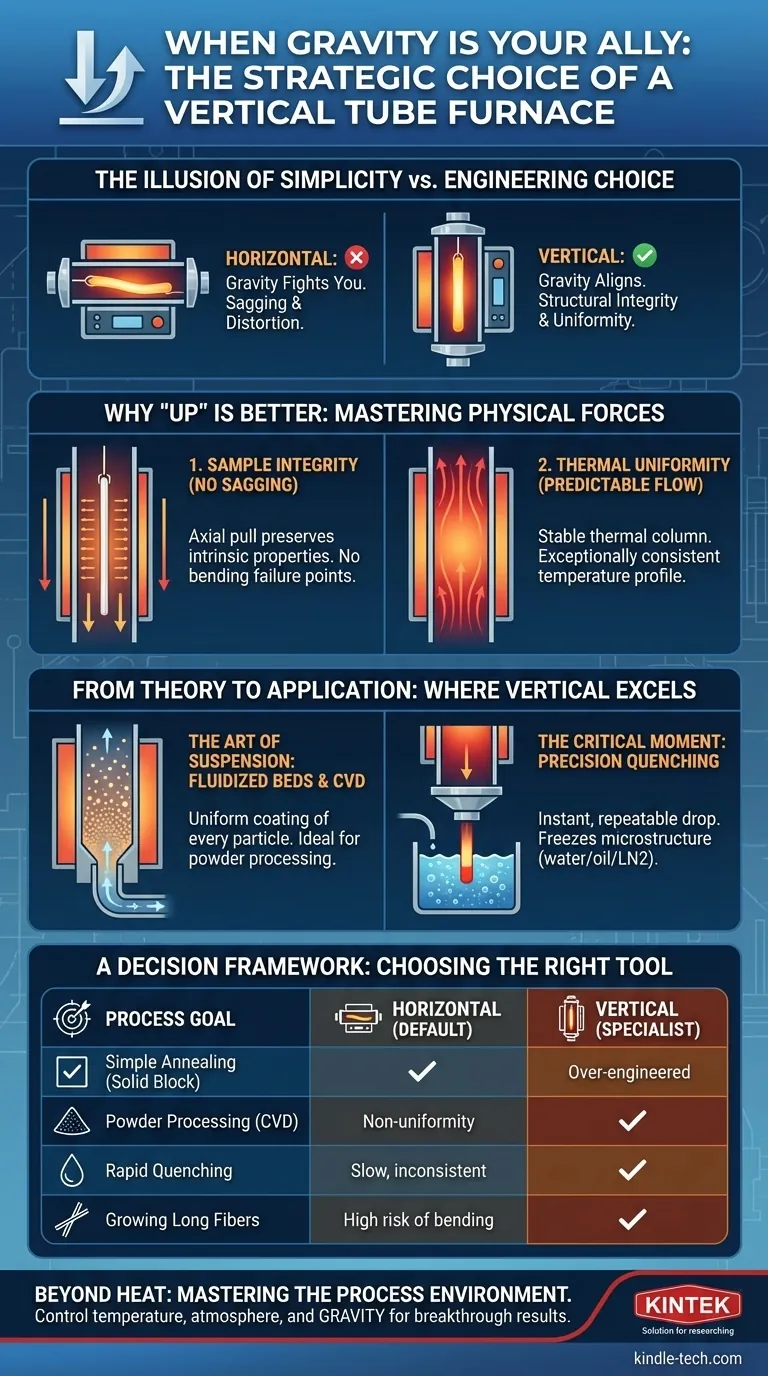
Now, place that same fiber in a vertical tube furnace. It hangs suspended, with gravity pulling axially along its length. The forces are uniform, distributed perfectly. There is no bending, no sagging. The material's intrinsic properties are preserved. The vertical orientation has removed a critical failure point by aligning with gravity instead of fighting it.
Mastering the Unseen Flow: Convection and Uniformity
Inside any heated tube, air or gas moves. In a horizontal tube, convection currents can be complex and somewhat chaotic. In a vertical tube, however, these currents become beautifully predictable.
The natural upward flow of hot gas creates a highly stable thermal column. This, combined with cylindrical heating elements, produces an exceptionally uniform temperature zone. For processes that demand consistent thermal exposure along the entire sample length, this inherent stability is not a feature—it's a prerequisite.
From Theory to Application: Where Vertical Furnaces Excel
This mastery of gravity and thermodynamics opens the door to processes that are difficult, if not impossible, to achieve otherwise.
The Art of Suspension: Fluidized Beds and CVD
Coating a fine powder with a uniform layer via Chemical Vapor Deposition (CVD) is a classic materials science challenge. If the powder sits in a horizontal boat, only the top layer is exposed. The particles underneath remain untouched.
A vertical furnace provides an elegant solution. By introducing a process gas from the bottom, the flow can be controlled to gently lift and suspend the powder particles on a porous disc. This "fluidized bed" makes the solid powder behave like a liquid. Every single particle is surrounded by the reactive gas and uniform heat, ensuring a perfectly consistent coating.
The Critical Moment: Precision Quenching
Quenching—the act of rapid cooling—is often as critical as heating. It freezes a material's microstructure in a desired state. To do this effectively requires moving the sample from extreme heat to a cooling medium in an instant.
Pulling a sample from a horizontal furnace is a slow, manual, and often inconsistent process. A bottom-loading vertical furnace, however, is built for this moment. After heating, a mechanism releases the sample, allowing it to drop directly into a bath of water, oil, or liquid nitrogen positioned immediately below. The transition is instantaneous, repeatable, and precisely controlled.
The Psychology of a Trade-off: Choosing the Right Tool
A vertical furnace is not a universal replacement for a horizontal one. It is a specialist's tool, and choosing it reflects a deeper understanding of the process at hand. It acknowledges that sometimes, the simplest-looking path is not the most effective one.
The trade-offs are real. A vertical furnace demands more vertical space. Sample handling can require specialized crucibles or hangers. It represents a commitment to solving a more complex problem. But for the right application, this commitment is the difference between incremental progress and a breakthrough.
A Decision Framework
Your process goal, not a tool's perceived simplicity, should guide your choice.
| Process Goal | Horizontal Furnace (The Default) | Vertical Furnace (The Specialist) |
|---|---|---|
| Simple Annealing (Solid Block) | Often sufficient, simpler, and cost-effective. | Over-engineered unless the sample is prone to sagging. |
| Powder Processing (CVD, Sintering) | Prone to non-uniformity and particle clumping. | The ideal choice for creating fluidized beds and uniform exposure. |
| Rapid Quenching | Slow, manual, and inconsistent process. | Enables instant, repeatable quenching by dropping the sample. |
| Growing Long, Thin Crystals/Fibers | High risk of bending or breaking under its own weight. | Gravity acts along the axis, preserving structural integrity. |
Beyond Heat: Mastering the Process Environment
Ultimately, advanced material processing is not just about managing heat. It's about controlling the entire physical environment your sample experiences. Temperature, atmosphere, and gravity are all variables that must be mastered.
Mastering these variables is the difference between a successful experiment and a frustrating failure. At KINTEK, we specialize in equipping labs with high-performance tools like vertical tube furnaces that offer this essential level of control. Whether you are optimizing a CVD process or developing a new material that requires precise thermal treatment, understanding the subtle power of orientation is key. Contact Our Experts
Visual Guide
Related Products
- Vertical Laboratory Tube Furnace
- Vertical High Temperature Graphite Vacuum Graphitization Furnace
- Customer Made Versatile CVD Tube Furnace Chemical Vapor Deposition Chamber System Equipment
- Rotary Tube Furnace Split Multi Heating Zone Rotating Tube Furnace
- Laboratory Vacuum Tilt Rotary Tube Furnace Rotating Tube Furnace
Related Articles
- Understanding Laboratory Tube Furnaces
- How to Choose a Laboratory Tube Furnace
- The Architecture of Heat: Inside the Precision of Laboratory Tube Furnaces
- Gravity as an Ally: The Engineering Logic Behind Vertical Tube Furnaces
- From Crack to Complete: A Scientist's Guide to Eliminating Catastrophic Tube Furnace Failures



















