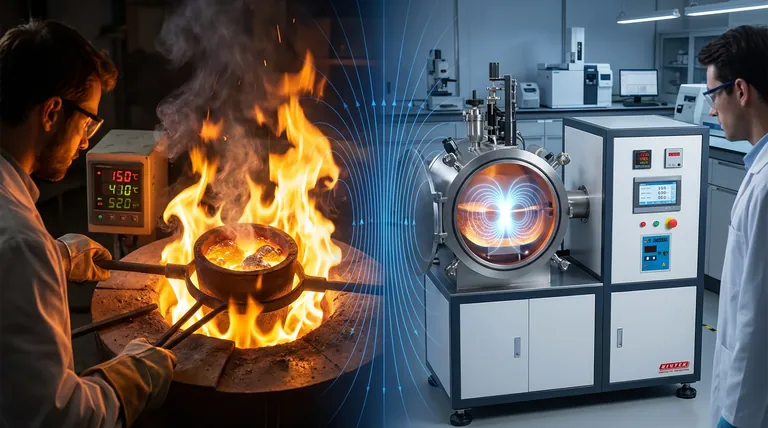
You’ve done everything by the book. The raw materials are certified, the calculations are double-checked, and the process is followed to the letter. Yet, when the analysis comes back, the results are disheartening. The alloy composition is off, unexpected impurities have appeared, and the batch is a write-off. It’s a familiar and deeply frustrating cycle: weeks of work undone by a result you can't seem to control.
The Costly Cycle of Guesswork
If this scenario sounds familiar, you're not alone. Across research labs and production facilities, teams struggle with the unpredictable nature of creating precise metal alloys. When a melt fails, the search for a culprit begins. Was it the crucible? The raw material purity? Operator error?
This leads to a familiar pattern of attempted fixes:
- Sourcing ever-more-expensive raw materials, hoping purity is the magic bullet.
- Implementing rigorous, time-consuming cleaning protocols for crucibles and equipment.
- Retraining staff on procedures, adding layers of verification to an already complex process.
While well-intentioned, these efforts rarely solve the problem for good. The inconsistency creeps back in, leading to significant business consequences: project deadlines are missed, R&D budgets are consumed by repeated work, and the risk of shipping a subpar product looms large. You're trapped in a costly cycle of guesswork, treating symptoms without ever curing the disease.
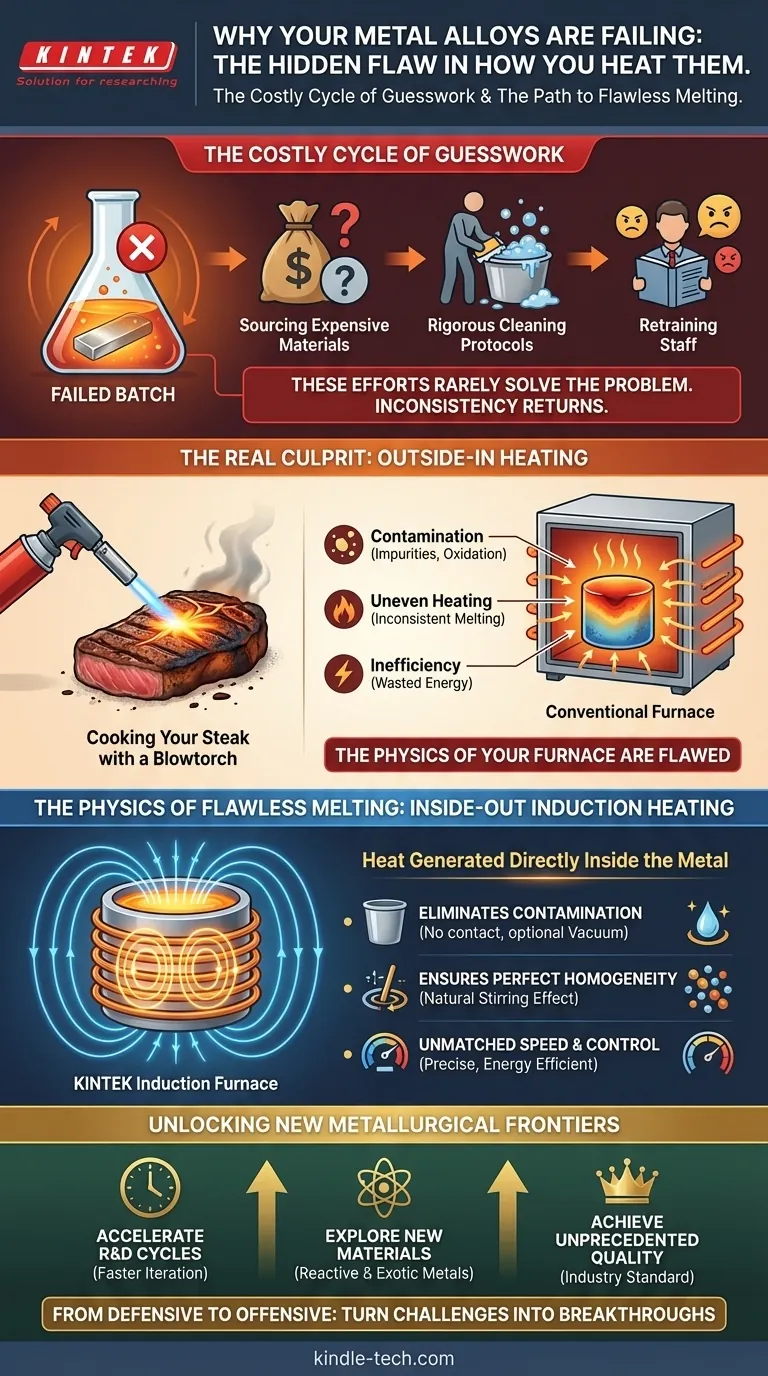
The Real Culprit: Are You Cooking Your Steak with a Blowtorch?
The reason these fixes fail is that they overlook the most fundamental factor: how the metal is being heated.
Think of it this way: imagine trying to cook a thick, perfect steak using a blowtorch. You blast the outside with intense heat. By the time the center is even warm, the surface is burnt to a crisp, creating a charred, uneven mess.
This is precisely what happens in a conventional furnace (like a gas or resistance furnace). The heat is generated outside the metal and must slowly seep in. This "outside-in" method is the hidden flaw behind your inconsistent results. It inherently creates several problems:
- Contamination: The intense external heat source can burn fuel incompletely or degrade, introducing impurities directly into your melt. The hot metal surface also reacts readily with oxygen in the air, causing oxidation.
- Uneven Heating: Just like the steak, the edges of the metal get much hotter than the core, leading to inconsistent melting and poor alloying.
- Inefficiency: A huge amount of energy is wasted heating the furnace walls and the air around your material, not the material itself.
You can have the world's best ingredients, but if your cooking method is flawed, you'll never get a perfect result. Your problem isn't your materials or your people; it's the physics of your furnace.
The Physics of Flawless Melting: Heating from the Inside-Out
What if, instead of heating the steak from the outside, you could make the steak cook itself perfectly from the inside-out?
This is the principle of induction heating. It uses a powerful, non-contact magnetic field to generate electrical "eddy currents" directly inside the metal. The metal's own natural resistance fights these currents, and that struggle instantly generates uniform, controllable heat throughout the material.
The metal becomes its own heating element. This simple shift in physics changes everything.
A Tool Engineered for the Principle: The Induction Furnace
To leverage the power of "inside-out" heating, you need a tool built specifically for that purpose. This is where a high-frequency induction furnace becomes the logical solution, not just another piece of equipment. It is the embodiment of a better scientific approach.
A KINTEK induction furnace directly addresses the root causes of failure that plague traditional methods:
- Eliminates Contamination: Because heating is non-contact, there are no burning fuels or degrading heating elements to introduce impurities. For the most sensitive applications, a Vacuum Induction Furnace removes air entirely, preventing any possibility of oxidation and creating ultra-pure alloys for aerospace or medical use.
- Ensures Perfect Homogeneity: The magnetic field that generates the heat also creates a natural, gentle stirring effect within the molten metal. This constant motion guarantees that all elements are perfectly mixed, resulting in a completely uniform and consistent alloy, every single time.
- Delivers Unmatched Speed and Control: Heat is generated instantly and only where it's needed—in the metal. This allows for incredibly fast melt times and precise temperature control that "outside-in" methods can never achieve, dramatically reducing energy consumption.
This isn't a temporary fix. It's a permanent solution engineered from a deeper understanding of the problem.
Beyond Consistency: Unlocking New Metallurgical Frontiers
Once you are free from the constant struggle for consistency, you can focus on what truly matters: innovation. Solving this "old problem" for good unlocks a new level of potential for your work.
- Accelerate R&D Cycles: When you can create a perfect test melt in a fraction of the time, your team can iterate on new formulas faster than ever before. The cycle of "idea-to-analysis" shrinks from weeks to days.
- Explore New Materials: You can now confidently work with highly reactive or exotic metals that were previously impossible to melt without significant contamination, opening doors to developing next-generation superalloys.
- Achieve Unprecedented Quality: For applications where failure is not an option, like medical implants or turbine blades, you can produce materials with a level of purity and structural integrity that sets a new industry standard.
You move from a defensive position of trying to avoid failure to an offensive one of actively pursuing new breakthroughs.
Your lab's challenges aren't just about managing materials; they're about overcoming fundamental physical barriers to achieve your goals. At KINTEK, we provide the tools that turn those barriers into gateways for innovation. Let's discuss how the right heating technology can transform your project from a challenge into a breakthrough. Contact Our Experts.
Visual Guide
Related Products
- 600T Vacuum Induction Hot Press Furnace for Heat Treat and Sintering
- Lab-Scale Vacuum Induction Melting Furnace
- Non Consumable Vacuum Arc Induction Melting Furnace
- Vacuum Arc Induction Melting Furnace
- Controlled Nitrogen Inert Hydrogen Atmosphere Furnace
Related Articles
- Comprehensive Guide to Vacuum Hot Press Furnace Application
- The Purity Paradox: Choosing the Heart of Your Vacuum Hot Press Furnace
- Vacuum Hot Press Furnace: A Comprehensive Guide
- Forging Perfection in a Void: The Physics of Ultra-Dense Materials
- Applications and Advances in Vacuum Hot Press Sintering Furnaces for Precision Ceramics



















