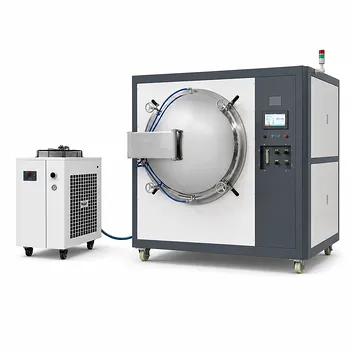
Vacuum hot press sintering (HPS) consolidates NiAl-Al2O3 powders through a synergistic combination of thermal energy and mechanical force. This process utilizes radiant heat from external elements to soften the material, while a hydraulic system applies continuous axial pressure. Under these high-temperature vacuum conditions, the powder particles densify through plastic deformation and diffusion creep.
Core Takeaway The effectiveness of HPS lies in its ability to mechanically force particle rearrangement and bonding while the material is thermally softened. This dual-action approach eliminates internal pores and produces a dense bulk material more efficiently than thermal sintering alone.
The Mechanical and Thermal Drivers
The HPS furnace operates by synchronizing two distinct physical inputs to drive the consolidation of the composite powder.
Radiant Thermal Energy
The furnace employs external heating elements to generate intense heat.
This energy is transferred to the powder via radiation. The primary goal is to elevate the temperature of the NiAl-Al2O3 mixture to a point where the material becomes compliant, yet remains below its melting point.
Continuous Axial Pressure
While the material is heated, a hydraulic system exerts a constant mechanical force.
This force is applied axially (in a single direction) onto the powder mass. The pressure acts as the physical driver that forces particles together, overcoming the resistance that naturally occurs between solid granules.
Microstructural Response Mechanisms
The application of heat and pressure triggers specific physical responses within the NiAl-Al2O3 powder that lead to consolidation.
Plastic Deformation
Under the influence of high heat and axial pressure, the powder particles yield physically.
They undergo plastic deformation, changing shape to fill the voids between them. This mechanical reshaping maximizes the contact area between the NiAl (metal aluminide) and Al2O3 (ceramic) particles.
Diffusion Creep
Simultaneously, the material experiences diffusion creep.
This is a time-dependent deformation process where atoms move (diffuse) under the influence of stress and temperature. This mechanism is critical for closing the smallest gaps between particles that plastic deformation alone cannot resolve.
Pore Elimination
The combination of deformation and creep results in the systematic removal of internal pores.
By mechanically collapsing voids and chemically bonding particle interfaces via diffusion, the process transforms loose powder into a solid, dense bulk material.
Understanding the Operational Environment
The Role of Vacuum
The entire process takes place within a vacuum environment.
This is essential for high-quality consolidation. The vacuum prevents oxidation of the metallic constituents (NiAl) at high temperatures and aids in the removal of volatile impurities that could otherwise become trapped within the solidifying mass.
Critical Considerations and Trade-offs
While HPS is effective, understanding the interaction between stress and temperature is vital for successful consolidation.
Dependency on Simultaneous Inputs
The process relies entirely on the simultaneous application of heat and pressure.
If pressure is applied without sufficient heat, the particles will not deform plastically, leading to a brittle, porous compact. Conversely, heat without sufficient pressure relies solely on diffusion, which is significantly slower and often yields lower density.
The Limits of Creep
Diffusion creep is the mechanism that finalizes density, but it is a slow process.
Pushing the process too fast by increasing pressure excessively can bypass the benefits of creep, potentially leading to residual stress or density gradients within the material. The parameters must be balanced to allow time for diffusion to occur.
Making the Right Choice for Your Goal
To maximize the quality of your NiAl-Al2O3 composite, align your process parameters with your specific material objectives.
- If your primary focus is Maximum Density: Prioritize the duration of the hold time at peak temperature and pressure to allow diffusion creep to fully eliminate microscopic pores.
- If your primary focus is Material Purity: Ensure the vacuum integrity is maintained throughout the heating cycle to prevent oxidation of the NiAl phase before consolidation occurs.
The success of vacuum hot press sintering depends on balancing sufficient thermal energy to soften the material with enough axial pressure to physically close the voids.
Summary Table:
| Mechanism | Action & Driver | Outcome |
|---|---|---|
| Radiant Heating | External elements provide thermal energy | Softens material and enables atomic diffusion |
| Axial Pressure | Hydraulic system applies continuous force | Forces particle rearrangement and physical contact |
| Plastic Deformation | Particles yield under heat and stress | Reshapes granules to fill large voids and gaps |
| Diffusion Creep | Time-dependent atomic migration | Eliminates microscopic pores for maximum density |
| Vacuum Environment | Removal of atmospheric gases | Prevents oxidation and extracts volatile impurities |
Elevate Your Material Research with KINTEK
Unlock the full potential of your composite materials with KINTEK’s industry-leading vacuum hot press sintering (HPS) systems. Whether you are developing advanced NiAl-Al2O3 composites or complex ceramics, our high-precision equipment provides the exact control over thermal and mechanical parameters required for zero-porosity consolidation.
Why choose KINTEK?
- Comprehensive Laboratory Solutions: From high-temperature furnaces and hydraulic presses to specialized crushing, milling, and sieving equipment.
- Precision Engineering: Our vacuum furnaces and autoclaves ensure material purity and consistent microstructural integrity.
- End-to-End Support: We provide the essential consumables, including ceramics and crucibles, to keep your lab running efficiently.
Ready to achieve superior material density and purity? Contact our technical experts today to find the perfect sintering solution for your lab.
Related Products
- 600T Vacuum Induction Hot Press Furnace for Heat Treat and Sintering
- Vacuum Heat Treat and Sintering Furnace with 9MPa Air Pressure
- Vacuum Heat Treat and Pressure Sintering Furnace for High Temperature Applications
- Vacuum Hot Press Furnace Heated Vacuum Press Machine Tube Furnace
- Vacuum Hot Press Furnace Machine Heated Vacuum Press
People Also Ask
- What role does an induction vacuum hot pressing furnace play in sintering? Achieve 98% Density in Carbide Blocks
- What advantages does a vacuum hot press furnace provide for LSLBO ceramic electrolytes? Achieve 94% Relative Density
- What role does a Vacuum Hot Press (VHP) furnace play in the densification of austenitic stainless steel 316 composites?
- What are the advantages of a vacuum hot press furnace for W-50%Cu? Achieve 99.6% Density at Lower Temperatures
- What role does mechanical pressure play during the vacuum diffusion bonding of tungsten and copper? Keys to Solid Bonding