Knowledge Can a furnace melt tungsten? Unlocking the Secrets of Extreme Temperature Processing
Author avatar

Tech Team · Kintek Solution

Updated 6 days ago

Can a furnace melt tungsten? Unlocking the Secrets of Extreme Temperature Processing


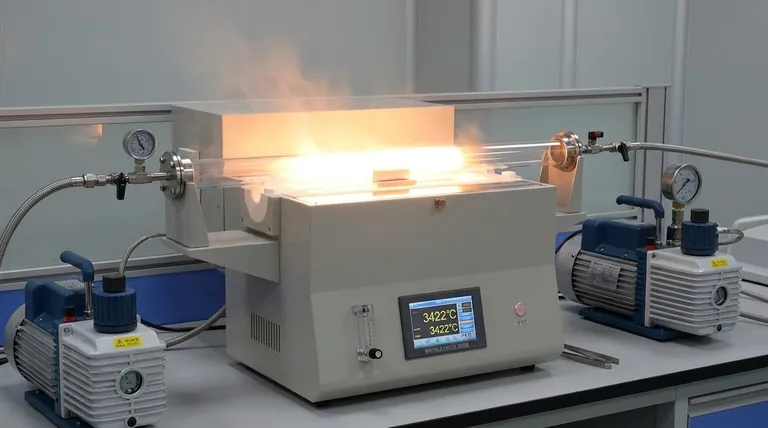
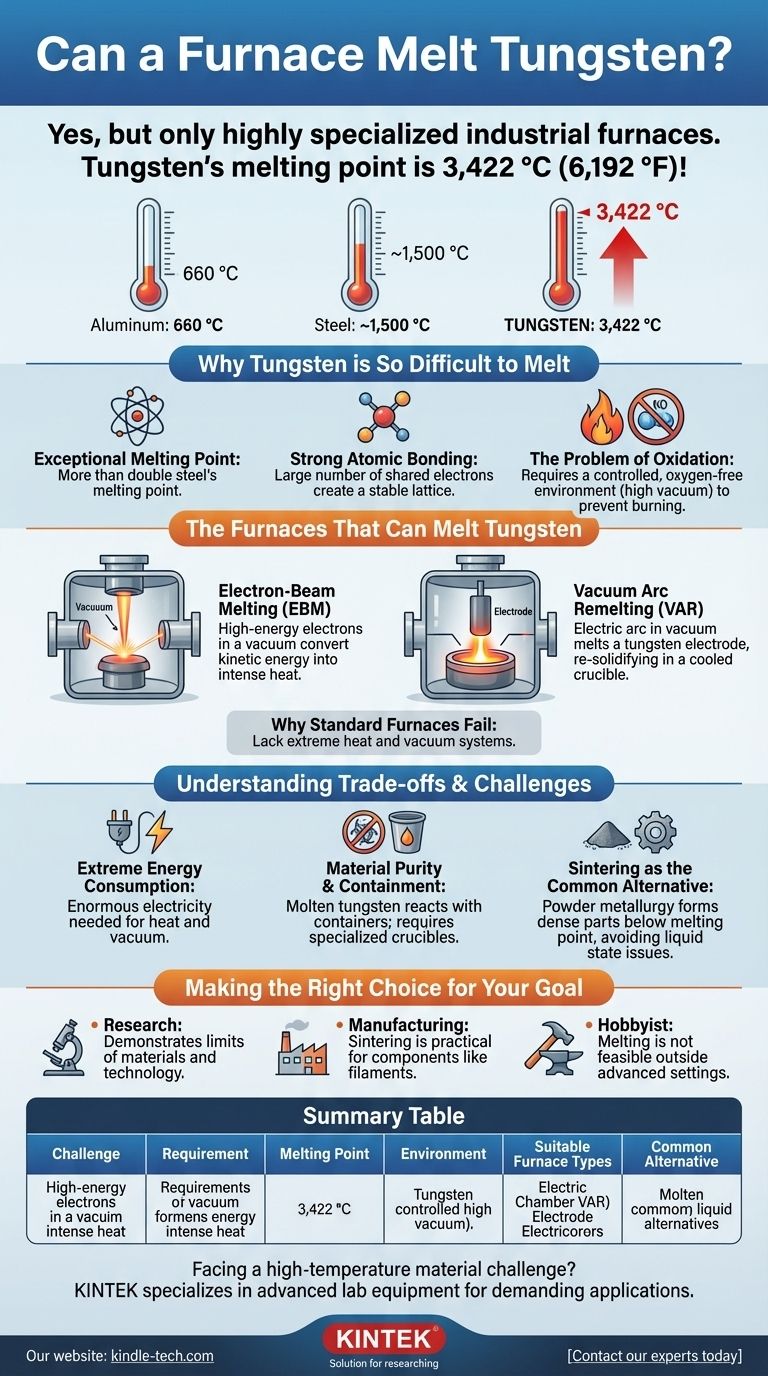
Yes, a furnace can melt tungsten, but only a highly specialized industrial one. Tungsten has the highest melting point of any pure metal at an astonishing 3,422 °C (6,192 °F). This temperature is far beyond the capability of any standard furnace, such as those used for steel or even a blacksmith's forge. Melting tungsten requires advanced technology designed specifically to generate and contain such extreme heat in a controlled environment.

The ability to melt tungsten is not a question of simply "getting it hot enough." It is an industrial challenge that requires overcoming its extreme melting point, preventing its rapid oxidation at high temperatures, and using specialized furnaces like electron-beam or vacuum arc systems that are fundamentally different from conventional equipment.
Can a furnace melt tungsten? Unlocking the Secrets of Extreme Temperature Processing

Why Tungsten is So Difficult to Melt

To appreciate the challenge, we must first understand the unique properties of the metal itself. Tungsten’s resilience is rooted in its fundamental atomic structure.

The Exceptional Melting Point

Tungsten's melting point of 3,422 °C (6,192 °F) sets it apart from nearly all other materials. For context, this is more than double the melting point of steel (around 1,500 °C) and five times that of aluminum (660 °C).

Strong Atomic Bonding

The "why" behind this high melting point lies in its atomic structure. Tungsten atoms are held together by incredibly strong metallic bonds. The large number of shared electrons creates a highly stable and dense lattice that requires an immense amount of thermal energy to break apart.

The Problem of Oxidation

Even if you could generate the required heat, you cannot melt tungsten in the open air. At elevated temperatures, tungsten reacts very quickly with oxygen and would essentially burn away (oxidize) before it ever reached a liquid state. This mandates a controlled, oxygen-free environment, typically a high vacuum.

The Furnaces That Can Melt Tungsten

Because of these challenges, melting tungsten is reserved for specific industrial processes using purpose-built equipment.

Electron-Beam Melting (EBM)

This is a highly precise method. In a high vacuum, a beam of high-energy electrons is aimed at the tungsten. The kinetic energy from the electrons is instantly converted into intense heat, melting the material. The vacuum environment is perfect for preventing oxidation.

Vacuum Arc Remelting (VAR)

In this process, a large tungsten electrode is positioned inside a vacuum chamber above a water-cooled copper crucible. An electric arc is struck between the electrode and the crucible, creating intense heat that melts the tip of the electrode. The molten tungsten drips down and re-solidifies in the crucible, forming a purified ingot.

Why Standard Furnaces Fail

A blast furnace for iron ore only reaches about 1,650 °C. A typical industrial heat-treating furnace may reach 1,300 °C. These temperatures are not even halfway to what is needed to melt tungsten. Furthermore, they lack the vacuum systems necessary to prevent catastrophic oxidation.

Understanding the Trade-offs and Challenges

Melting tungsten is not just difficult; it is also resource-intensive and presents unique engineering problems.

Extreme Energy Consumption

Generating the temperatures and high vacuums required for EBM or VAR furnaces consumes an enormous amount of electricity. This contributes significantly to the high cost of processing tungsten.

Material Purity and Containment

At 3,422 °C, molten tungsten is highly reactive. It can dissolve or react with almost any container (crucible) holding it, leading to contamination. This is why water-cooled copper crucibles or "crucible-less" EBM methods are used, as they keep the molten pool contained without direct contact with a meltable material.

Sintering as the Common Alternative

Because of these complexities, the vast majority of tungsten products are not made by melting and casting. Instead, they are formed through powder metallurgy. Tungsten powder is compressed into a desired shape and then heated to a high temperature—but below its melting point—in a process called sintering. The atoms bond together, creating a solid, dense object without ever becoming liquid.

Making the Right Choice for Your Goal

Your approach to tungsten depends entirely on your objective, as working with it in its molten state is rarely the practical solution.

  • If your primary focus is research or academics: Understand that melting tungsten is a benchmark for extreme material processing, demonstrating the limits of both material science and furnace technology.
  • If your primary focus is manufacturing or design: Recognize that tungsten parts are almost exclusively made via sintering (powder metallurgy), which is a more practical and cost-effective method for creating components like filaments or electrical contacts.
  • If your primary focus is hobbyist metalworking: Acknowledge that melting tungsten is not feasible outside of a major industrial or advanced research setting due to the prohibitive temperature, vacuum, and safety requirements.

Understanding the immense difficulty of melting tungsten gives you a clear appreciation for why it is one of our most vital high-performance materials.

Summary Table:

Challenge Requirement
Melting Point 3,422 °C (6,192 °F)
Environment High Vacuum (to prevent oxidation)
Suitable Furnace Types Electron-Beam Melting (EBM), Vacuum Arc Remelting (VAR)
Common Alternative Powder Metallurgy / Sintering

Facing a high-temperature material challenge? KINTEK specializes in advanced lab equipment and consumables for demanding applications. Whether you're in R&D or manufacturing, our expertise can help you select the right technology for your specific material processing needs. Contact our experts today to discuss how we can support your laboratory's goals.

Visual Guide
Can a furnace melt tungsten? Unlocking the Secrets of Extreme Temperature Processing Visual Guide

Related Products

People Also Ask

Related Products

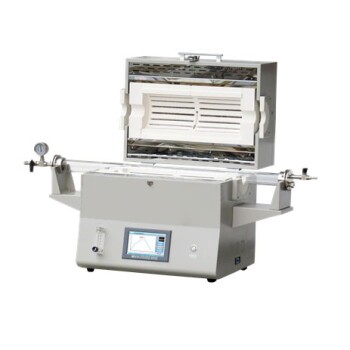
1400℃ Laboratory Quartz Tube Furnace with Alumina Tube Tubular Furnace

1400℃ Laboratory Quartz Tube Furnace with Alumina Tube Tubular Furnace

Looking for a tube furnace for high-temperature applications? Our 1400℃ Tube Furnace with Alumina Tube is perfect for research and industrial use.

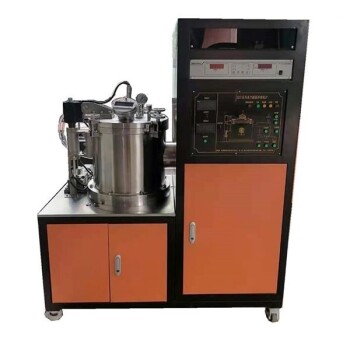
Vacuum Heat Treat Furnace and Levitation Induction Melting Furnace

Vacuum Heat Treat Furnace and Levitation Induction Melting Furnace

Experience precise melting with our Vacuum Levitation Melting Furnace. Ideal for high melting point metals or alloys, with advanced technology for effective smelting. Order now for high-quality results.

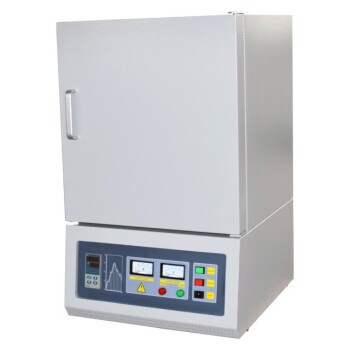
Laboratory Muffle Oven Furnace Bottom Lifting Muffle Furnace

Laboratory Muffle Oven Furnace Bottom Lifting Muffle Furnace

Efficiently produce batches with excellent temperature uniformity using our Bottom Lifting Furnace. Features two electric lifting stages and advanced temperature control up to 1600℃.

Vacuum Heat Treat Sintering Brazing Furnace

Vacuum Heat Treat Sintering Brazing Furnace

A vacuum brazing furnace is a type of industrial furnace used for brazing, a metalworking process that joins two pieces of metal using a filler metal that melts at a lower temperature than the base metals. Vacuum brazing furnaces are typically used for high-quality applications where a strong, clean joint is required.

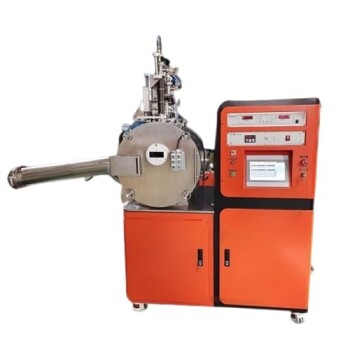
Vacuum Induction Melting Spinning System Arc Melting Furnace

Vacuum Induction Melting Spinning System Arc Melting Furnace

Develop metastable materials with ease using our Vacuum Melt Spinning System. Ideal for research and experimental work with amorphous and microcrystalline materials. Order now for effective results.

Molybdenum Vacuum Heat Treat Furnace

Molybdenum Vacuum Heat Treat Furnace

Discover the benefits of a high-configuration molybdenum vacuum furnace with heat shield insulation. Ideal for high-purity, vacuum environments like sapphire crystal growth and heat treatment.

1700℃ Controlled Atmosphere Furnace Nitrogen Inert Atmosphere Furnace

1700℃ Controlled Atmosphere Furnace Nitrogen Inert Atmosphere Furnace

KT-17A Controlled atmosphere furnace: 1700℃ heating, vacuum sealing technology, PID temperature control, and versatile TFT smart touch screen controller for laboratory and industrial use.

High Pressure Laboratory Vacuum Tube Furnace Quartz Tubular Furnace

High Pressure Laboratory Vacuum Tube Furnace Quartz Tubular Furnace

KT-PTF High Pressure Tube Furnace: Compact split tube furnace with strong positive pressure resistance. Working temp up to 1100°C and pressure up to 15Mpa. Also works under controller atmosphere or high vacuum.

1700℃ Laboratory Quartz Tube Furnace with Alumina Tube Tubular Furnace

1700℃ Laboratory Quartz Tube Furnace with Alumina Tube Tubular Furnace

Looking for a high-temperature tube furnace? Check out our 1700℃ Tube Furnace with Alumina Tube. Perfect for research and industrial applications up to 1700C.

1800℃ Muffle Oven Furnace for Laboratory

1800℃ Muffle Oven Furnace for Laboratory

KT-18 muffle furnace with Japan Al2O3 polycrystalline fibe and Silicon Molybdenum heating element, up to 1900℃, PID temperature control and 7" smart touch screen. Compact design, low heat loss, and high energy efficiency. Safety interlock system and versatile functions.

High Temperature Muffle Oven Furnace for Laboratory Debinding and Pre Sintering

High Temperature Muffle Oven Furnace for Laboratory Debinding and Pre Sintering

KT-MD High temperature debinding and pre-sintering furnace for ceramic materials with various molding processes. Ideal for electronic components such as MLCC and NFC.

600T Vacuum Induction Hot Press Furnace for Heat Treat and Sintering

600T Vacuum Induction Hot Press Furnace for Heat Treat and Sintering

Discover the 600T Vacuum Induction Hot Press Furnace, designed for high-temperature sintering experiments in vacuum or protected atmospheres. Its precise temperature and pressure control, adjustable working pressure, and advanced safety features make it ideal for nonmetal materials, carbon composites, ceramics, and metal powders.

1700℃ Muffle Oven Furnace for Laboratory

1700℃ Muffle Oven Furnace for Laboratory

Get superior heat control with our 1700℃ Muffle Furnace. Equipped with intelligent temperature microprocessor, TFT touch screen controller & advanced insulation materials for precise heating up to 1700C. Order now!

1400℃ Muffle Oven Furnace for Laboratory

1400℃ Muffle Oven Furnace for Laboratory

Get precise high-temperature control up to 1500℃ with KT-14M Muffle furnace. Equipped with a smart touch screen controller and advanced insulation materials.

Vacuum Hot Press Furnace Heated Vacuum Press Machine Tube Furnace

Vacuum Hot Press Furnace Heated Vacuum Press Machine Tube Furnace

Reduce forming pressure & shorten sintering time with Vacuum Tube Hot Press Furnace for high-density, fine-grain materials. Ideal for refractory metals.

Graphite Vacuum Continuous Graphitization Furnace

Graphite Vacuum Continuous Graphitization Furnace

High-temperature graphitization furnace is a professional equipment for graphitization treatment of carbon materials. It is a key equipment for the production of high-quality graphite products. It has high temperature, high efficiency and uniform heating. It is suitable for various high-temperature treatments and graphitization treatments. It is widely used in metallurgy, electronics, aerospace, etc. industry.

Vacuum Heat Treat and Sintering Furnace with 9MPa Air Pressure

Vacuum Heat Treat and Sintering Furnace with 9MPa Air Pressure

The air pressure sintering furnace is a high-tech equipment commonly used for the sintering of advanced ceramic materials. It combines vacuum sintering and pressure sintering techniques to achieve high-density and high-strength ceramics.

Vacuum Heat Treat and Molybdenum Wire Sintering Furnace for Vacuum Sintering

Vacuum Heat Treat and Molybdenum Wire Sintering Furnace for Vacuum Sintering

A vacuum molybdenum wire sintering furnace is a vertical or bedroom structure, which is suitable for withdrawal, brazing, sintering and degassing of metal materials under high vacuum and high temperature conditions. It is also suitable for dehydroxylation treatment of quartz materials.

Vertical High Temperature Graphite Vacuum Graphitization Furnace

Vertical High Temperature Graphite Vacuum Graphitization Furnace

Vertical high temperature graphitization furnace for carbonization and graphitization of carbon materials up to 3100℃.Suitable for shaped graphitization of carbon fiber filaments and other materials sintered in a carbon environment.Applications in metallurgy, electronics, and aerospace for producing high-quality graphite products like electrodes and crucibles.

Vacuum Sealed Continuous Working Rotary Tube Furnace Rotating Tube Furnace

Vacuum Sealed Continuous Working Rotary Tube Furnace Rotating Tube Furnace

Experience efficient material processing with our vacuum-sealed rotary tube furnace. Perfect for experiments or industrial production, equipped with optional features for controlled feeding and optimized results. Order now.


Leave Your Message