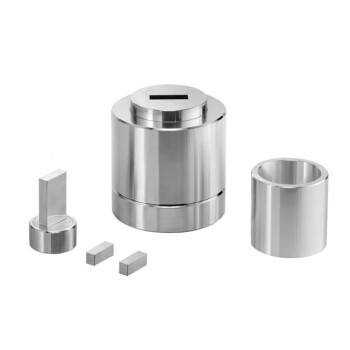
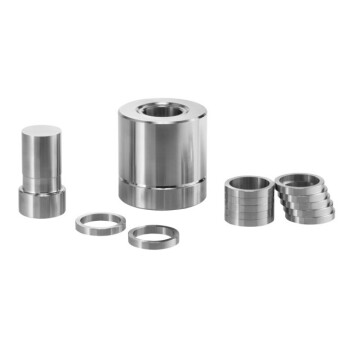
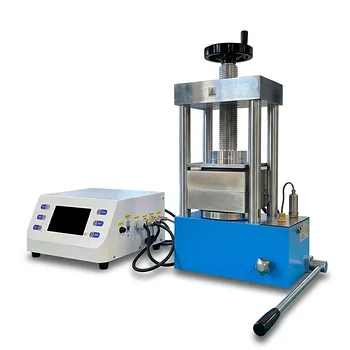
Laboratory hydraulic presses and pellet dies are used to compress loose vanadium oxide powders into dense, solid pellets with fixed geometric dimensions. This physical transformation is necessary to eliminate contact resistance and air gaps that would otherwise distort electrical readings. By creating a uniform, high-density sample, researchers can accurately measure the material’s intrinsic resistivity changes as it undergoes phase transitions during heating or cooling cycles.
The Core Takeaway: Using a hydraulic press and pellet die converts vanadium oxide powder into a standardized pellet to ensure that DC conductivity measurements reflect the material's true physical properties, rather than the interference caused by loose particle contact.
Transforming Powder into Measurable Samples
Achieving Precise Geometric Dimensions
A pellet die serves as a precision mold, typically producing samples with a diameter of approximately 8 mm and a thickness of 2 mm. These fixed dimensions are critical for calculating resistivity, as they provide a consistent volume for current to flow through.
The Role of High-Pressure Compression
The hydraulic press applies several tons of force to the powder within the metal die. This force causes particles to undergo plastic deformation, packing them closely together and effectively excluding air from the sample.
Ensuring Sample Structural Integrity
High-pressure pressing provides the initial density required for the sample to remain intact during testing. For materials requiring further processing, such as sintering, this high green density prevents the formation of voids that would obstruct current conduction.
Eliminating Resistance Interference
Removing Contact Resistance
Loose powders suffer from high contact resistance because current must "jump" between poorly connected particles. The hydraulic press ensures tight contact between powder particles, which removes this interference and allows for a clean measurement of the material's bulk conductivity.
Minimizing Porosity and Air Gaps
Porosity in a sample creates "dead zones" where electricity cannot flow easily. By using a press to reach a high compaction density, researchers minimize these gaps, ensuring the resulting data accurately reflects the intrinsic conductive performance of the vanadium oxide.
Facilitating Uniform Current Flow
A dense, uniform pellet ensures that the direct current (DC) flows evenly across the entire cross-section of the sample. This uniformity is essential for obtaining reproducible data that can be compared across different experimental batches.
Capturing Intrinsic Phase Transitions
Monitoring Resistivity Changes
Vanadium oxides are known for their ability to undergo phase transitions at specific temperatures. Dense pellets allow researchers to observe how resistivity shifts during these transitions without the noise caused by shifting powder grains.
Stability During Thermal Cycles
As the sample is subjected to heating or cooling cycles, it must remain physically stable. A pressed pellet maintains its shape and particle-to-particle contact even as the material expands or contracts during temperature changes.
Identifying High-Performance Networks
Using the precision pressure-holding function of a hydraulic press, researchers can study the relationship between compaction density and electrical conductivity. This helps in identifying the optimal preparation parameters for creating high-performance conductive networks.
Understanding the Trade-offs
Pressure Sensitivity
The conductivity of a sample can change depending on the applied pressure used during formation. If the pressure is not standardized, different pellets of the same material may yield different conductivity results, leading to inconsistent data.
Material Brittleness and Cracking
Not all powders deform easily; some vanadium oxide structures may be brittle. Applying excessive pressure can cause micro-cracking or "capping" (where the pellet delaminates), which introduces new resistances and ruins the measurement.
Surface Contamination
The use of metal pellet dies introduces a risk of surface contamination from the mold itself. Any metallic residue left on the surface of the vanadium oxide pellet can create a "short circuit," leading to artificially high conductivity readings.
How to Apply This to Your Research
Recommended Best Practices
- If your primary focus is intrinsic material properties: Ensure you press the powder to a density where conductivity no longer increases with additional pressure, indicating that contact resistance has been minimized.
- If your primary focus is phase transition temperature: Use a pellet die that produces a thin sample (around 2 mm) to ensure rapid and uniform heat distribution throughout the material during testing.
- If your primary focus is electrode performance: Utilize a hydraulic press with a variable pressure-holding module to record how conductivity fluctuates at different stages of material compaction.
Proper sample preparation through controlled hydraulic pressing is the foundational step in unlocking the complex electrical secrets of vanadium oxide materials.
Summary Table:
| Feature | Application in Conductivity Measurement | Key Benefit |
|---|---|---|
| High Compression | Eliminates air gaps & contact resistance | Accurate intrinsic resistivity |
| Precision Molding | Provides fixed geometric dimensions | Consistent volume for calculations |
| Green Density | Ensures structural integrity | Stability during thermal cycles |
| Uniform Packing | Facilitates even current flow | High reproducibility of data |
Elevate Your Material Research with KINTEK
Precision in sample preparation is the key to unlocking accurate electrical data. KINTEK specializes in high-performance laboratory equipment designed for rigorous material science applications. Whether you are measuring the DC conductivity of vanadium oxides or exploring phase transitions, our solutions ensure consistency and reliability.
Our specialized portfolio includes:
- Hydraulic Presses: Precision pellet, hot, and isostatic presses for optimal sample density.
- Crushing & Milling: High-efficiency systems for uniform powder preparation.
- High-Temperature Furnaces: Muffle, tube, and vacuum furnaces for precise thermal cycling.
- Consumables: High-quality pellet dies, crucibles, and ceramics.
Don't let sample inconsistencies skew your research results. Contact KINTEK today to discover how our high-pressure systems and thermal solutions can streamline your laboratory workflow and deliver superior data accuracy.
References
- P. Polak, Tomasz K. Pietrzak. Observation of Metal–Insulator Transition (MIT) in Vanadium Oxides V2O3 and VO2 in XRD, DSC and DC Experiments. DOI: 10.3390/cryst13091299
This article is also based on technical information from Kintek Solution Knowledge Base .
Related Products
- Automatic Laboratory Hydraulic Pellet Press Machine for Lab Use
- kbr pellet press 2t
- Laboratory Manual Hydraulic Pellet Press for Lab Use
- Automatic Laboratory Hydraulic Press for XRF & KBR Pellet Press
- Laboratory Manual Hydraulic Pellet Press for Lab Use
People Also Ask
- What is the role of a laboratory hydraulic pellet press and stainless steel molds in the fabrication of RuO2/NbC anodes?
- What role does a laboratory pellet press play in the enhancement of biomass energy products? Optimize Fuel Efficiency
- What is the purpose of using a laboratory pellet press when evaluating the electronic conductivity of carbon powders? Guide
- How does a laboratory hydraulic pellet press contribute to SiCw/2024 aluminum composite preforms? Optimize Densification
- What is the significance of applying 200 MPa of pressure with a laboratory hydraulic pellet press for composite ceramics?