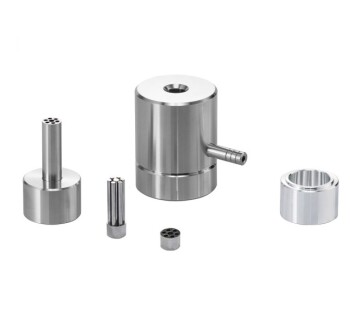
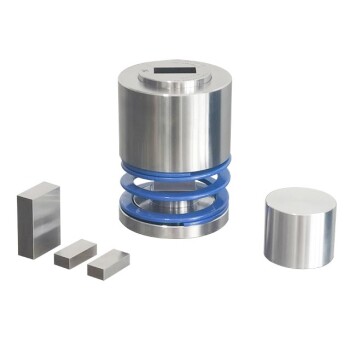
Laboratory hydraulic presses and toroid-type high-pressure devices function as the essential engine for converting loose carbide nanopowders into high-performance bulk materials. By operating in tandem, these tools generate extreme environments—specifically pressures up to 8 GPa and temperatures around 850 °C—to facilitate the sintering and consolidation necessary for creating solid nanocomposites.
The core advantage of this high-pressure approach is the ability to decouple densification from grain growth. By applying ultra-high pressure during sintering, these devices inhibit the expansion of crystalline grains that normally occurs at high temperatures, preserving the material's nanostructure while achieving full density.
The Mechanics of Consolidation
Generating Extreme Conditions
The process relies on the synergy between the hydraulic press and the toroid-type device. The hydraulic press supplies the raw force, while the toroid device translates and focuses this force into an ultra-high pressure environment.
Together, they achieve processing conditions that standard sintering methods cannot match. Specifically, they allow for operations at pressures of 8 GPa and temperatures of 850 °C.
From Powder to Bulk
The primary physical task of this setup is consolidation. It transforms synthesized nanopowders, which are loose and difficult to handle, into a solid, cohesive unit.
This is achieved through sintering, where thermal energy and pressure fuse the particles together. The toroid-type device ensures this pressure is applied uniformly to the sample.
Controlling Microstructure and Performance
Inhibiting Grain Growth
The most critical contribution of this technology is its impact on grain size. In conventional sintering, high temperatures usually cause nanocrystalline grains to grow larger, effectively destroying the "nano" aspect of the material.
The ultra-high pressure provided by the hydraulic press counteracts this thermal effect. It physically inhibits the growth of the grains, locking the microstructure in its nanoscale state even as the material heats up.
Achieving Superior Properties
The result of this controlled process is a bulk nanocomposite with distinct physical advantages. Because the grains remain fine, the final product exhibits a fine-grained microstructure.
This microstructure directly correlates to enhanced mechanical performance. The consolidated materials are characterized by high density and superior hardness, properties that would be diminished if the grains were allowed to expand.
Understanding the Process Dynamics
The Temperature-Structure Trade-off
A common challenge in materials science is that the heat required to make a material dense also tends to degrade its fine structure. High temperatures typically drive grain boundary migration, leading to coarsening.
These high-pressure devices effectively bypass this trade-off. They allow you to apply the heat needed for density without suffering the penalty of grain growth, but this requires precise control over the pressure parameters to ensure the inhibition mechanism is active.
Making the Right Choice for Your Goal
To maximize the effectiveness of laboratory hydraulic presses and toroid-type devices in your workflow, consider your specific material objectives:
- If your primary focus is preserving nanostructure: Prioritize maintaining ultra-high pressure (e.g., 8 GPa) throughout the heating cycle to actively prevent grain coarsening.
- If your primary focus is mechanical hardness: Ensure the consolidation temperature is sufficient (e.g., 850 °C) to achieve high density, relying on the pressure to maintain the fine-grained microstructure that drives hardness.
High-pressure consolidation remains the most effective pathway for translating the theoretical benefits of nanopowders into tangible, high-hardness bulk composites.
Summary Table:
| Parameter | Specification/Effect | Role in Consolidation |
|---|---|---|
| Applied Pressure | Up to 8 GPa | Suppresses grain growth and ensures high density |
| Temperature | Around 850 °C | Provides thermal energy for sintering nanopowders |
| Material State | Powder to Bulk | Transforms loose nanopowder into solid composites |
| Microstructure | Nanoscale | Preserves fine-grained structure via pressure inhibition |
| Key Outcome | Enhanced Hardness | Achieves superior mechanical performance and durability |
Elevate Your Materials Research with KINTEK Precision Solutions
Transform your nanopowders into high-performance bulk materials with KINTEK’s industry-leading laboratory equipment. Whether you are developing next-generation carbide nanocomposites or advanced ceramics, our comprehensive range of hydraulic presses (pellet, hot, isostatic) and high-temperature furnaces provides the extreme pressure and thermal control necessary to achieve full density without sacrificing nanostructure.
From high-temperature high-pressure reactors to specialized crushing and milling systems, KINTEK empowers researchers and manufacturers with the tools to push the boundaries of materials science.
Ready to optimize your consolidation process? Contact us today to find the perfect equipment for your lab!
References
- O. Nakonechna, N.M. Belyavina. Effect of Carbon Nanotubes on Mechanochemical Synthesis of d-Metal Carbide Nanopowders and Nanocomposites. DOI: 10.15407/ufm.20.01.005
This article is also based on technical information from Kintek Solution Knowledge Base .
Related Products
- Vacuum Heat Treat and Sintering Furnace with 9MPa Air Pressure
- Vacuum Heat Treat and Pressure Sintering Furnace for High Temperature Applications
- 600T Vacuum Induction Hot Press Furnace for Heat Treat and Sintering
- High Temperature Muffle Oven Furnace for Laboratory Debinding and Pre Sintering
- Spark Plasma Sintering Furnace SPS Furnace
People Also Ask
- What is the process of pressure sintering? Achieve Superior Density and Strength for High-Performance Parts
- What is the effect of pressure during sintering? Achieve Higher Density and Finer Microstructures Faster
- Why must green bodies produced via binder jetting undergo treatment in a vacuum sintering furnace?
- What is a vacuum sintering furnace? Unlock Purity and Performance in Advanced Materials
- How does the vacuum environment impact sintering of diamond-copper composites? Protect Against Thermal Damage