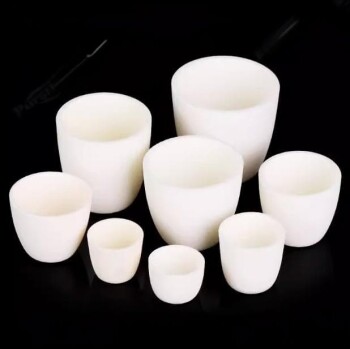
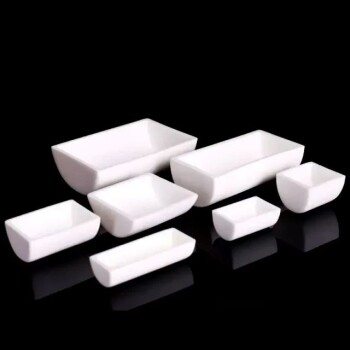
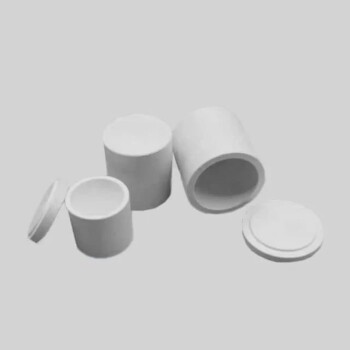
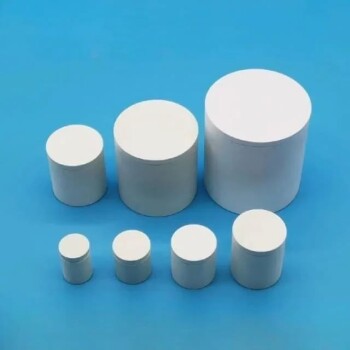
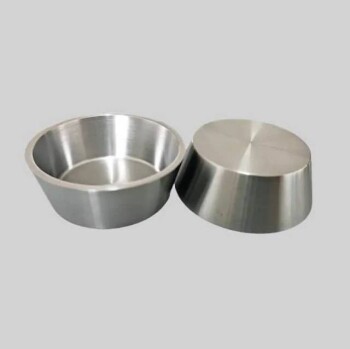
Magnesium oxide (MgO) crucibles and sacrificial powders function as a dual-layer protection system during the high-temperature sintering of Li1.5Al0.5Ti1.5(PO4)3 (LATP). While the MgO crucible provides the necessary thermal resistance to contain the process at 900°C, the sacrificial powder acts as a critical physical barrier to isolate the LATP green body from the container walls.
The core purpose of this configuration is to decouple thermal containment from chemical interaction. By preventing direct contact between the LATP and the crucible, you ensure the final ceramic pellets achieve high density without suffering from adhesion or chemical contamination.
The Role of the MgO Crucible
The sintering of LATP requires exposing the material to intense heat to induce solid-state reactions. The crucible serves as the foundational vessel for this process.
High-Temperature Containment
The MgO crucible is specifically selected for its ability to withstand the 900°C sintering temperature required for LATP processing.
It acts as a stable, high-temperature resistant container that holds the green body within the furnace's heating zone.
Structural Stability
During the heating cycle, the crucible maintains the physical placement of the materials.
It ensures that the LATP precursors remain localized while the furnace provides the thermal energy necessary for atomic diffusion.
The Critical Function of Sacrificial Powder
While the crucible handles the heat, the sacrificial powder manages the chemical and physical interface. This powder is placed directly between the LATP green body and the crucible.
Creating an Isolation Layer
The primary role of the sacrificial powder is to serve as a physical isolation layer.
It creates a buffer zone that prevents the LATP green body from touching the interior surface of the MgO crucible.
Preventing Chemical Reactions
At high temperatures, materials become more reactive and prone to diffusion.
The sacrificial powder blocks potential chemical interactions between the LATP and the MgO crucible, ensuring the chemical composition of the electrolyte remains pure.
Eliminating Adhesion
Sintering involves grain boundary bonding, which can cause materials to stick to their containers.
The powder layer prevents the LATP pellet from adhering or fusing to the crucible bottom, preserving the structural integrity of the final ceramic pellet.
Context: Why This Protection is Necessary
To understand the necessity of this setup, one must look at the physics of the sintering process itself.
Atomic Diffusion and Densification
High-temperature furnaces provide the thermal environment needed to promote atomic diffusion and grain boundary bonding.
This process is intended to eliminate internal porosity and result in a dense, uniform, and highly crystalline LATP pellet.
The Risk of Direct Contact
Because the LATP is undergoing significant atomic rearrangement to densify, it is in a highly active state.
Without the protective measures of the MgO crucible and sacrificial powder, this active state would lead to reaction with the containment vessel rather than internal densification.
Common Pitfalls and Trade-offs
Understanding what happens when this protocol is ignored highlights the importance of the sacrificial layer.
Contamination Risks
Omitting the sacrificial powder exposes the LATP to the crucible material.
This often leads to cross-contamination, which can alter the crystalline structure and degrade the ionic conductivity of the solid electrolyte.
Physical Damage
If the isolation layer is too thin or uneven, the sintered pellet may bond to the crucible.
Removing a fused pellet typically results in cracking or shattering, rendering the sample useless for electrochemical testing.
Making the Right Choice for Your Goal
When designing your sintering protocol for LATP, consider these specific adjustments based on your objectives.
- If your primary focus is Purity: Ensure the sacrificial powder layer is uniform and of sufficient thickness to guarantee zero contact between the green body and the crucible.
- If your primary focus is Structural Integrity: Verify that the MgO crucible is free of defects and capable of maintaining thermal stability at 900°C to prevent thermal shock from affecting the pellet.
The success of LATP synthesis relies not just on the temperature, but on rigorously isolating the reactive ceramic from its container.
Summary Table:
| Component | Primary Function | Key Benefit at 900°C |
|---|---|---|
| MgO Crucible | Thermal containment & structural support | High-temperature stability and material localization |
| Sacrificial Powder | Physical isolation barrier | Prevents chemical contamination and crucible adhesion |
| Sintering Process | Atomic diffusion & grain bonding | Achieves high density and crystallinity in LATP pellets |
Elevate Your Solid-State Battery Research with KINTEK
Precise sintering requires high-purity materials and reliable equipment. KINTEK specializes in advanced laboratory solutions, providing the MgO crucibles, high-temperature furnaces, and PTFE products essential for LATP synthesis and solid electrolyte development.
Whether you are refining atomic diffusion processes or scaling up battery research, our comprehensive range of high-temperature furnaces (muffle, tube, and vacuum) and hydraulic pellet presses ensures your ceramic pellets achieve maximum density without contamination.
Ready to optimize your sintering results? Contact our technical experts today to discover how KINTEK’s precision consumables and equipment can enhance your lab’s efficiency and material purity.
Related Products
- Electron Beam Evaporation Coating Gold Plating Tungsten Molybdenum Crucible for Evaporation
- Electron Beam Evaporation Coating Tungsten Crucible and Molybdenum Crucible for High Temperature Applications
- High Purity Pure Graphite Crucible for Evaporation
- High Purity Pure Graphite Crucible for Electron Beam Evaporation
- Arc-Shaped Alumina Ceramic Crucible High Temperature Resistant for Engineering Advanced Fine Ceramics
People Also Ask
- What is the container that holds the metal source material called in e-beam evaporation? Ensure Purity and Quality in Your Thin-Film Deposition
- What materials are used in electron beam evaporation? Master High-Purity Thin Film Deposition
- What is the process of e-beam coating? Achieve High-Purity, Precise Thin Films for Your Lab
- What is e-beam evaporation? Achieve High-Purity Thin Film Deposition for Your Lab
- What is the voltage of e-beam evaporation? Achieve Precise Thin-Film Deposition