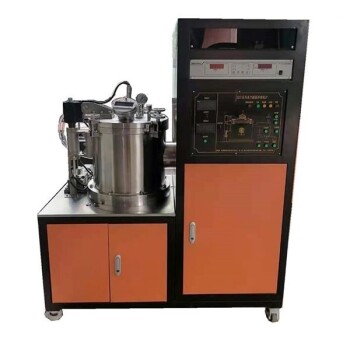
Temperature control thermocouples and PID control cabinets act as the critical stabilizing force in crude magnesium vacuum distillation. They directly determine separation efficiency by maintaining the crucible temperature at a precise set point, typically around 873K, which allows the system to exploit the specific differences in saturated vapor pressures between magnesium and its impurities.
The essence of purification efficiency lies in thermal precision. By eliminating temperature fluctuations, these control systems ensure that magnesium vaporizes while high-boiling-point impurities remain in the crucible, enabling selective elemental separation based on thermodynamics rather than chance.
The Physics of Selective Separation
Exploiting Vapor Pressure Differences
The separation of magnesium from impurities such as lead (Pb), manganese (Mn), and copper (Cu) is driven by thermodynamics.
Each element has a distinct saturated vapor pressure at a given temperature.
To separate them, you must operate within a specific thermal window where magnesium volatilizes into a gas, but the impurities do not.
The Critical Process Point
This process relies on maintaining a specific process temperature, often cited as 873K.
At this exact temperature, the vapor pressure gap between magnesium and the target impurities is maximized for separation.
If the temperature is maintained here, the physics of the materials will naturally drive high-purity separation.
How Control Systems Enforce Purity
The Role of Thermocouples
High-precision thermocouples serve as the sensory system for the distillation unit.
They provide real-time, continuous monitoring of the crucible temperature.
Without this feedback, the system is blind to thermal drifts that naturally occur during the energy-intensive evaporation process.
The Role of PID Control Cabinets
PID (Proportional-Integral-Derivative) cabinets act as the "brain" that interprets the thermocouple data.
They automatically adjust the heating power to correct errors before they become significant temperature swings.
This ensures the temperature remains stable at the set point (e.g., 873K) rather than oscillating around it.
Understanding the Trade-offs of Instability
The Danger of Temperature Spikes
If the control system fails to dampen fluctuations, even momentary temperature spikes can be disastrous for purity.
An overshoot in temperature increases the vapor pressure of high-boiling-point impurities like lead and copper.
This causes them to co-volatilize into the gas phase alongside the magnesium, contaminating the final product.
Managing Condensation Gradients
While the primary focus is the crucible, thermal control extends to the condensation zones as well.
Poor control here can lead to the condensation of highly volatile impurities, such as zinc (Zn) or cadmium (Cd), in the primary product zone.
Precise thermal gradients ensure these volatile elements pass through to a separate collection area, preserving magnesium purity.
Making the Right Choice for Your Goal
To optimize your vacuum distillation process, align your control strategy with your specific purity requirements:
- If your primary focus is eliminating heavy metals (Pb, Mn, Cu): Prioritize PID tuning that minimizes "overshoot," as strictly capping the maximum temperature prevents these elements from entering the vapor phase.
- If your primary focus is eliminating volatile impurities (Zn, Cd): Focus on the thermal gradient of the condensation zone to ensure the product collection area remains too hot for these elements to condense.
- If your primary focus is process consistency: Invest in high-precision thermocouples with rapid response times to catch thermal drifts the instant they begin.
True efficiency in vacuum distillation is not just about applying heat; it is about the rigorous, automated discipline of temperature stability.
Summary Table:
| Component | Role in Distillation | Impact on Separation Efficiency |
|---|---|---|
| Thermocouple | Real-time thermal sensing | Provides critical feedback to prevent thermal drift and blindness. |
| PID Control Cabinet | Automated power adjustment | Eliminates temperature oscillations and prevents impurity co-volatilization. |
| Crucible Temp (873K) | Thermodynamic set point | Maximizes the vapor pressure gap between magnesium and heavy metals. |
| Thermal Gradient | Condensation zone management | Ensures volatile impurities like Zn and Cd bypass the product collection zone. |
Enhance Your Distillation Precision with KINTEK
Achieving high-purity magnesium requires more than just heat—it requires the rigorous thermal discipline of KINTEK’s high-temperature systems. Whether you are managing complex vacuum distillation or specialized metallurgy, our range of muffle, tube, and vacuum furnaces, paired with high-precision control units, ensures your laboratory or production line maintains the exact thermodynamic windows needed for success.
From high-performance crushing and milling systems to essential crucibles and ceramic consumables, KINTEK provides the comprehensive toolkit for advanced materials research. Contact us today to discover how our tailored heating and laboratory solutions can refine your process and eliminate contamination.
Related Products
- Molybdenum Vacuum Heat Treat Furnace
- 2200 ℃ Tungsten Vacuum Heat Treat and Sintering Furnace
- Ultra-High Temperature Graphite Vacuum Graphitization Furnace
- Graphite Vacuum Furnace IGBT Experimental Graphitization Furnace
- Small Vacuum Heat Treat and Tungsten Wire Sintering Furnace
People Also Ask
- What is the process of vacuum heat treating? Achieve Superior Hardening with a Clean, Bright Finish
- How does heat transmit in a vacuum? Mastering Thermal Radiation for Purity & Precision
- Why do you heat treat in a vacuum? Achieve Perfect Surface Finish and Material Integrity
- How does a vacuum heat treat furnace work? Achieve Pristine, Oxide-Free Metal Parts
- What is a vacuum heat treatment furnace? The Ultimate Guide to Controlled Atmosphere Processing