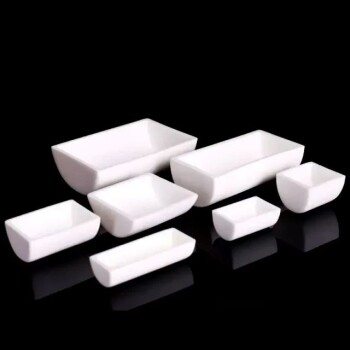
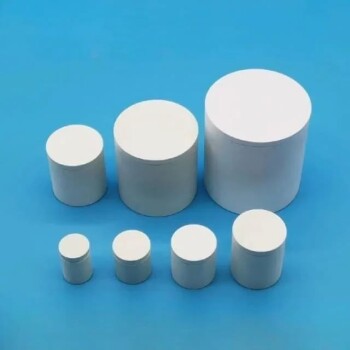
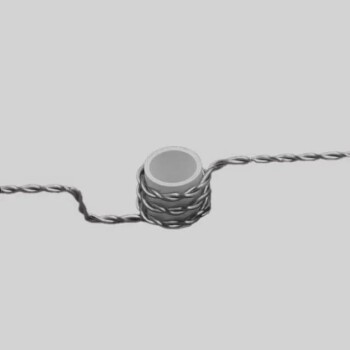
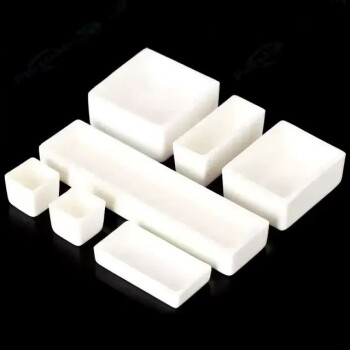
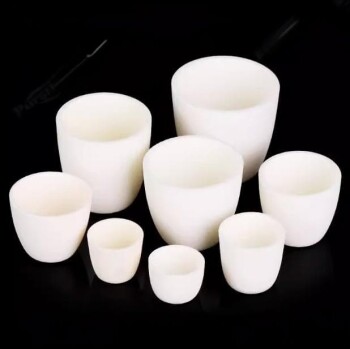
The ceramic crucible and lid function as a mechanical isolation chamber within the high-temperature muffle furnace. By creating a physical barrier between the biomass sample and the oxygen-rich atmosphere of the furnace, this setup forces the material to undergo thermal decomposition rather than combustion.
Core Takeaway The lid is critical for generating a "micro-reducing environment" that excludes oxygen at high temperatures (typically 925 °C). This ensures that any mass loss is strictly due to the release of volatile organic gases, preventing the premature burning of fixed carbon.
The Mechanism of Isolation
Creating a Micro-Reducing Environment
The primary function of the covered crucible is to manipulate the atmospheric conditions immediately surrounding the sample. While the muffle furnace itself contains ambient air, the lid restricts airflow into the crucible. This creates an oxygen-deficient zone known as a micro-reducing environment.
Preventing Fixed Carbon Combustion
In the presence of oxygen, high heat would cause the biomass to burn completely to ash. The lid prevents this oxidation. By excluding oxygen, the fixed carbon component of the biomass remains intact, while only the volatile matter is released.
Simulating Rapid Pyrolysis
Because oxidation is blocked, the biomass undergoes pyrolysis—chemical decomposition caused by heat alone. The organic substances inside the sample break down and turn into gas. These gases escape around the lid, leaving the solid char (fixed carbon) behind.
The Role of the Muffle Furnace
Precise Thermal Delivery
The muffle furnace acts as the external energy source, heating the chamber using electric resistance elements. A microprocessor PID controller regulates the power to ensure the temperature remains stable at the required set point (referenced as 925 °C in primary protocols).
Protecting the Sample from Direct Contact
The design of the muffle furnace ensures that the heating elements do not directly touch the crucible. The refractory material of the furnace chamber radiates heat evenly. This allows the crucible to reach the target temperature rapidly without localized hotspots that could skew results.
Understanding the Trade-offs
The Risk of Improper Sealing
The effectiveness of this analysis relies entirely on the "tightness" of the lid's fit. If the lid is too loose, oxygen will penetrate the micro-environment, leading to partial combustion of the fixed carbon and artificially inflating the volatile matter reading.
Thermal Lag
Ceramic is a refractory material, meaning it resists heat flow. While this protects the sample from shock, there is a slight delay between the furnace reaching 925 °C and the interior of the crucible reaching that same temperature. The heating duration must be standardized to account for this thermal lag.
Making the Right Choice for Your Goal
To ensure accurate volatile matter analysis, apply the following principles:
- If your primary focus is data accuracy: Verify the mechanical fit of the crucible lid prior to heating to guarantee a true oxygen-deficient environment.
- If your primary focus is process consistency: Ensure the furnace utilizes a PID controller to maintain the specific 925 °C set point required for valid thermal decomposition.
Ultimately, the integrity of your data depends on the lid's ability to turn a combustion chamber into a pyrolysis capsule.
Summary Table:
| Component | Primary Function in Volatile Analysis | Impact on Results |
|---|---|---|
| Ceramic Crucible | Acts as a heat-resistant mechanical isolation chamber. | Ensures uniform heating of the biomass sample. |
| Crucible Lid | Creates a micro-reducing environment by excluding oxygen. | Prevents fixed carbon combustion; ensures only volatiles escape. |
| Muffle Furnace | Provides precise, radiant thermal energy (925 °C). | Guarantees stable temperature via PID control for consistent data. |
| Micro-Environment | Facilitates thermal decomposition (pyrolysis). | Converts organic substances to gas without burning the solid char. |
Elevate Your Analytical Precision with KINTEK
Achieving accurate results in biomass volatile matter analysis requires the perfect synergy between high-quality consumables and precise thermal equipment. KINTEK specializes in providing the laboratory industry with high-performance muffle furnaces, ceramic crucibles, and high-temperature consumables designed to maintain the integrity of your most sensitive experiments.
From our advanced PID-controlled furnaces to our precision-engineered PTFE and ceramic products, we offer the tools you need to prevent sample contamination and ensure repeatable data. Whether you are conducting research in battery materials, bioenergy, or advanced material science, KINTEK is your partner in laboratory excellence.
Ready to optimize your lab's efficiency? Contact our technical experts today to find the ideal furnace and crucible solution for your specific application.
References
- G. Gayathri, Kiran Babu Uppuluri. The comprehensive characterization of Prosopis juliflora pods as a potential bioenergy feedstock. DOI: 10.1038/s41598-022-22482-9
This article is also based on technical information from Kintek Solution Knowledge Base .
Related Products
- Alumina Al2O3 Ceramic Crucible Semicircle Boat with Lid for Engineering Advanced Fine Ceramics
- Engineering Advanced Fine Ceramics Alumina Al2O3 Crucible With Lid Cylindrical Laboratory Crucible
- Engineering Advanced Fine Ceramics Alumina Crucibles (Al2O3) for Thermal Analysis TGA DTA
- Evaporation Crucible for Organic Matter
- Boron Nitride (BN) Crucible for Phosphorous Powder Sintered
People Also Ask
- Why are alumina crucibles and mother powder essential for LATP sintering? Optimize Your Solid Electrolyte Performance
- Why are high-purity alumina crucibles used for liquid lead corrosion experiments? Ensure Data Accuracy at 550°C
- Why Use Alumina Crucibles & Powder Burial for NaSICON? Ensure Phase Purity and Prevent Elemental Volatilization
- What is the primary purpose of using alumina crucibles for LLTO ceramics? Optimize Your High-Temperature Sintering
- What are the benefits of using an alumina crucible with a lid for TiB2 nanopowder heat treatment? Ensure High Purity