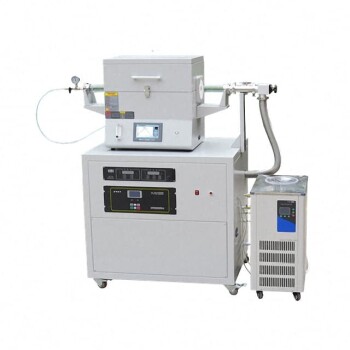
The Chemical Vapor Deposition (CVD) reaction furnace serves as the foundational processing unit for synthesizing Nanocrystalline Diamond (NCD) coatings. It functions by creating a controlled, high-temperature environment that decomposes precursor gases—specifically methane and hydrogen. This thermal decomposition enables the precise growth of pure diamond films onto alloy substrates at an atomic level.
The CVD furnace acts as a stability chamber, ensuring that high temperatures are maintained consistently to achieve the atomic-level bonding required for a pure diamond phase. This process transforms raw gases into a coating characterized by extreme chemical inertness and electrical insulation.
The Mechanism of NCD Synthesis
Decomposition of Precursor Gases
The primary role of the CVD furnace is to facilitate the chemical breakdown of specific gases.
The system introduces a mixture of methane and hydrogen into the reaction chamber. Under high heat, these molecules decompose to release the carbon necessary for diamond formation.
Growth on Alloy Substrates
Once the gases are decomposed, the carbon atoms must deposit onto a solid surface.
The furnace is designed to accommodate alloy substrates, providing the platform where the diamond film grows. This capability allows standard industrial materials to be upgraded with diamond-like surface properties.
The Role of Temperature Stability
Ensuring Phase Purity
The quality of an NCD coating is directly dependent on the stability of the environment during growth.
The CVD furnace maintains a stable high-temperature environment, which is critical for preventing impurities. This stability ensures that the resulting coating is a pure diamond phase rather than a lower-quality carbon form.
Achieving Atomic-Level Bonding
Adhesion is often the failure point for industrial coatings, but the CVD process addresses this through thermal energy.
The high heat facilitates atomic-level bonding between the coating and the substrate. This results in a cohesive structure that is far more durable than a superficial layer.
Functional Outcomes and Applications
Extreme Chemical Inertness
The process produces a surface that is highly resistant to chemical reaction.
This chemical inertness makes NCD coatings ideal for biomedical implants, where the material must exist inside the human body without degrading or causing adverse reactions.
Electrical Insulation and Corrosion Resistance
Beyond biological safety, the coating provides robust protection in harsh environments.
The NCD layer offers electrical insulation, preventing galvanic corrosion. This is essential for protecting industrial pump and valve components that operate in high-corrosion settings.
Understanding the Trade-offs
Thermal Constraints on Substrates
While the furnace enables growth on alloys, the requirement for high temperatures imposes limits.
Not all substrate materials can withstand the thermal stress of the CVD process without deforming or altering their properties. You must ensure your base alloy is compatible with the specific temperature range of the furnace.
Complexity of Process Control
Achieving atomic-level bonding and phase purity is not automatic; it requires precise control.
If the furnace fails to maintain a stable environment, the quality of the diamond phase will degrade. This makes the reliability of the furnace's thermal regulation system a critical factor in production success.
Making the Right Choice for Your Goal
The utility of a CVD reaction furnace depends largely on the specific environmental challenges your components will face.
- If your primary focus is biomedical applications: Prioritize the furnace's ability to produce high-purity coatings that offer maximum chemical inertness for biocompatibility.
- If your primary focus is heavy industry: Leverage the furnace to create coatings with high electrical insulation to protect pumps and valves from corrosive fluids.
The CVD reaction furnace is the definitive tool for converting standard alloys into high-performance, diamond-clad components capable of surviving extreme conditions.
Summary Table:
| Feature | Role in NCD Synthesis | Benefit to Coating |
|---|---|---|
| Gas Decomposition | Breaks down Methane/Hydrogen | Provides carbon for diamond growth |
| Thermal Stability | Maintains consistent high heat | Ensures pure diamond phase & atomic bonding |
| Alloy Compatibility | Provides a growth platform | Upgrades industrial alloys with diamond properties |
| Environmental Control | Prevents impurity infiltration | Delivers extreme chemical inertness & insulation |
Elevate Your Material Science with KINTEK Precision
Unlock the full potential of Nanocrystalline Diamond coatings with KINTEK’s advanced CVD and PECVD reaction furnaces. Whether you are developing biocompatible medical implants or corrosion-resistant industrial components, our high-temperature systems provide the thermal stability and gas control essential for atomic-level bonding.
Our laboratory solutions include:
- High-Temperature Furnaces: Muffle, tube, rotary, vacuum, and specialized CVD/PECVD/MPCVD systems.
- Processing Equipment: Crushing, milling, sieving, and high-pressure reactors.
- Advanced Hydraulics: Pellet, hot, and isostatic presses for superior material density.
- Specialized Consumables: High-purity ceramics, crucibles, and PTFE products.
Don't let thermal instability compromise your research. Partner with KINTEK for reliable equipment that guarantees phase purity and performance.
Contact Our Technical Experts Today
References
- R.J.K. Wood, Ping Lu. Coatings and Surface Modification of Alloys for Tribo-Corrosion Applications. DOI: 10.3390/coatings14010099
This article is also based on technical information from Kintek Solution Knowledge Base .
Related Products
- HFCVD Machine System Equipment for Drawing Die Nano-Diamond Coating
- Custom CVD Diamond Coating for Lab Applications
- 915MHz MPCVD Diamond Machine Microwave Plasma Chemical Vapor Deposition System Reactor
- Microwave Plasma Chemical Vapor Deposition MPCVD Machine System Reactor for Lab and Diamond Growth
- CVD Diamond Dressing Tools for Precision Applications
People Also Ask
- What is the full form of HFCVD? A Guide to Hot Filament Chemical Vapor Deposition
- What are the disadvantages and challenges of the HFCVD method? Overcome Growth Limits and Filament Issues
- What is the function of tungsten filaments in HFCVD? Powering Diamond Film Synthesis with Thermal Excitation
- Why is Chemical Vapor Deposition (CVD) equipment uniquely suited for constructing hierarchical superhydrophobic structures?
- What is the chemical vapor deposition growth process? Build Superior Thin Films from the Atom Up