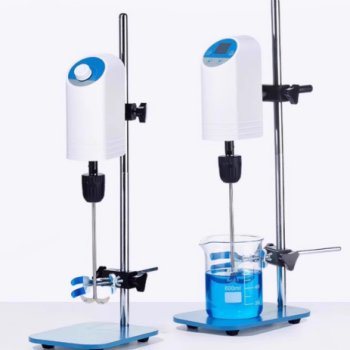
A high-speed stirring system drives metal recovery by utilizing mechanical power to maintain the uniform suspension of roasted solid particles within a sulfuric acid medium. This vigorous agitation maximizes the effective solid-liquid contact area, ensuring that the leaching agent can physically reach the zinc sulfide ore. By solving the physical challenge of particle settling, the system creates the necessary environment for chemical extraction to occur efficiently.
The core function of high-speed stirring is not just mixing, but the destruction of mass transfer resistance. By breaking down the liquid-phase diffusion layer, the system removes the primary physical barrier preventing zinc ions from entering the solution, enabling extraction rates that often exceed 50%.
The Mechanics of Enhanced Leaching
Maximizing Surface Contact
For leaching to be effective, the sulfuric acid must have unobstructed access to the mineral surface. A high-speed stirring system uses mechanical power to prevent solid particles from settling at the bottom of the reactor.
By keeping these roasted particles uniformly suspended, the system dramatically increases the effective solid-liquid contact area. This suspension ensures that the entire surface area of the ore is available for the chemical reaction at all times.
Breaking the Diffusion Layer
Surrounding every solid particle in a liquid medium is a stagnant film known as the liquid-phase diffusion layer. This layer acts as a buffer, slowing down the interaction between the solid and the bulk liquid.
The vigorous agitation provided by high-speed stirring physically shears and breaks down this diffusion layer. Removing this film is a critical physical condition required to accelerate the chemical dissolution process.
Preventing Local Saturation
Without adequate fluid motion, metal ions released from the ore can accumulate in the immediate vicinity of the particle. This creates a zone of local concentration supersaturation.
Continuous, high-speed stirring disperses these ions immediately upon release. This prevents local saturation and facilitates the stable, continuous transfer of metal ions from the solid matrix into the liquid phase.
The Impact on Mass Transfer Kinetics
Reducing Mass Transfer Resistance
The speed of leaching is often dictated by how much resistance the system offers to the movement of ions. A static or slow-moving system has high mass transfer resistance due to the intact diffusion layer.
High-speed stirring directly reduces this resistance. By thinning or eliminating the boundary layer, the system allows the chemical driving force (the acid concentration) to act directly on the mineral surface without impediment.
Accelerating Ion Transport
The ultimate goal of the process is to move zinc ions from the solid mineral lattice into the leaching solution. The rate at which this happens is the defining factor of recovery efficiency.
Agitation accelerates this specific transfer. This acceleration is the primary mechanism that allows operators to achieve high zinc extraction rates, pushing yields significantly higher than what is possible with passive leaching methods.
Understanding the Physical Constraints
The Barrier of the Diffusion Layer
It is important to recognize that the diffusion layer is a persistent physical phenomenon. It naturally forms around particles in solution and will re-establish itself if agitation drops.
If the stirring speed is insufficient, the diffusion layer remains intact, and the reaction becomes diffusion-controlled. In this scenario, increasing acid concentration will have little effect because the reagents cannot effectively cross the stagnant barrier to reach the particle surface.
The Risk of Supersaturation
Reliance on chemical potential alone is a common pitfall. Even with strong acid, a lack of mechanical mixing leads to local supersaturation at the particle surface.
This local saturation essentially halts the leaching process at the microscopic level, even if the bulk solution appears unsaturated. Consistent mechanical energy is required to refresh the liquid at the particle interface continuously.
Making the Right Choice for Your Goal
To maximize your zinc recovery, you must view the stirring system as a kinetic tool rather than just a mixer.
- If your primary focus is Extraction Yield: Prioritize high stirring speeds to forcefully break the liquid-phase diffusion layer, which is required to push extraction rates above 50%.
- If your primary focus is Process Stability: Ensure the stirring provides uniform suspension to prevent local supersaturation, ensuring a steady transfer of ions from the solid to the liquid phase.
Optimization in leaching requires balancing chemical strength with the physical force necessary to deliver that chemistry to the mineral surface.
Summary Table:
| Feature | Physical Impact | Benefit for Metal Recovery |
|---|---|---|
| Uniform Suspension | Prevents particle settling | Maximizes effective solid-liquid contact area |
| High-Shear Agitation | Breaks the liquid-phase diffusion layer | Removes mass transfer resistance for faster kinetics |
| Ion Dispersion | Prevents local concentration supersaturation | Maintains a continuous, stable transfer of metal ions |
| Mechanical Power | Overcomes stagnant boundary layers | Ensures chemical reagents reach the mineral surface |
Optimize Your Leaching Efficiency with KINTEK Precision
Unlock the full potential of your mineral processing with KINTEK’s advanced laboratory solutions. From high-performance crushing and milling systems to precision-engineered high-temperature high-pressure reactors and autoclaves, we provide the specialized equipment necessary to overcome mass transfer barriers and maximize your recovery rates.
Whether you are refining zinc sulfide ore or conducting complex metallurgical research, our comprehensive range—including high-temperature furnaces, electrolytic cells, and chemical-resistant consumables—is designed to deliver the mechanical force and thermal stability your lab requires.
Ready to elevate your extraction yields? Contact KINTEK today to discover how our high-speed stirring and reactor technologies can transform your laboratory workflow.
References
- Dessy Amalia, Yuhelda Dahlan. The natures of zinc sulfide concentrates and its behavior after roasting process. DOI: 10.30556/imj.vol21.no2.2018.698
This article is also based on technical information from Kintek Solution Knowledge Base .
Related Products
- High Performance Laboratory Stirrers for Diverse Applications
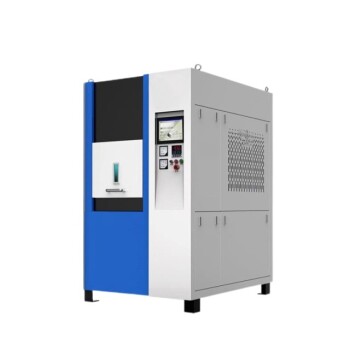
- Spark Plasma Sintering Furnace SPS Furnace
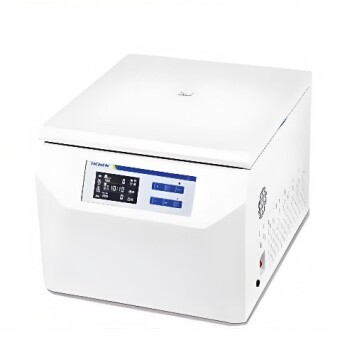
- Laboratory Benchtop High Speed Small Centrifuge for Low Temp Serum Separation Dehydration Research
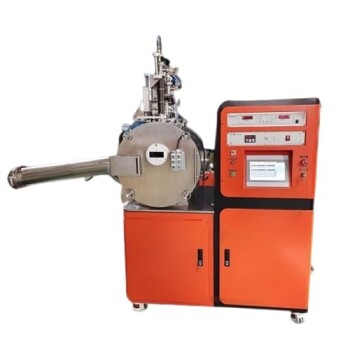
- Vacuum Induction Melting Spinning System Arc Melting Furnace
- Laboratory Small Constant Temperature Heated Magnetic Stirrer Heater and Stirrer
People Also Ask
- How does a laboratory stirrer influence MOF product quality? Master Precision in Non-Solvothermal Synthesis
- What critical role does a Laboratory Stirrer play during leaching? Enhance Titanium-Magnesium Waste Recovery
- What is the primary function of laboratory stirring equipment in the preparation of compost leachate? Optimize Extraction
- What is a laboratory mixer? A Guide to Achieving Perfect Sample Homogeneity
- What is a laboratory mixer used for? Choose the Right Tool for Liquids or Solids