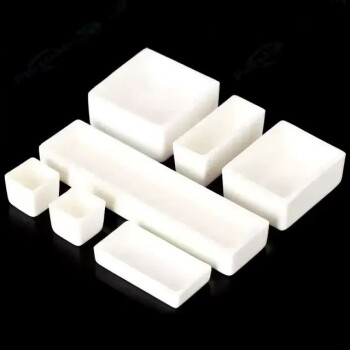
A high-temperature muffle furnace serves as the critical purification and crystallization chamber for yttrium oxide ceramic powders. It functions primarily through precise calcination—typically at temperatures around 850°C—to burn off organic additives like PEG and facilitate the atomic rearrangement necessary to form high-purity cubic phase powders.
The furnace transforms a raw, chemically complex precursor into a stable, optical-grade ceramic powder. By strictly controlling the thermal environment, it ensures the complete removal of impurities and the formation of the specific crystal structure required for transparency.
The Mechanism of Purification
Thermal Decomposition of Organics
The initial role of the muffle furnace is to act as a controlled incinerator for organic processing aids.
During earlier processing stages, dispersants such as PEG (polyethylene glycol) are often added to the mix.
The muffle furnace provides the necessary thermal energy and oxidizing atmosphere to completely decompose these organics, preventing carbon residue from ruining the final ceramic's transparency.
Elimination of Impurity Ions
Beyond organic dispersants, the raw precursor material often contains residual impurity ions that can degrade optical quality.
The high-temperature environment drives the volatilization and removal of these ions.
This results in a chemically pure powder, which is a non-negotiable requirement for high-performance transparent ceramics.
Crystal Structure and Phase Formation
Creating the Cubic Phase
Transparency in yttrium oxide ceramics is heavily dependent on the material's crystal symmetry.
The furnace maintains the specific temperature (e.g., 850°C) required to drive crystallization.
This thermal energy forces the atoms to rearrange from a disordered precursor state into a highly ordered cubic phase structure.
Complete Precursor Decomposition
Before the material becomes yttrium oxide, it exists as a precursor (often a salt or hydroxide).
The muffle furnace facilitates the complete chemical breakdown of this precursor.
This ensures that the final output is 100% yttrium oxide, establishing a robust phase foundation for the subsequent sintering process.
Understanding the Trade-offs
The Importance of Temperature Precision
While high heat is necessary, the definition of "precise calcination" is critical.
If the furnace temperature is too low, organic decomposition will be incomplete, leading to defects and poor transparency.
Conversely, if the temperature fluctuates or is uncontrolled, it may lead to inconsistent grain development, compromising the structural stability of the final sintered ceramic.
Making the Right Choice for Your Goal
To maximize the quality of your yttrium oxide powders, align your furnace parameters with your specific end-goals:
- If your primary focus is Optical Transparency: Prioritize a furnace with exceptional temperature uniformity to ensure the complete elimination of PEG and the formation of a pure cubic phase.
- If your primary focus is Chemical Purity: Ensure the furnace can maintain a stable oxidizing atmosphere to facilitate the total burnout of residual ions and organic dispersants.
Success in transparent ceramics begins with the thermal history of the powder; the muffle furnace is the tool that defines that history.
Summary Table:
| Process Function | Mechanism | Impact on Quality |
|---|---|---|
| Organic Removal | Thermal decomposition of PEG/dispersants | Prevents carbon residue & loss of transparency |
| Chemical Purification | Volatilization of residual impurity ions | Ensures high-purity, optical-grade powders |
| Phase Transformation | Atomic rearrangement at ~850°C | Forms necessary cubic crystal symmetry |
| Precursor Breakdown | Complete chemical decomposition | Establishes 100% yttrium oxide composition |
Elevate Your Ceramic Research with KINTEK Precision
Unlock the full potential of your yttrium oxide powders with KINTEK’s advanced high-temperature muffle furnaces. Designed for superior temperature uniformity and precise atmospheric control, our furnaces ensure complete organic burnout and stable phase formation for high-performance transparent ceramics.
Whether you are refining advanced optical materials or optimizing battery research, KINTEK provides a comprehensive range of crushing systems, hydraulic presses, and specialized sintering furnaces to support every stage of your workflow.
Ready to achieve optical-grade purity? Contact us today to discover how our laboratory solutions can enhance your material processing efficiency!
Related Products
- 1200℃ Muffle Furnace Oven for Laboratory
- 1800℃ Muffle Oven Furnace for Laboratory
- 1400℃ Muffle Oven Furnace for Laboratory
- 1700℃ Muffle Oven Furnace for Laboratory
- High Temperature Muffle Oven Furnace for Laboratory Debinding and Pre Sintering
People Also Ask
- How does a muffle furnace ensure reliability in calcification roasting? Achieve Precision in Pellets Conversion
- Why is a laboratory high-temperature muffle furnace required for the post-annealing treatment of copper oxide?
- What role does a laboratory high-temperature muffle furnace play in iron-based composite phase structure development?
- How is a laboratory high-temperature muffle furnace utilized in sol-gel synthesis for perovskite catalysts?
- How does a muffle furnace influence 8YSZ ceramic densification? Master Precision Sintering at 1500°C