Knowledge How does a high-temperature oven contribute to the preparation of monoclinic phase BiVO4 nanoparticles? Precision Heating
Author avatar

Tech Team · Kintek Solution

Updated 2 days ago

How does a high-temperature oven contribute to the preparation of monoclinic phase BiVO4 nanoparticles? Precision Heating


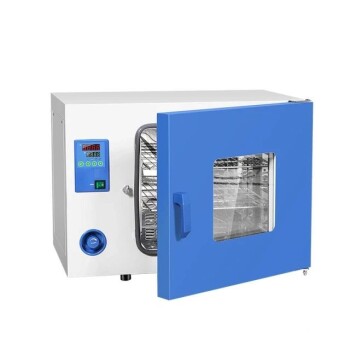
The high-temperature oven acts as the critical thermal regulator in the synthesis of monoclinic BiVO4 nanoparticles. By maintaining a precise, constant temperature of 180°C for a duration of 20 hours, it provides the specific energy environment required to drive precursor transformation, control particle growth kinetics, and stabilize the desired crystal structure.

Precise thermal management is not merely about heating; it is the governing factor in phase selection. The high-temperature oven ensures the consistent environment necessary to lock in the monoclinic phase, directly influencing the material's final morphology and photocatalytic stability.

The Role of Thermal Stability in Synthesis

Ensuring a Constant Environment

The primary function of the high-temperature oven is to create a stable thermal environment for the reaction vessels. This isolation prevents external temperature fluctuations from disrupting the sensitive chemical processes occurring inside the vessels.

Precision Temperature Control

The oven utilizes precise control mechanisms to maintain the target temperature. For BiVO4 synthesis, strict adherence to 180°C is required to initiate the specific chemical reactions needed.

Driving Phase Transformation

Providing Activation Energy

The synthesis requires a sustained duration of 20 hours at high heat. This provides the necessary activation energy to drive the chemical transformation of the precursors.

Achieving the Monoclinic Structure

This specific thermal profile—180°C for 20 hours—is tuned to favor the thermodynamic stability of the monoclinic phase. Without this exact combination of time and temperature, the material may fail to crystallize into the correct phase.

Controlling Growth Kinetics and Morphology

Regulating Particle Growth

The oven allows researchers to control the growth kinetics of the nanoparticles. A stable heat source ensures that the rate of particle formation is consistent, preventing chaotic or uneven precipitation.

Defining Material Morphology

The thermal conditions directly dictate the final shape and surface features of the nanoparticles. Proper heating is essential to achieving the specific morphology required for the material's intended application.

Ensuring Structural Stability

Beyond just shape, the heat treatment solidifies the structural integrity of the photocatalyst. This ensures the final BiVO4 product remains stable and durable during use.

Understanding the Trade-offs

Time and Energy Intensity

The requirement for a 20-hour cycle at 180°C represents a significant energy investment. This long synthesis time limits the speed of production and throughput for the material.

Sensitivity to Parameter Deviations

The process relies heavily on the "constant" nature of the heat. If the oven fluctuates or fails to maintain 180°C, the growth kinetics will change, likely resulting in an impure phase or poor morphology.

Optimizing Your Synthesis Strategy

To achieve the best results in preparing BiVO4 nanoparticles, consider your specific objectives:

  • If your primary focus is Phase Purity: Ensure your equipment can maintain 180°C without deviation for the full 20 hours to guarantee the complete transformation to the monoclinic structure.
  • If your primary focus is Particle Uniformity: Prioritize the oven's spatial temperature consistency to ensure identical growth kinetics across all reaction vessels placed inside.

Precision in thermal control is the difference between a functional photocatalyst and a failed experiment.

Summary Table:

Feature Synthesis Requirement Role of High-Temperature Oven
Temperature 180°C (Constant) Precise thermal regulation & activation energy
Duration 20 Hours Sustained environment for phase stability
Phase Target Monoclinic Scheelite Thermodynamic selection and structural locking
Morphology Uniform Nanoparticles Kinetic control of growth and surface features
Critical Factor Thermal Stability Prevents phase impurities and chaotic precipitation

Elevate Your Material Synthesis with KINTEK Precision

Achieving the perfect monoclinic phase in BiVO4 nanoparticles requires absolute thermal stability. KINTEK specializes in advanced laboratory equipment designed for the most demanding research environments. Whether you need high-precision high-temperature furnaces (muffle, tube, or vacuum), specialized high-temperature high-pressure reactors and autoclaves, or robust crushing and milling systems to prepare your precursors, we provide the tools to ensure your experiments are repeatable and successful.

From PTFE products and crucibles to comprehensive battery research tools, KINTEK is your partner in material science innovation. Contact us today to find the perfect thermal solution for your laboratory!

References

  1. Arup Kumar De, Indrajit Sinha. Cd-doped Ag<sub>2</sub>O/BiVO<sub>4</sub> visible light Z-scheme photocatalyst for efficient ciprofloxacin degradation. DOI: 10.1039/d2ra07200a

This article is also based on technical information from Kintek Solution Knowledge Base .

Related Products

People Also Ask

Related Products

1700℃ Muffle Oven Furnace for Laboratory

1700℃ Muffle Oven Furnace for Laboratory

Get superior heat control with our 1700℃ Muffle Furnace. Equipped with intelligent temperature microprocessor, TFT touch screen controller & advanced insulation materials for precise heating up to 1700C. Order now!

1800℃ Muffle Oven Furnace for Laboratory

1800℃ Muffle Oven Furnace for Laboratory

KT-18 muffle furnace with Japan Al2O3 polycrystalline fibe and Silicon Molybdenum heating element, up to 1900℃, PID temperature control and 7" smart touch screen. Compact design, low heat loss, and high energy efficiency. Safety interlock system and versatile functions.

1400℃ Muffle Oven Furnace for Laboratory

1400℃ Muffle Oven Furnace for Laboratory

Get precise high-temperature control up to 1500℃ with KT-14M Muffle furnace. Equipped with a smart touch screen controller and advanced insulation materials.

1700℃ Laboratory High Temperature Tube Furnace with Alumina Tube

1700℃ Laboratory High Temperature Tube Furnace with Alumina Tube

Looking for a high-temperature tube furnace? Check out our 1700℃ Tube Furnace with Alumina Tube. Perfect for research and industrial applications up to 1700C.

Laboratory Muffle Oven Furnace Bottom Lifting Muffle Furnace

Laboratory Muffle Oven Furnace Bottom Lifting Muffle Furnace

Efficiently produce batches with excellent temperature uniformity using our Bottom Lifting Furnace. Features two electric lifting stages and advanced temperature control up to 1600℃.

1200℃ Split Tube Furnace with Quartz Tube Laboratory Tubular Furnace

1200℃ Split Tube Furnace with Quartz Tube Laboratory Tubular Furnace

KT-TF12 split tube furnace: high-purity insulation, embedded heating wire coils, and max. 1200C. Widely used for new materials and chemical vapour deposition.

1400℃ Controlled Atmosphere Furnace with Nitrogen and Inert Atmosphere

1400℃ Controlled Atmosphere Furnace with Nitrogen and Inert Atmosphere

Achieve precise heat treatment with KT-14A controlled atmosphere furnace. Vacuum sealed with a smart controller, it's ideal for lab and industrial use up to 1400℃.

Horizontal High Temperature Graphite Vacuum Graphitization Furnace

Horizontal High Temperature Graphite Vacuum Graphitization Furnace

Horizontal Graphitization Furnace: This type of furnace is designed with the heating elements placed horizontally, allowing for uniform heating of the sample. It's well-suited for graphitizing large or bulky samples that require precise temperature control and uniformity.

Vertical High Temperature Graphite Vacuum Graphitization Furnace

Vertical High Temperature Graphite Vacuum Graphitization Furnace

Vertical high temperature graphitization furnace for carbonization and graphitization of carbon materials up to 3100℃.Suitable for shaped graphitization of carbon fiber filaments and other materials sintered in a carbon environment.Applications in metallurgy, electronics, and aerospace for producing high-quality graphite products like electrodes and crucibles.

Vacuum Heat Treat and Molybdenum Wire Sintering Furnace for Vacuum Sintering

Vacuum Heat Treat and Molybdenum Wire Sintering Furnace for Vacuum Sintering

A vacuum molybdenum wire sintering furnace is a vertical or bedroom structure, which is suitable for withdrawal, brazing, sintering and degassing of metal materials under high vacuum and high temperature conditions. It is also suitable for dehydroxylation treatment of quartz materials.

Ultra-High Temperature Graphite Vacuum Graphitization Furnace

Ultra-High Temperature Graphite Vacuum Graphitization Furnace

The ultra-high temperature graphitization furnace utilizes medium frequency induction heating in a vacuum or inert gas environment. The induction coil generates an alternating magnetic field, inducing eddy currents in the graphite crucible, which heats up and radiates heat to the workpiece, bringing it to the desired temperature. This furnace is primarily used for graphitization and sintering of carbon materials, carbon fiber materials, and other composite materials.

1700℃ Controlled Atmosphere Furnace Nitrogen Inert Atmosphere Furnace

1700℃ Controlled Atmosphere Furnace Nitrogen Inert Atmosphere Furnace

KT-17A Controlled atmosphere furnace: 1700℃ heating, vacuum sealing technology, PID temperature control, and versatile TFT smart touch screen controller for laboratory and industrial use.

Mesh belt controlled atmosphere furnace

Mesh belt controlled atmosphere furnace

Discover our KT-MB mesh belt sintering furnace - perfect for high-temperature sintering of electronic components & glass insulators. Available for open air or controlled atmosphere environments.

Dental Porcelain Zirconia Sintering Ceramic Vacuum Press Furnace

Dental Porcelain Zirconia Sintering Ceramic Vacuum Press Furnace

Get precise dental results with Dental Vacuum Press Furnace. Automatic temperature calibration, low noise tray, and touch screen operation. Order now!

Vacuum Dental Porcelain Sintering Furnace

Vacuum Dental Porcelain Sintering Furnace

Get precise and reliable results with KinTek's Vacuum Porcelain Furnace. Suitable for all porcelain powders, it features hyperbolic ceramic furnace function, voice prompt, and automatic temperature calibration.

1200℃ Controlled Atmosphere Furnace Nitrogen Inert Atmosphere Furnace

1200℃ Controlled Atmosphere Furnace Nitrogen Inert Atmosphere Furnace

Discover our KT-12A Pro Controlled atmosphere furnace - high precision, heavy duty vacuum chamber, versatile smart touch screen controller, and excellent temperature uniformity up to 1200C. Ideal for both laboratory and industrial application.

Vacuum Heat Treat and Sintering Furnace with 9MPa Air Pressure

Vacuum Heat Treat and Sintering Furnace with 9MPa Air Pressure

The air pressure sintering furnace is a high-tech equipment commonly used for the sintering of advanced ceramic materials. It combines vacuum sintering and pressure sintering techniques to achieve high-density and high-strength ceramics.

Vacuum Hot Press Furnace Heated Vacuum Press Machine Tube Furnace

Vacuum Hot Press Furnace Heated Vacuum Press Machine Tube Furnace

Reduce forming pressure & shorten sintering time with Vacuum Tube Hot Press Furnace for high-density, fine-grain materials. Ideal for refractory metals.

Non Consumable Vacuum Arc Induction Melting Furnace

Non Consumable Vacuum Arc Induction Melting Furnace

Explore the benefits of Non-Consumable Vacuum Arc Furnace with high melting point electrodes. Small, easy to operate & eco-friendly. Ideal for laboratory research on refractory metals & carbides.

600T Vacuum Induction Hot Press Furnace for Heat Treat and Sintering

600T Vacuum Induction Hot Press Furnace for Heat Treat and Sintering

Discover the 600T Vacuum Induction Hot Press Furnace, designed for high-temperature sintering experiments in vacuum or protected atmospheres. Its precise temperature and pressure control, adjustable working pressure, and advanced safety features make it ideal for nonmetal materials, carbon composites, ceramics, and metal powders.


Leave Your Message