A laboratory hydraulic press is the critical starting point for the accurate physical characterization of Platinum-Palladium (Pt/Pd) alloys. By utilizing precision molds, the press compresses loose Pt/Pd alloy powders into solid pellets with specific geometric shapes and high density. This mechanical transformation provides the standardized physical state necessary to measure the material's performance properties reliably.
The primary function of the press is to minimize porosity and ensure uniform internal density, creating a reproducible baseline for measuring electrical conductivity, hardness, and thermal conductivity.
The Mechanics of Sample Preparation
Creating Defined Geometry
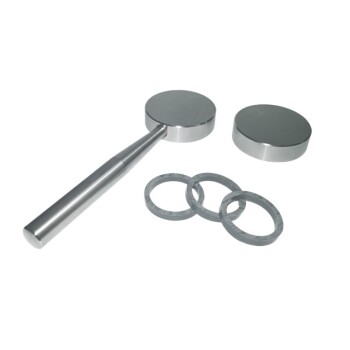
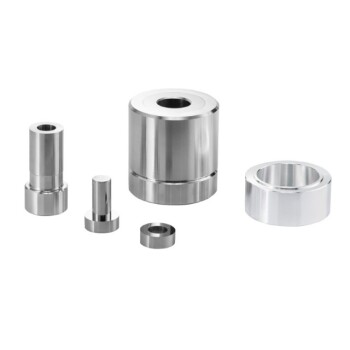
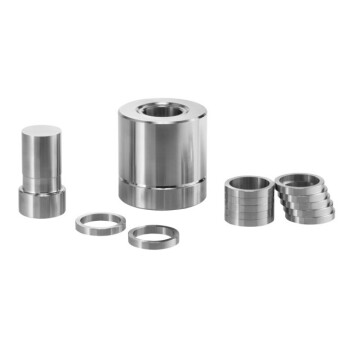
Characterization equipment often requires samples to have exact dimensions. A hydraulic press forces Pt/Pd powders into precision molds, creating pellets with specific, consistent geometric shapes.
Achieving High Density
Loose powders contain significant air gaps and voids. The press applies substantial force to compact these particles, drastically increasing the overall density of the material.
Reducing Porosity
By compressing the material, the press eliminates internal voids. This reduction in porosity is essential because air pockets act as insulators or structural weak points, which would otherwise skew experimental data.
Impact on Material Characterization
Standardizing Electrical Conductivity
Accurate electrical measurements require a continuous path for current to flow. High-density compaction increases the contact area between powder particles, ensuring stable electron transport during testing.
Ensuring Accurate Hardness Readings
Hardness tests measure a material's resistance to deformation. If a sample is porous, the testing instrument may crush the voids rather than test the material itself. The press creates a solid substrate that reflects the true hardness of the alloy.
Facilitating Thermal Conductivity Measurements
Heat transfer relies on the continuity of the material. The precise pressure control allows for a uniform internal structure, ensuring that thermal conductivity measurements reflect the alloy's properties rather than the influence of trapped air.
Critical Factors for Success
The Importance of Pressure Control
Merely applying force is not enough; the pressure must be precisely controlled.
Uniform Internal Density
Without controlled pressure, a sample may have density gradients—being dense on the outside but porous in the center. This inconsistency leads to non-reproducible results across different measurement trials.
Preventing Sample Defects
Proper pressing ensures the "green body" (the compressed pellet) has sufficient strength to be handled. This structural integrity prevents the sample from crumbling before or during the characterization process.
Making the Right Choice for Your Goal
To maximize the quality of your Pt/Pd alloy characterization, align your pressing strategy with your specific analytical needs:
- If your primary focus is Electrical Conductivity: Prioritize maximizing density to ensure optimal particle-to-particle contact and stable current flow.
- If your primary focus is Hardness Testing: Ensure the applied pressure is high enough to eliminate all microscopic porosity that could yield false, low hardness values.
- If your primary focus is Experimental Reproducibility: rigorous adherence to specific pressure settings and dwell times is required to ensure every sample pellet is physically identical.
The laboratory hydraulic press transforms variable raw powders into consistent, testable solids, serving as the guarantor of your data's validity.
Summary Table:
| Feature | Impact on Pt/Pd Characterization | Benefit to Research |
|---|---|---|
| High-Force Compaction | Eliminates internal voids and porosity | Prevents data skewing from air pockets |
| Precision Molds | Creates standardized geometric shapes | Meets equipment requirements for testing |
| Density Control | Maximizes particle-to-particle contact | Ensures stable electrical & thermal pathways |
| Structural Integrity | Produces durable "green body" pellets | Prevents sample crumbling during handling |
Elevate Your Material Characterization with KINTEK
Precision in sample preparation is the foundation of reliable data. KINTEK specializes in advanced laboratory equipment designed to meet the rigorous demands of Pt/Pd alloy research. Our comprehensive range of hydraulic presses (pellet, hot, and isostatic) ensures uniform density and reproducible results for your most critical characterization trials.
Beyond compaction, KINTEK offers a full suite of laboratory solutions, including:
- High-Temperature Furnaces (Muffle, Vacuum, and Tube) for alloy sintering.
- Crushing and Milling Systems for consistent powder preparation.
- High-Pressure Reactors & Autoclaves for advanced chemical processing.
- Battery Research Tools and essential consumables like PTFE and ceramics.
Ensure your research is backed by the industry's most reliable tools. Contact KINTEK today to discuss your specific application needs and find the perfect hydraulic press for your laboratory.
References
- L Botha, Elizaveta Ivanovna Plastinina. Ab Initio Study of Structural, Electronic, and Thermal Properties of Pt/Pd-Based Alloys. DOI: 10.3390/condmat8030076
This article is also based on technical information from Kintek Solution Knowledge Base .
Related Products
- Automatic Laboratory Hydraulic Pellet Press Machine for Lab Use
- Laboratory Manual Hydraulic Pellet Press for Lab Use
- Laboratory Manual Hydraulic Pellet Press for Lab Use
- kbr pellet press 2t
- Laboratory Hydraulic Pellet Press for XRF KBR FTIR Lab Applications
People Also Ask
- What is the role of a laboratory hydraulic pellet press and stainless steel molds in the fabrication of RuO2/NbC anodes?
- What role does a laboratory pellet press play in the enhancement of biomass energy products? Optimize Fuel Efficiency
- What is the purpose of using a laboratory pellet press when evaluating the electronic conductivity of carbon powders? Guide
- How does a laboratory hydraulic pellet press contribute to SiCw/2024 aluminum composite preforms? Optimize Densification
- What is the significance of applying 200 MPa of pressure with a laboratory hydraulic pellet press for composite ceramics?