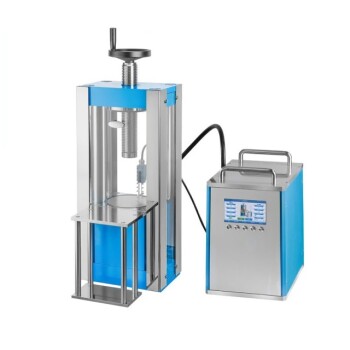
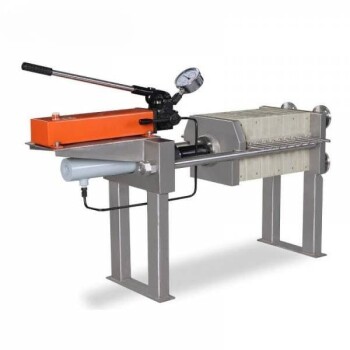
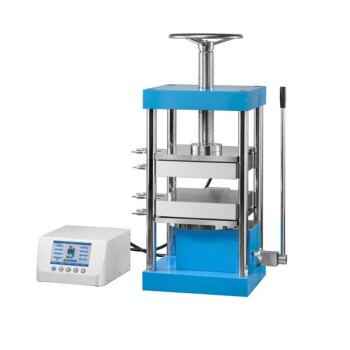
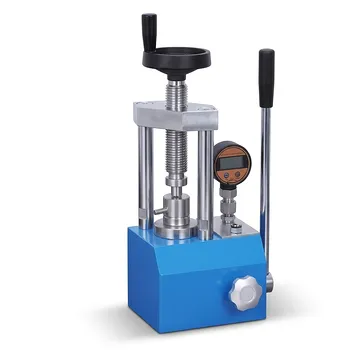
A laboratory hydraulic press is the fundamental tool used to transform loose powder mixtures into dense, disk-shaped green bodies through the application of precisely controlled high pressure. By compressing materials at pressures often ranging from 98 MPa to 380 MPa, the press minimizes porosity and maximizes particle contact, creating the necessary physical structure for efficient ion transport and subsequent processing.
Core Takeaway The hydraulic press does not merely shape the battery component; it induces plastic deformation in solid electrolyte particles to eliminate microscopic voids. This densification is the defining factor in establishing continuous ion transport channels and reducing the interfacial resistance that otherwise limits battery performance.
The Mechanics of Densification
Creating the Physical Foundation
According to the primary reference, the fundamental role of the hydraulic press is to convert loose mixed powders into a cohesive solid.
By applying specific high pressures (such as 98 MPa), the press forces particles closer together.
This creates a dense green body that serves as the physical baseline for all subsequent manufacturing steps, including sintering.
Inducing Plastic Deformation
For specific materials, particularly sulfide-based electrolytes, the press plays a more active role than simple compaction.
The high uniaxial pressure exploits the deformability of these materials, causing the particles to physically change shape (plastic deformation).
This forces the electrolyte material to flow into and fill the gaps between electrode particles, ensuring intimate contact without the need for extreme heat.
Enhancing Electrochemical Performance
Eliminating Porosity
The primary enemy of solid-state battery efficiency is air gaps (pores) between particles.
The hydraulic press exerts force sufficient to eliminate these voids, significantly increasing the relative density of the pellet.
Removing these pores is critical because they act as barriers to ionic flow; a denser pellet translates directly to lower internal resistance.
Reducing Grain Boundary Resistance
Beyond simple density, the press improves the connection between individual grains of material.
High-pressure compaction reduces "grain boundary resistance," which is the impedance ions face when jumping from one particle to another.
This creates continuous, unobstructed channels for lithium-ion transport throughout the electrolyte layer.
Structural Integrity and Safety
Forming Robust Bilayer Structures
The press is often used to compress cathode mixtures and solid electrolyte powders simultaneously.
This results in a dense bilayer structure where the electrode and electrolyte are mechanically bonded.
This physical integration creates a robust interface capable of withstanding the mechanical stresses of battery operation.
Inhibiting Dendrite Penetration
A critical safety function of the press is the prevention of short circuits.
By compressing the sulfide electrolyte into a highly dense pellet, the process creates a physical barrier.
This high density effectively inhibits the penetration of lithium dendrites through pores, which is a common cause of failure in less dense solid-state systems.
Understanding the Process Variables
Pressure Magnitude Sensitivity
While pressure is essential, the specific magnitude required varies significantly by process stage and material.
References indicate a wide operational range, from 98 MPa for initial green body formation to 380 MPa for final bilayer densification.
Selecting the incorrect pressure range can lead to insufficient density (too low) or potentially damaging structural stress (too high).
Thermal Considerations
While the press is primarily mechanical, it is often used in conjunction with temperature controls.
"Cold pressing" relies solely on mechanical force, while "warm pressing" introduces heat to aid deformation.
Understanding whether your specific electrolyte requires thermal assistance during pressing is key to achieving optimal interfacial contact.
Making the Right Choice for Your Goal
To maximize the effectiveness of your laboratory hydraulic press, align your pressing parameters with your specific performance objectives:
- If your primary focus is Ionic Conductivity: Prioritize pressures high enough (e.g., 380 MPa) to induce plastic deformation, as this eliminates the voids that interrupt ion flow.
- If your primary focus is Safety (Dendrite Prevention): Focus on maximizing the relative density of the electrolyte pellet to eliminate the pore pathways that allow lithium dendrite growth.
Ultimate Success Factor: The laboratory hydraulic press is not just a molding tool, but a resistance-reduction device that dictates the final electrochemical efficiency of your solid-state battery.
Summary Table:
| Process Objective | Mechanism | Pressure Range | Impact on Battery |
|---|---|---|---|
| Green Body Formation | Powder compaction | 98 - 150 MPa | Establishes basic physical structure & cohesion |
| Densification | Plastic deformation | 150 - 380 MPa | Minimizes porosity & interfacial resistance |
| Interface Bonding | Bilayer compression | ~380 MPa | Creates robust contact between electrode/electrolyte |
| Safety Enhancement | Pore elimination | High Pressure | Inhibits lithium dendrite penetration/shorting |
Elevate Your Battery Research with KINTEK Precision
Ready to achieve the perfect pellet density for your solid-state research? KINTEK specializes in advanced laboratory equipment designed to meet the rigorous demands of material science. Our comprehensive range of hydraulic presses (pellet, hot, isostatic) provides the precise control needed to induce plastic deformation and eliminate interfacial resistance in your green bodies.
From high-temperature furnaces and crushing systems to specialized high-temperature high-pressure reactors and autoclaves, KINTEK offers the full ecosystem of tools for battery innovation. Whether you are working with sulfide electrolytes or advanced electrode mixtures, our expertise ensures you get the structural integrity and electrochemical performance your project requires.
Maximize your lab's efficiency and battery safety—contact KINTEK today to find the ideal pressing solution for your application!
Related Products
- Laboratory Hydraulic Press Lab Pellet Press Machine for Glove Box
- Laboratory Hydraulic Press Split Electric Lab Pellet Press
- Laboratory Hydraulic Press Lab Pellet Press for Button Battery
- Automatic Laboratory Hydraulic Press for XRF & KBR Pellet Press
- Automatic Laboratory Hydraulic Pellet Press Machine for Lab Use
People Also Ask
- What is the function of a laboratory hydraulic press in W-Cu composites? Control Porosity and Material Ratio
- What is the role of a laboratory hydraulic press in the initial stages of Li6PS5Cl preparation? Key to Green Pellets
- What role does a laboratory hydraulic press play in triboelectric testing? Achieve Precision Alloy Sample Prep
- How can a laboratory hydraulic press be applied to chitosan for wastewater treatment? Optimize Pores & Strength
- How do a precision laboratory hydraulic press and specialized molds contribute to the fabrication of spherical ceramic samples? Achieving High-Density Material Precision