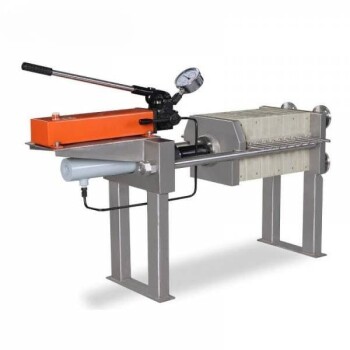
The laboratory hydraulic press acts as the critical bridge between loose raw materials and a finished structural composite. For C-SiC-B4C-TiB2 powders specifically, it is used to perform cold-press pre-forming at a pressure of approximately 15 MPa. This step transforms the volatile, loose powder mixture into a cohesive, solid shape known as a "green body" prior to the final hot-pressing phase.
Core Takeaway The hydraulic press consolidates loose powder into a compact form with defined initial density and handling strength. This pre-processing is essential for reducing powder volume, facilitating efficient loading into graphite molds, and ensuring high densification during the subsequent sintering process.
The Mechanics of Pre-Forming
Establishing the Green Body
The primary function of the hydraulic press in this context is consolidation. Loose C-SiC-B4C-TiB2 mixed powders lack structural integrity and are difficult to manage.
By applying approximately 15 MPa of pressure, the press forces the particles into close contact. This mechanical interlocking creates a "green body"—a semi-solid puck that retains its shape without the need for heat or binders at this stage.
Volume Reduction for Mold Compatibility
Loose powders have a high specific volume, meaning they take up a significant amount of space due to the air gaps between particles.
The hydraulic press significantly reduces this volume by compacting the material. This is practically necessary because the uncompressed powder volume often exceeds the capacity of the graphite molds used in the final hot-pressing furnace.
Driving Process Efficiency and Quality
Improving Final Densification
The quality of the final sintered product is heavily dependent on the state of the material before heat is ever applied.
Pre-pressing establishes a specific initial density. By minimizing large voids and bringing particles closer together early in the process, the hydraulic press sets the stage for more effective sintering, ultimately leading to a denser, stronger final composite.
Facilitating Material Handling
Without pre-pressing, loading loose powder into a hot-press furnace is messy, imprecise, and prone to contamination or loss of material.
The hydraulic press ensures the material has sufficient strength for handling. Operators can move the pre-formed green body into the graphite mold as a single unit, simplifying the workflow and ensuring the material is perfectly positioned for the hot-pressing cycle.
Understanding the Trade-offs
The Risk of Inadequate Pressure
While the hydraulic press is a vital tool, the application of pressure must be precise.
If the pressure applied is significantly lower than the recommended 15 MPa for this specific composite, the green body may lack the necessary cohesion. This results in a fragile pre-form that crumbles during handling or loading, reintroducing voids and inconsistencies that the process was meant to eliminate.
Air Entrapment
One of the goals of compaction is to remove air, but rapid compression can sometimes trap pockets of gas if not managed correctly.
While the primary goal is densification, the process effectively aids in degassing by mechanically squeezing out air between particles. Failure to achieve this initial particle contact can lead to defects or lower density in the final sintered part.
Making the Right Choice for Your Goal
## Optimizing Your Pre-Processing Strategy
To ensure the best results for C-SiC-B4C-TiB2 composites, align your hydraulic pressing parameters with your specific processing targets:
- If your primary focus is maximum final density: Ensure you achieve the target pressure of 15 MPa to maximize initial particle contact and minimize void volume before sintering.
- If your primary focus is process efficiency: Focus on the handling strength of the green body to ensure rapid, error-free loading into graphite molds without material loss.
- If your primary focus is geometric precision: Use the press to strictly control the pre-form dimensions, ensuring a perfect fit within the hot-press tooling to maintain uniform heating rates.
Correctly utilizing the hydraulic press during the cold stage is the single most effective way to guarantee the structural success of the hot-pressing stage.
Summary Table:
| Process Step | Function of Hydraulic Press | Key Parameter/Benefit |
|---|---|---|
| Cold-Press Pre-forming | Consolidates loose powder into a "green body" | 15 MPa applied pressure |
| Volume Reduction | Minimizes air gaps and specific volume | Facilitates loading into graphite molds |
| Densification | Establishes uniform initial density | Improves final composite structural strength |
| Handling | Increases mechanical interlocking | Enables single-unit material transfer |
Elevate Your Advanced Ceramics Research with KINTEK
Precision in pre-forming is the foundation of high-performance C-SiC-B4C-TiB2 composites. KINTEK specializes in high-quality laboratory equipment, offering a robust range of hydraulic presses (pellet, hot, isostatic) designed to achieve the precise 15 MPa pressure required for perfect green bodies.
Beyond compaction, we provide the full ecosystem for material science—from high-temperature hot-pressing furnaces and vacuum systems to crushing, milling, and specialized ceramics. Our solutions ensure your lab achieves maximum densification and process efficiency every time.
Ready to optimize your material preparation? Contact our technical experts today to find the perfect hydraulic press and consumables for your specific research goals.
Related Products
- Laboratory Hydraulic Press Split Electric Lab Pellet Press
- Laboratory Hydraulic Press Lab Pellet Press Machine for Glove Box
- Laboratory Hydraulic Press Lab Pellet Press for Button Battery
- Automatic Laboratory Hydraulic Pellet Press Machine for Lab Use
- Automatic Laboratory Hydraulic Press for XRF & KBR Pellet Press
People Also Ask
- What role does a laboratory hydraulic press play in platinum recovery research? Enhancing Sample Precision
- What are the specific applications of a lab hydraulic press in biochar evaluation? Optimize density and data accuracy.
- What are the roles of a laboratory hydraulic press and stainless steel molds in the preparation of graphite samples?
- What is the role of a laboratory hydraulic press in electrode prep? Maximize Energy Density & Sealing Precision
- Why must a laboratory hydraulic press equipped with cylindrical molds be used when preparing BZY green bodies? High Density