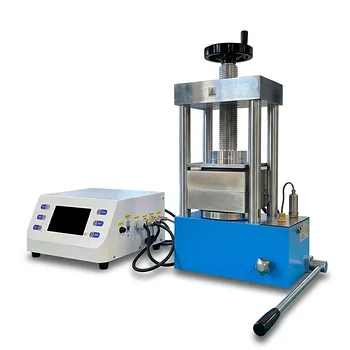
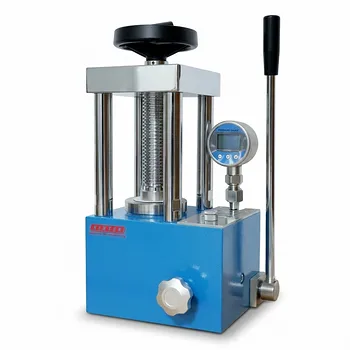
A laboratory hydraulic press guarantees consistency by delivering constant, uniform pressure during the mechanical sealing of CR2032 coin cells. This precision ensures that the battery case, gaskets, spring plates, and electrodes are compressed identically in every iteration, strictly adhering to the assembly parameters required for reproducible research.
Precise pressure control is the foundation of experimental reliability in battery research. By facilitating tight internal contact and uniform sealing deformation, a hydraulic press lowers ohmic resistance and prevents leakage, ensuring that test results reflect the true properties of materials like fluorinated graphene rather than assembly errors.
Optimizing Electrical Performance
The Criticality of Component Contact
For a coin cell to function correctly, the internal stack—comprising the electrodes, separator, and spring plates—must be held together under tension.
A hydraulic press applies a specific, uniform pressure to the assembly. This forces these layers into tight contact with one another and the external casing.
Reducing Ohmic Internal Resistance
The primary electrical benefit of this tight contact is the minimization of ohmic internal resistance.
If the pressure is too low or uneven, gaps occur between components, impeding the flow of electrons. By eliminating these variables, the press ensures that impedance data is accurate.
Achieving a Hermetic Seal
Controlled Deformation of the Sealing Ring
The CR2032 casing relies on a polymer gasket, or sealing ring, to isolate the anode from the cathode and seal the cell.
The hydraulic press exerts enough force to properly deform this ring and crimp the metal casing edges over it. This mechanical action must be exact to create a reliable barrier.
Preventing Environmental Contamination
Proper deformation serves two safety roles: it stops the electrolyte from leaking out and prevents ambient air from infiltrating the cell.
Air infiltration or leakage would chemically alter the sample, rendering any subsequent test data invalid.
Ensuring Data Comparability
Removing the Human Variable
Manual crimping tools can vary in force depending on the operator. A hydraulic press removes this variability.
Because the pressure is automated and controlled, the mechanical seal is identical across every batch.
Validating Material Research
In advanced research, such as testing fluorinated graphene samples, scientists need to compare slight variations in material performance.
The hydraulic press ensures that any observed difference in performance is due to the material itself, not inconsistent assembly pressure.
Understanding the Trade-offs
The Risk of Incorrect Pressure Settings
While a hydraulic press offers consistency, it does not automatically guarantee the correct pressure.
If the machine is consistently set to a pressure that is too high, it may crush internal components or pierce the separator, causing immediate shorts.
The Danger of Under-Compression
Conversely, consistently applying insufficient pressure will result in cells that appear mechanically sound but suffer from high impedance.
The "consistency" of the machine is only as valuable as the calibration of the pressure parameters chosen by the user.
Making the Right Choice for Your Research
To maximize the utility of your laboratory hydraulic press, tailor your approach to your specific testing metrics:
- If your primary focus is electrical efficiency: Prioritize pressure settings that maximize internal component contact to lower ohmic resistance without damaging the separator.
- If your primary focus is long-term cycle life: Focus on the precise deformation of the sealing ring to ensure no electrolyte leakage or air infiltration occurs over time.
- If your primary focus is material comparison: Maintain rigid adherence to a single pressure set-point to ensure baseline comparability across different sample batches.
Reliable data begins with a reliable assembly process; mastering your pressure control is the first step toward defensible results.
Summary Table:
| Feature | Impact on Consistency | Benefit for Research |
|---|---|---|
| Uniform Pressure | Eliminates gaps between internal layers | Minimizes ohmic internal resistance |
| Controlled Deformation | Precise crimping of polymer gaskets | Ensures hermetic seal & prevents leaks |
| Automated Force | Removes human variability from assembly | Guarantees data comparability across batches |
| Calibrated Settings | Maintains rigid assembly parameters | Validates material performance (e.g., graphene) |
Elevate Your Battery Research with Precision Engineering
In the pursuit of reproducible data, inconsistent assembly is your greatest enemy. KINTEK specializes in high-performance laboratory hydraulic presses (pellet, hot, isostatic) and specialized battery research tools designed to ensure every CR2032 cell meets rigorous standards.
Whether you are testing fluorinated graphene or advanced electrolytes, our equipment provides the uniform sealing and pressure control necessary to eliminate variables and focus on material performance. Beyond presses, explore our comprehensive portfolio including high-temperature furnaces, vacuum systems, and essential consumables like PTFE products and ceramics.
Don't let assembly errors compromise your results. Contact KINTEK today to find the perfect solution for your lab!
References
- Xu Bi, Jin Zhou. Fluorinated Graphene Prepared by Direct Fluorination of N, O-Doped Graphene Aerogel at Different Temperatures for Lithium Primary Batteries. DOI: 10.3390/ma11071072
This article is also based on technical information from Kintek Solution Knowledge Base .
Related Products
- Automatic Laboratory Hydraulic Pellet Press Machine for Lab Use
- Laboratory Hydraulic Press Lab Pellet Press for Button Battery
- Automatic High Temperature Heated Hydraulic Press Machine with Heated Plates for Lab
- Laboratory Hydraulic Pellet Press for XRF KBR FTIR Lab Applications
- Laboratory Hydraulic Press Split Electric Lab Pellet Press
People Also Ask
- What is the role of a laboratory hydraulic pellet press and stainless steel molds in the fabrication of RuO2/NbC anodes?
- What role does a laboratory pellet press play in the enhancement of biomass energy products? Optimize Fuel Efficiency
- What is the purpose of using a laboratory pellet press when evaluating the electronic conductivity of carbon powders? Guide
- How does a laboratory hydraulic pellet press contribute to SiCw/2024 aluminum composite preforms? Optimize Densification
- What is the significance of applying 200 MPa of pressure with a laboratory hydraulic pellet press for composite ceramics?