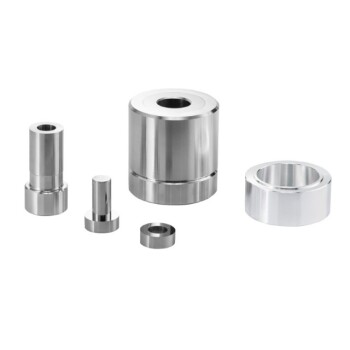
Precise pressure application is the defining factor in preparing Cerium Oxide samples for irradiation. A laboratory hydraulic press functions by compressing synthesized powders into dense, cylindrical "green bodies," typically around 10mm in diameter, by eliminating inter-particle pores to create a cohesive solid.
The hydraulic press does not merely shape the material; it creates the ultra-thin, high-density geometry required for heavy ions to penetrate the entire sample, ensuring experimental data is not corrupted by non-irradiated material.
Achieving Critical Sample Geometry
Eliminating Porosity
The primary function of the hydraulic press is to apply controlled force to eliminate voids between powder particles.
By increasing particle bonding, the press transforms loose Cerium Oxide powder into a solid structure. This densification is a prerequisite for creating a sample that behaves consistently under stress.
Creating Ultra-Thin Targets
For specific irradiation experiments, such as those involving heavy ions (e.g., Xe22+), samples must be exceptionally thin—approximately 15μm.
The hydraulic press enables the production of these thin, uniform pellets. Without the ability to compress material into such fine dimensions, the sample would be too thick for effective experimentation.
Ensuring Full-Depth Penetration
The thickness of the sample directly dictates the quality of the irradiation data.
If a sample is too thick or porous, heavy ions cannot penetrate the full depth of the test layer. This results in "interference," where non-irradiated sections of the ceramic skew the results of the experiment.
The Role of Density Consistency
Standardizing Ion Energy Deposition
In irradiation experiments, the density of the target material affects how deep ions travel and how their energy is deposited.
A laboratory hydraulic press ensures highly consistent initial density across the sample. This uniformity guarantees that the damage profile caused by the ions is reproducible and accurate.
Reducing Data Deviation
Variations in pressing pressure can lead to density gradients within a single pellet.
By maintaining stable pressure control, the press minimizes internal stress non-uniformity. This ensures that the microstructure remains consistent, reducing deviation in the final experimental data.
Understanding the Trade-offs
The Risk of Density Gradients
While hydraulic presses are essential for densification, applying pressure too quickly or unevenly can cause density gradients.
If the friction between the powder and the die wall is too high, the edges of the pellet may be denser than the center. This non-uniformity can lead to warping during sintering or inconsistent irradiation results.
Green Strength vs. Micro-Cracking
High pressure increases the "green strength" (handling strength) of the pellet, but excessive pressure can induce micro-cracking.
When pressure is released, the material undergoes elastic spring-back. If the pressure was too high, this expansion can create microscopic fractures that compromise the sample before the experiment even begins.
Making the Right Choice for Your Goal
To ensure valid experimental results, align your pressing parameters with your specific testing requirements:
- If your primary focus is Ion Irradiation (e.g., Xe22+): Prioritize achieving the minimum possible thickness (approx. 15μm) and high density to ensure the ions damage the entire test layer uniformly.
- If your primary focus is Mechanical Testing (e.g., Fracture Toughness): Focus on stress uniformity and pore elimination to prevent structural flaws that would artificially lower toughness ratings.
Success in irradiation experiments relies less on the chemistry of the powder and more on the geometric precision of the pressed sample.
Summary Table:
| Feature | Impact on Sample Quality | Benefit for Irradiation |
|---|---|---|
| Precise Pressure | Eliminates inter-particle pores and voids | Creates cohesive, high-density "green bodies" |
| Controlled Thickness | Enables ultra-thin targets (~15μm) | Ensures full-depth penetration of heavy ions |
| Density Consistency | Standardizes ion energy deposition | Reduces data deviation and ensures reproducibility |
| Controlled Release | Minimizes elastic spring-back | Prevents micro-cracking and structural failure |
Elevate Your Materials Research with KINTEK Precision
High-stakes irradiation and mechanical testing demand flawless sample preparation. At KINTEK, we specialize in the laboratory equipment you need to ensure experimental integrity. From our advanced hydraulic presses (pellet, hot, and isostatic) designed for perfect density consistency to our crushing and milling systems and high-temperature furnaces, we provide the tools required for sophisticated ceramic research.
Whether you are preparing ultra-thin 15μm targets or robust structural ceramics, KINTEK offers a comprehensive range of consumables, including PTFE products, ceramics, and crucibles, alongside specialized tools like high-pressure reactors and battery research equipment.
Don't let sample inconsistency compromise your data. Contact our laboratory specialists today to find the ideal pressing and sintering solution for your next breakthrough.
References
- Аrtem L. Kozlovskiy, Maxim V. Zdorovets. Study of the Influence of Doping Efficiency of CeO2 Ceramics with a Stabilizing Additive Y2O3 on Changes in the Strength and Thermophysical Parameters of Ceramics under High-Temperature Irradiation with Heavy Ions. DOI: 10.3390/cryst14040320
This article is also based on technical information from Kintek Solution Knowledge Base .
Related Products
- Laboratory Hydraulic Pellet Press for XRF KBR FTIR Lab Applications
- kbr pellet press 2t
- Automatic Laboratory Hydraulic Pellet Press Machine for Lab Use
- Laboratory Manual Hydraulic Pellet Press for Lab Use
- Automatic Laboratory Hydraulic Press for XRF & KBR Pellet Press
People Also Ask
- What is the role of a laboratory hydraulic pellet press and stainless steel molds in the fabrication of RuO2/NbC anodes?
- What is the significance of applying 200 MPa of pressure with a laboratory hydraulic pellet press for composite ceramics?
- What is the necessity of using a laboratory hydraulic pellet press in the preparation of biomass fuel pellets? Guide
- How does a laboratory hydraulic pellet press contribute to SiCw/2024 aluminum composite preforms? Optimize Densification
- What function does a laboratory pellet press or rolling mill serve? Enhance Electrode Density and Performance